
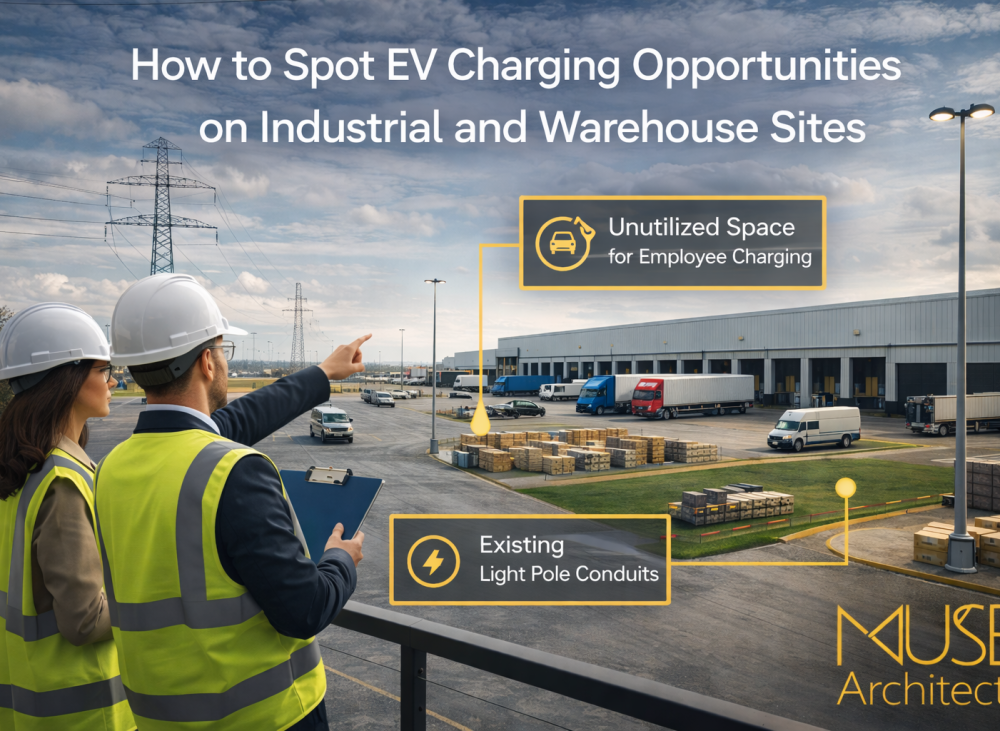
How to Spot EV Charging Opportunities on Industrial and Warehouse Sites
How to Spot EV Charging Opportunities on Industrial and Warehouse Sites EV charging is becoming a key consideration for industrial and warehouse properties—but poorly planned installations can create more problems than value. For landlords, occupiers, and investors, the opportunity is clear. EV infrastructure can future-proof assets, attract modern tenants, and support fleet electrification. However, success depends entirely on how charging is integrated into the site. The real question is not “Can we add EV chargers?” It is “Where should they go so they add value without disrupting operations?” This is where many sites go wrong. At Muse, EV strategy is assessed alongside site layout, circulation, and planning—ensuring charging infrastructure supports how the site actually works. Why EV Charging Is Becoming Essential for Industrial Sites The shift toward electric vehicles is accelerating across the UK. Fleet operators, logistics businesses, and occupiers are increasingly requiring on-site charging infrastructure. For warehouse landlords, this creates an opportunity to: Increase asset attractiveness Support tenant requirements Future-proof long-term value Enhance ESG positioning However, this opportunity must be approached carefully. EV charging is not just an add-on—it directly affects how a site functions. For broader asset strategy, our guide on property investment strategies in the UK explains how infrastructure and repositioning decisions influence long-term value. The Risk: When EV Charging Creates Operational Problems Many EV installations fail because they are treated as a bolt-on feature rather than part of site design. Poor placement can: Block vehicle circulation Reduce usable yard space Interfere with loading and unloading Create safety conflicts between vehicles and pedestrians Limit future flexibility of the site In some cases, EV chargers reduce the operational efficiency of the warehouse—making the asset less attractive to occupiers. This is why warehouse EV charging strategy must be considered early. Practical Tests: How to Identify EV Charging Opportunities Before installing EV chargers, several key factors should be assessed. Spare Parking Capacity Unused or underutilised parking bays are often the easiest locations for EV charging. However, removing parking without proper assessment can create pressure during peak periods. Underused Yard Edges In some cases, the edges of a yard can accommodate charging without affecting core operations. This requires careful positioning to avoid interfering with turning space and loading zones. Power Source Proximity Charging infrastructure depends on access to sufficient electrical capacity. The closer the chargers are to the power source, the lower the installation cost and complexity. Cable Routes and Infrastructure Cable routing must be practical and safe. Poorly planned routes can create hazards or increase costs significantly. Vehicle Dwell Time Different types of vehicles require different charging durations. Understanding how long vehicles remain on-site is critical to selecting the right charging strategy. Types of EV Charging for Warehouse Sites Not all EV charging is the same. Each type has different spatial and operational requirements. Staff Charging Typically located in standard parking areas, staff charging supports longer dwell times and predictable usage patterns. Visitor Charging Requires convenient and accessible locations, often near entrances or reception areas. Fleet Charging Fleet vehicles require dedicated zones, often separate from general parking, with efficient access and circulation. Rapid Turnover Charging Fast chargers require high accessibility and must not interfere with operational flow due to frequent vehicle movement. Understanding these distinctions is essential when planning EV charging for warehouse sites. Planning and Infrastructure Considerations (UK 2026) EV charging installations may involve planning considerations depending on scale, location, and impact. Applications and guidance are typically managed through the Planning Portal. Authorities may assess visual impact, access, and safety implications. Where planning becomes more complex, cases may involve review by the Planning Inspectorate. Because EV infrastructure interacts with site layout and access, understanding planning frameworks is essential. Our UK planning permission guide explains how these decisions are structured. Why Layout and Circulation Must Come First EV charging should never compromise how a warehouse operates. Vehicle movement, loading, and access must always take priority. A well-functioning site depends on: Clear circulation routes Efficient loading zones Safe separation of vehicles and pedestrians Adequate turning space If EV chargers disrupt these elements, the site becomes less efficient—and less valuable. This is why charging must be integrated into the overall layout strategy. Common Mistakes in Warehouse EV Charging Installation Where Projects Lose Value Many issues arise from poor early decisions. Common mistakes include: Installing chargers in high-traffic areas Reducing critical yard space Ignoring future expansion needs Failing to align charging type with user requirements Overlooking power capacity constraints These mistakes can reduce both operational performance and long-term flexibility. UK Trends Driving EV Integration in Industrial Property What Is Changing in 2026 EV adoption is increasing across both private and commercial sectors. Fleet electrification is becoming a priority for logistics and industrial occupiers. At the same time, ESG requirements are influencing property decisions. This is driving demand for well-integrated EV charging infrastructure—not just installations, but properly planned solutions. How to Assess EV Charging Potential on Your Site A Practical Checklist Before committing to EV infrastructure, key questions should be answered: Is there available space without impacting operations? Is power capacity sufficient? Are charging locations accessible but not disruptive? Does the layout support safe circulation? Will the installation support current and future needs? These factors determine whether EV charging adds value or creates problems. How Muse Integrates EV Charging Into Site Design A Planning-Led, Operational Approach Muse works with landlords, investors, and occupiers to assess EV charging opportunities for warehouse sites before commitments are made. This includes: Site layout and circulation analysis EV positioning strategy Power and infrastructure considerations Planning and compliance review Operational impact assessment Why This Approach Works By integrating EV charging into the overall site design, Muse ensures that infrastructure supports operations rather than disrupting them. This creates solutions that are practical, future-proof, and commercially viable. If you are also exploring residential or mixed-use strategies, our HMO planning guide in the UK provides useful insight into alternative planning routes. To see how these principles apply in practice, you can explore the approach taken