
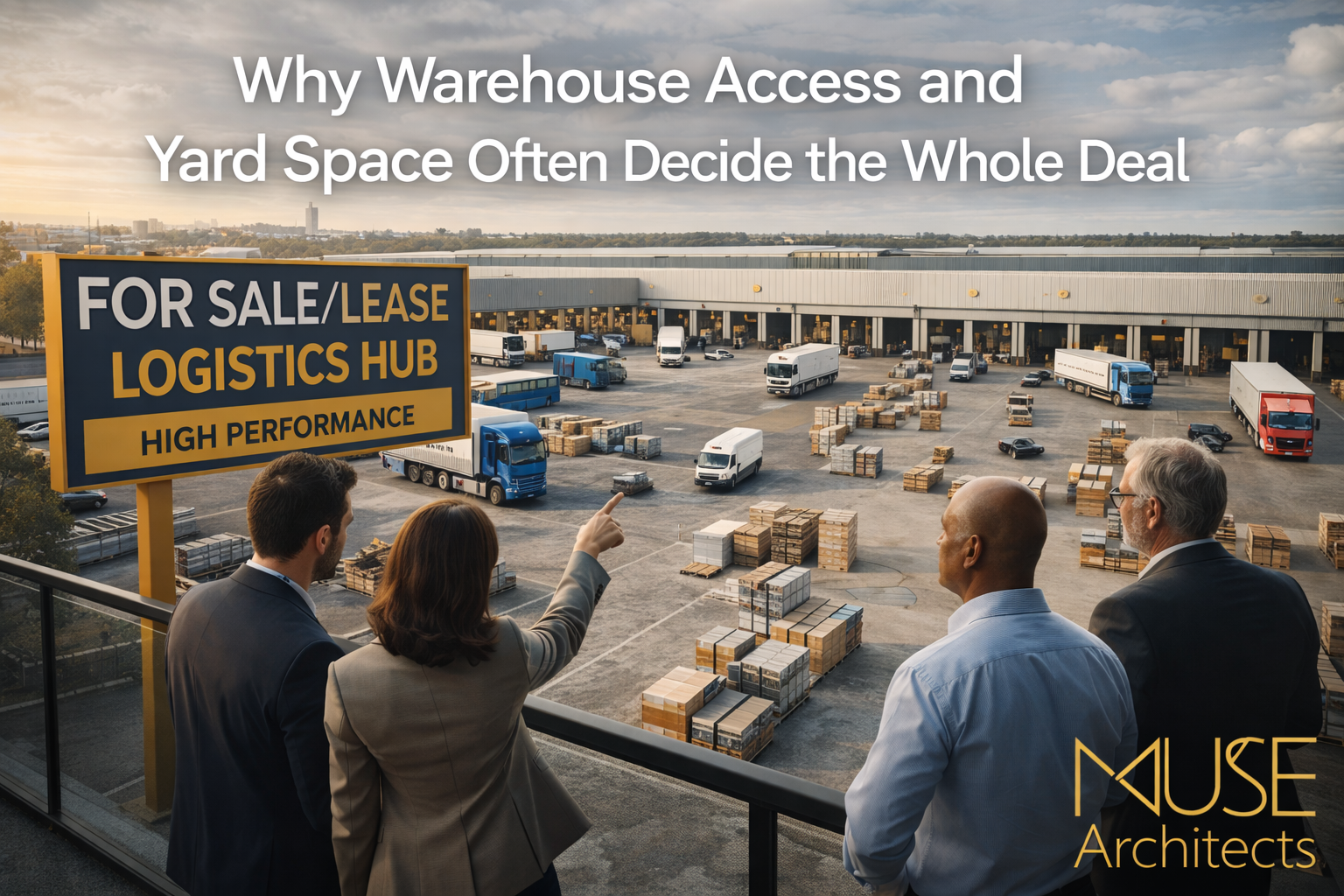
Why Warehouse Access and Yard Space Often Decide the Whole Deal
In warehouse and industrial property, most attention is placed on the building itself—its size, height, and internal specification.
However, in practice, the success of a warehouse is rarely decided inside the building.
It is determined outside—by how vehicles move, how goods are handled, and how efficiently the site operates.
Access, yard space, and circulation are not secondary considerations. They are fundamental to whether a warehouse works at all.
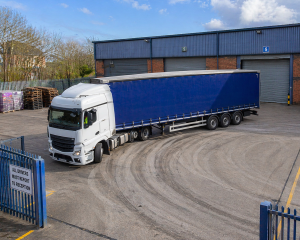
A well-designed internal layout can still fail completely if vans cannot turn, HGVs cannot load efficiently, or customers cannot access the site safely.
This is where many developments, acquisitions, and change-of-use strategies break down.
At Muse, this is assessed at the earliest stage. Before design or planning progresses, the site layout, access strategy, and operational flow are tested alongside the building—ensuring the scheme works in reality, not just in concept.
Why Warehouse Access and Yard Space Drive Commercial Value
Warehouse performance is driven by movement, not just structure.
Goods must arrive, be handled, and leave efficiently. Vehicles must move safely and predictably. Customers must access the site without friction.
When these elements are aligned, the site becomes commercially attractive.
A well-planned warehouse access and yard space strategy can increase letting potential, support a wider range of occupiers, improve operational efficiency, and strengthen long-term asset value.
This shift in how warehouse sites are evaluated is closely linked to broader commercial strategy, particularly how investors approach underperforming assets and reposition them for stronger returns. A deeper breakdown of this can be found in our guide on property investment strategies in the UK.
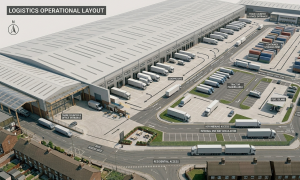
The Hidden Risk: When Strong Buildings Fail Due to Poor Access
One of the most common issues in warehouse change of use and industrial investments is focusing too heavily on the building while overlooking the site.
Even well-specified warehouses can struggle where operational movement is compromised.
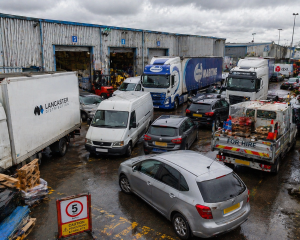
Typical issues include insufficient turning space, poorly positioned loading bays, congested yard areas, inefficient access points, and conflicts between different user groups.
These problems reduce usability and limit occupier interest.
In many cases, tenants prioritise operational efficiency over internal specification. A building that looks good but does not function well will struggle to perform commercially.
Understanding Warehouse Access and Yard Design (UK 2026)
What Defines an Efficient Warehouse Site Layout
A successful warehouse site layout is designed around movement.
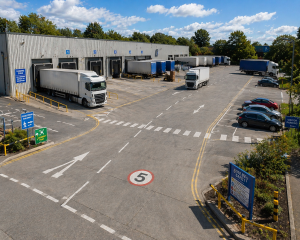
It must support clear, safe, and efficient circulation for all users, including adequate turning radii for vans and HGVs, clearly defined loading zones, and logical access points.
These elements ensure that operations can run smoothly without conflict or delay, while also improving the attractiveness of the site to potential occupiers.
Why Yard Space Is One of the Most Valuable Assets
Yard space is often undervalued—but in many cases, it is more important than the building itself.
It enables efficient loading and unloading, vehicle manoeuvrability, operational flexibility, and adaptability for future uses.
Where yard space is constrained, the functionality of the entire site is limited—reducing both usability and long-term value.
Planning and Highways: Why Access Can Determine Approval
Planning Requirements for Warehouse Access
Planning authorities place significant importance on access and movement when assessing industrial schemes.
Planning applications for warehouse developments and changes of use are typically submitted through the Planning Portal
[External Link: https://www.planningportal.co.uk/]
Authorities will evaluate whether the site can safely accommodate vehicle movements, including deliveries, staff access, and customer use.
Where proposals involve more complex access or highways concerns, cases may be reviewed by the Planning Inspectorate
[External Link: https://www.gov.uk/government/organisations/planning-inspectorate]
Highways and Traffic Impact Considerations
Access is not just a site issue—it extends to the surrounding road network.
Planning decisions often depend on safe entry and exit points, traffic generation, and the impact on local infrastructure.
Because access and highways considerations are often central to approval, it is important to understand how planning decisions are structured. This is explored in more detail in our UK planning permission guide.
Turning, Loading, and Gate Positioning: Small Details, Big Impact
The operational success of a warehouse often comes down to seemingly small details.
Turning areas must allow vehicles to manoeuvre without disruption. Loading bays should be positioned to maximise efficiency, while gate locations must support smooth entry and exit.
These elements define how the site performs daily—and whether it meets occupier expectations.
Shared Yards and Multi-Occupier Conflict
Shared yards are common in industrial estates, but they introduce operational complexity.
Conflicts can arise between different occupiers, customer vehicles, and delivery vehicles—particularly during peak periods.
Without careful planning, shared yards can become congested and inefficient, reducing usability and increasing risk.
Design Is Not Just the Building—It Is the Site
A key misconception in industrial development is that architecture only applies to the building.
In reality, site planning is equally important.
A successful warehouse scheme considers vehicle movement patterns, user hierarchy, access points, and yard organisation.
This is where architecture meets operations—and where design directly influences commercial performance.
Common Mistakes in Warehouse Access and Yard Planning
Where Projects Lose Value
Many of the most costly mistakes occur during early site assessment.
Common issues include underestimating turning requirements, poorly positioning loading areas, ignoring access constraints, and failing to consider operational conflicts.
These mistakes reduce letting potential and create planning challenges—but are often avoidable with proper feasibility analysis.
UK Trends Shaping Warehouse Site Design (2026)
Key Market Changes
Industrial and logistics operations are becoming more demanding.
Occupiers now expect efficient access, flexible yard space, and safe circulation.
At the same time, planning authorities are placing greater emphasis on safety, traffic impact, and operational realism.
This makes warehouse access and yard space a critical factor in determining project success.
How to Assess Warehouse Access Before You Invest
A Practical Feasibility Checklist
Before committing to a warehouse site, key questions should be addressed.
Can vehicles turn safely on-site? Is there sufficient yard space? Are loading areas efficient? Is access compliant with planning expectations?
These factors often determine whether a deal is viable.
How Muse Helps You Get Site Planning Right
A Planning-Led, Operational Approach
Muse works with landlords, investors, and operators to assess warehouse access and yard space before commitments are made.
This includes site layout analysis, access and highways assessment, yard optimisation, and operational flow planning.
Why This Approach Matters
Many deals fail not because of the building—but because the site does not function properly.
By testing access, movement, and operational requirements early, Muse helps ensure that schemes are practical, compliant, and commercially viable.
For a broader commercial perspective, our property investment strategies guide outlines how different asset classes can be repositioned effectively.
If you want tailored advice on a specific site, you can get in touch with our team here. Contact us
Conclusion: The Real Value Is in How the Site Works
Warehouse success is not defined by the building alone.
Access, yard space, and circulation determine whether a site can operate efficiently and attract the right occupiers.
A strong internal concept can fail if movement is restricted.
Understanding this early is what separates successful projects from costly mistakes.
Call to Action
Before committing to a warehouse deal, it is essential to understand whether the site actually works operationally.
Share your site plan—we will identify access, yard, and circulation issues early, helping you avoid costly mistakes and make informed decisions before you invest further.
Frequently Asked Questions About Warehouse Access and Yard Space
Why is warehouse access so important?
Warehouse access determines how efficiently vehicles can enter, exit, and operate on-site. Poor access can reduce usability, limit tenant demand, and negatively impact long-term value.
What is the ideal yard space for a warehouse?
The ideal yard space depends on the type of operation, but it must allow safe turning, loading, unloading, and smooth circulation for vans and HGVs.
Can poor access affect planning approval?
Yes. Planning authorities often assess highways impact, vehicle movement, and safety. Poor access or unsafe circulation can lead to refusal.
How does yard space impact warehouse value?
Adequate yard space increases flexibility, improves operational efficiency, and attracts a wider range of occupiers, which enhances rental and capital value.
What are common access issues in warehouse sites?
Common problems include restricted turning space, poorly positioned loading bays, limited entry points, and conflicts between vehicles and pedestrians.
Are shared yards a problem for industrial sites?
Shared yards can create congestion and operational conflicts, especially during peak times, if not properly planned and managed.
What should I check before buying a warehouse site?
You should assess access points, turning areas, yard size, loading positions, and overall circulation to ensure the site works operationally.