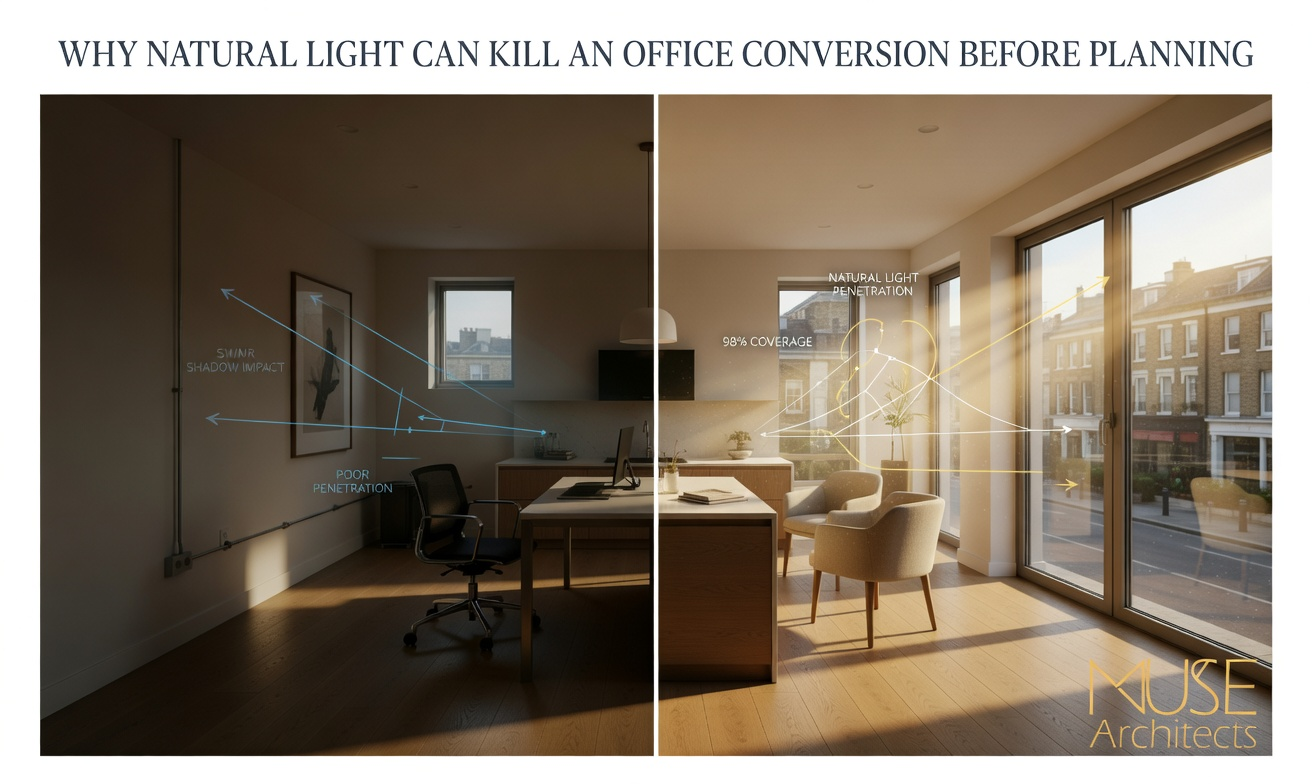
Why Natural Light Can Kill an Office Conversion Before Planning Is Even Submitted
It’s not just a design issue. It’s a commercial risk.
Many developers approach office conversions assuming that planning strategy is the main hurdle. But in reality, one of the biggest risks sits quietly in the background—natural light.
Before layouts, before unit mix, and even before planning submission, daylight can determine whether a scheme is viable or fundamentally flawed.
Because no matter how clever the planning route is, poor natural light will always show up in the final product—and the market will respond accordingly.
Daylight Is a Value Driver, Not a Design Preference
Natural light is often treated as an aesthetic consideration. In reality, it directly impacts both planning outcomes and financial performance.
A building with poor daylight conditions will typically struggle in three key areas:
- Planning resistance or stricter scrutiny
- Reduced unit quality and desirability
- Lower sales values or rental income
This means daylight is not just about how a space looks—it defines how well it performs commercially.
Where Daylight Problems Start
1. Deep-Plan Office Floor Plates
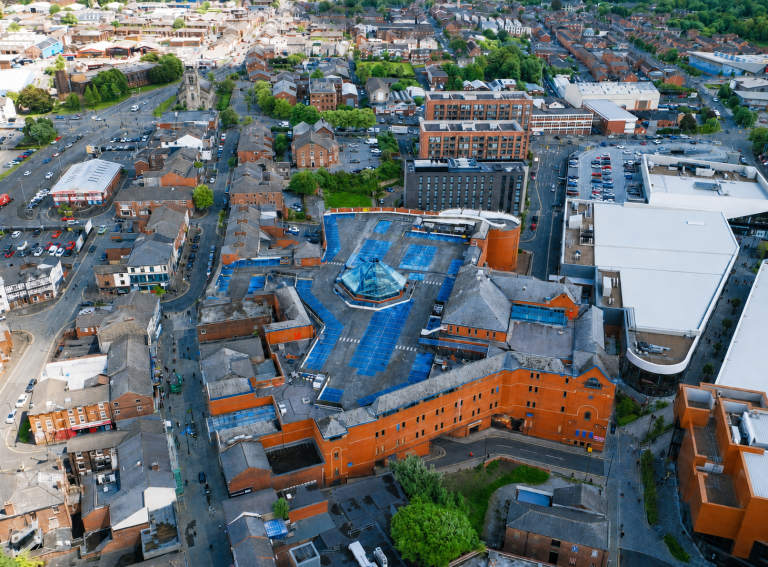
Deep-plan offices are one of the most common risks in conversion projects. These buildings were never designed for residential use, which means large portions of the floor plate sit far away from windows.
As a result, significant areas receive little to no natural light. This creates immediate limitations on where viable units can be placed.
In practice, this often leads to:
- Large unusable internal zones
- Over-reliance on artificial lighting
- Compromised unit layouts
2. Close Opposing Buildings
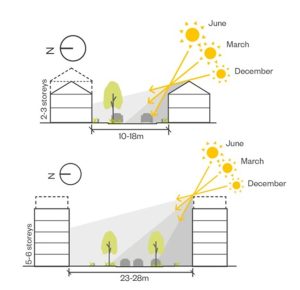
Even when a building benefits from multiple windows, this does not automatically translate into good natural daylight performance—particularly in dense urban environments where surrounding structures play a critical role. In many city-centre locations, closely positioned neighbouring buildings can significantly obstruct incoming light, limiting sky visibility and reducing the amount of daylight that actually reaches internal spaces. This condition, commonly known as overshadowing, often results in interiors that feel darker, more enclosed, and less appealing to occupants. As a consequence, units may suffer from limited outlook, reduced perceived space quality, and an overall drop in desirability. From a commercial perspective, these factors directly impact market appeal, making properties harder to sell or let at optimal values and ultimately weakening the financial performance of the entire conversion scheme.
3. North-Facing or Overshadowed Orientations

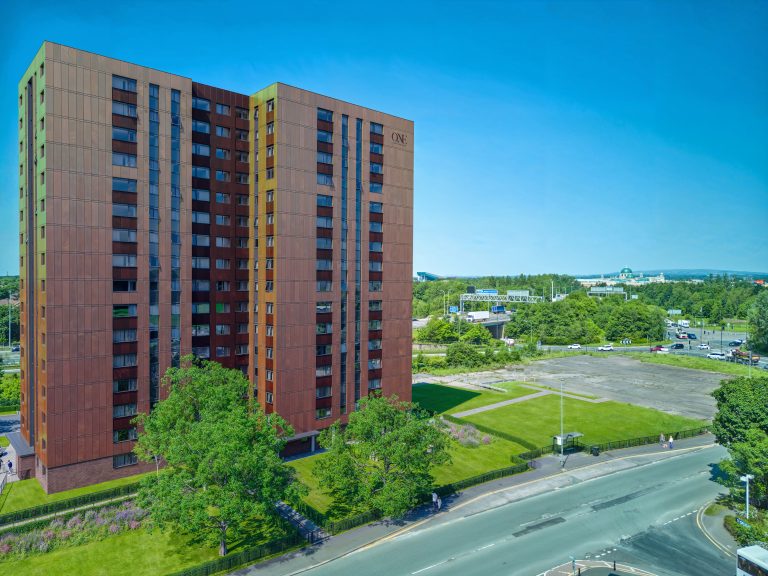
Orientation is a critical factor in determining how effectively natural light enters a building, directly influencing both livability and commercial performance. North-facing units or heavily overshadowed facades typically receive limited direct sunlight throughout the day, resulting in consistently lower daylight levels compared to well-oriented spaces. While such layouts may still meet minimum planning or technical requirements, they often lead to compromised living environments that feel dim, less inviting, and less functional for occupants. Over time, this reduced quality becomes evident in the market, negatively shaping buyer and tenant perception, limiting achievable sale or rental values, and weakening long-term demand. In practical terms, poor orientation does not just affect design—it directly impacts the financial viability and competitiveness of a conversion scheme.
Why Poor Daylight Kills Schemes Early
One of the biggest mistakes developers make is assuming that if a planning route exists, the project will work.
But daylight issues often undermine schemes long before planning is submitted—or shortly after.
In many cases, poor daylight leads to:
- Reduced unit numbers due to unusable areas
- Lower-quality units that struggle in the market
- Increased risk during planning review
Even if approval is granted, the commercial performance of the scheme can be significantly weakened.
The Reality: Daylight Problems Show Up Early
Daylight is not something that appears later in the design process—it is visible from the very beginning if assessed properly.
With honest early evaluation, you can quickly identify:
- Which areas of the building are viable
- Where units will struggle to perform
- Whether the scheme is worth pursuing at all
This is why experienced developers prioritise early-stage analysis before committing time and budget.
How Smart Developers Avoid False Optimism
The most successful developers do not rely on assumptions. They test the building’s real potential before progressing.
This involves reviewing:
- Existing window arrangements
- Surrounding building context
- Floor plate depth and layout constraints
- Daylight penetration and unit positioning
By doing this early, they avoid investing in schemes that look promising on paper—but fail in reality.
How Muse Architects Protects Your Investment
How Muse Architects Protects Your Investment
At Muse Architects, natural light is not treated as a secondary design factor—it is assessed as a core commercial risk from the very beginning.
Before any planning strategy is pursued, the building is evaluated honestly to determine how daylight will perform across the entire floor plate. This early-stage clarity helps prevent one of the most common and costly mistakes in office conversions: committing to a scheme that looks viable on paper but fails in reality.
Through early feasibility and daylight-focused test-fit studies, we help clients understand what the building can genuinely deliver.
This includes:
- Assessing window positions, orientation, and surrounding context
- Identifying overshadowing risks and low-performing areas
- Testing layout options based on realistic daylight conditions
- Highlighting where unit quality—and therefore value—may be compromised
By addressing these factors upfront, clients are able to make informed decisions before investing time, design fees, or acquisition capital into the wrong opportunity.
The result is a more confident strategy—one that focuses on schemes with real potential rather than false optimism.
Because the goal isn’t just to make a project possible.
It’s to make sure it performs.
Explore more here:
Musearchitects.co.uk/services
Musearchitects.co.uk/change-of-use
Musearchitects.co.uk/blog
The Bottom Line
A building can look like a great opportunity on paper.
It can even have a clear planning route.
But if natural light doesn’t work, the scheme doesn’t work.
Because in the end, the market doesn’t buy planning approvals—it buys quality space.
Call to Action
Before you commit to a conversion scheme, take a step back and assess the building honestly.
Send photos, plans, and window arrangements for an early daylight viability opinion.
That one step can save months of time—and protect your investment from false optimism.
FAQs
Why is natural light important in office conversions?
Natural light directly affects planning success, unit quality, and market value, making it a key commercial factor.
Can poor daylight affect planning approval?
Yes. Poor daylight can lead to planning concerns or reduced scheme viability, even if a route initially seems possible.
What buildings are most at risk of poor daylight?
Deep-plan offices, heavily overshadowed buildings, and north-facing structures are most at risk.
Can a conversion still work with limited daylight?
In some cases, but it often results in lower-quality units and reduced financial performance.
How can developers assess daylight early?
By reviewing window placement, building surroundings, and layout constraints before committing to a design or planning strategy.