Why Many Class E Units Are Underused in the UK
Across UK high streets, local parades, and roadside locations, one issue continues to repeat itself.
Small Class E units in the UK sitting vacant, underperforming, or occupied by uses that no longer match current demand.
The default explanation is usually simple:
“The retail market is struggling.”
But in reality, that explanation is incomplete.
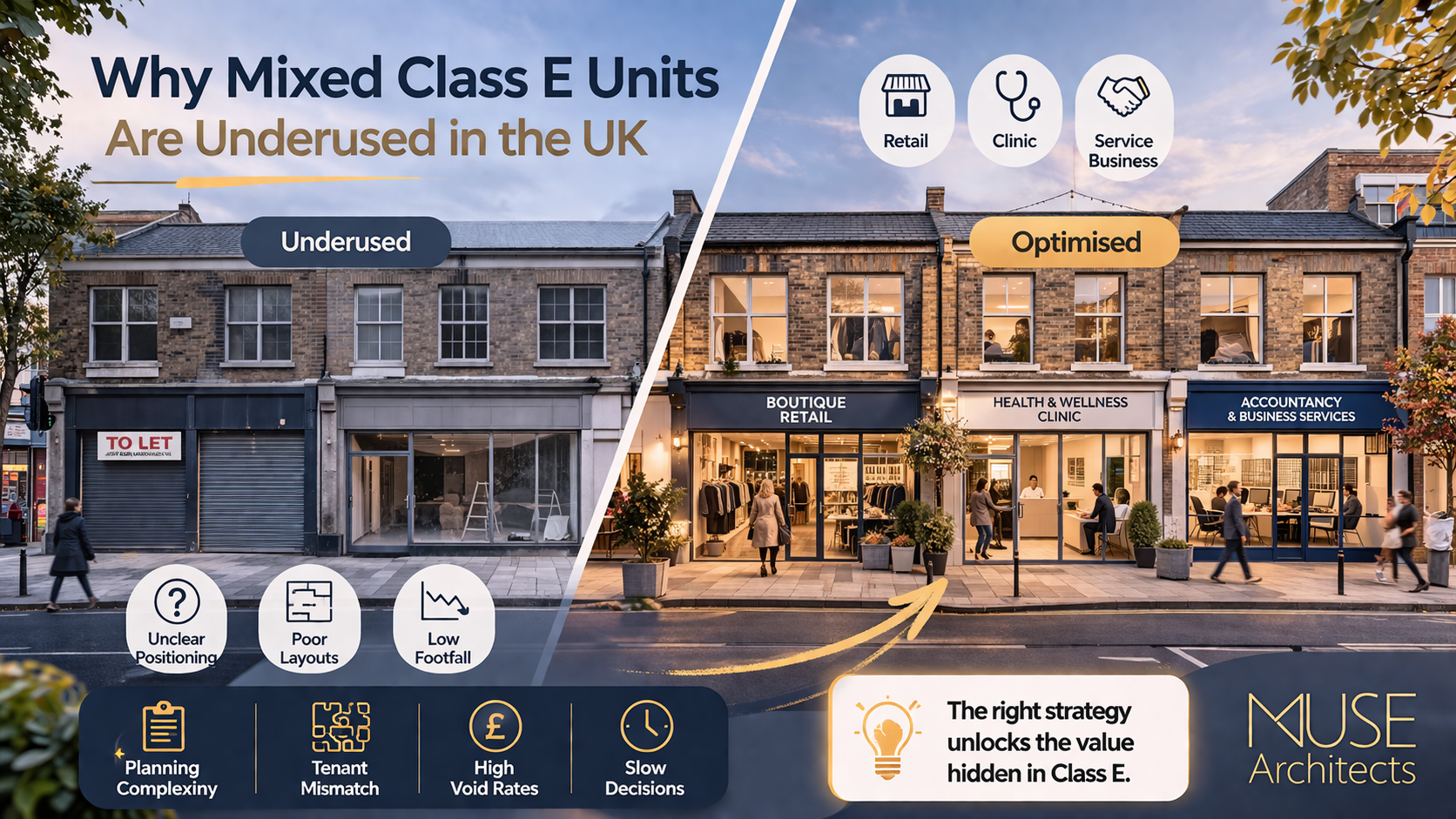
The issue is often not just the market—it is the strategy behind how these small commercial units in the UK are being used.
Many landlords continue to rely on outdated retail assumptions, even though Class E flexibility in the UK allows for a much broader range of uses.
The result is a mismatch between what the space offers and what the market actually needs.
The key insight is this:
A weak use will always struggle—even in a strong location. A well-matched use can outperform expectations, even in average locations.
At Muse, this is where the process begins—not with design, but with identifying the right use strategy for the unit.

Understanding Class E Use in the UK
Class E use in the UK was introduced to simplify planning and allow commercial spaces to adapt more easily to changing demand.
It includes a wide range of uses such as:
- Retail shops
- Offices and professional services
- Medical and wellness clinics
- Gyms and indoor fitness spaces
- Cafés and certain food-led uses
- Studios and flexible workspaces
This flexibility creates opportunity—but only if it is used correctly.
Planning applications and guidance are typically handled through the Planning Portal www.planningportal.co.uk
To understand how planning interacts with Class E commercial property in the UK, our UK planning permission guide explains the framework in detail.
Why Many Class E Units Underperform
The underperformance of Class E units UK is rarely caused by one issue.
It is usually the result of multiple strategic mistakes.
Outdated Retail-Only Thinking
Many landlords still default to traditional retail use, even in locations where retail demand has weakened.
This leads to:
- Longer void periods
- Reduced rental levels
- Lower tenant quality
In many cases, the issue is not the unit—it is the assumption that it must remain retail.
Poor Alignment Between Use and Location
A key factor in commercial property performance in the UK is alignment between use and context.
For example:
- A clinic may perform better in a quieter, accessible location
- A showroom requires visibility and parking
- A café depends on footfall and passing trade
- A studio or office may thrive in secondary locations
Choosing the wrong use for the location leads to underperformance—even if the building itself is suitable.
Lack of Clear Strategy
Many small commercial units UK are let reactively rather than strategically.
Short-term decisions often result in:
- Frequent tenant turnover
- Inconsistent income
- Poor long-term performance
A clear use strategy is essential for sustainable results.
Class E Flexibility UK: The Real Opportunity
The real strength of Class E flexibility in the UK is the ability to reposition a unit based on demand.
This allows landlords to move beyond outdated retail models and explore more resilient uses.

Alternative Uses That Often Outperform Retail
Depending on location and context, stronger uses may include:
- Wellness and medical clinics
- Office or hybrid workspace
- Creative studios
- Trade-led or showroom uses
- Food-led or service-based businesses
These uses often provide:
- More stable demand
- Longer occupancy periods
- Stronger rental performance
This is where commercial property repositioning in the UK becomes a key value driver.
What Determines the Right Use for a Class E Unit?
Selecting the right use is not guesswork—it is based on clear, practical factors.
Frontage and Visibility
Units with strong frontage and visibility are best suited to uses that rely on passing trade.
Retail, food, and showroom uses benefit from exposure.
Catchment and Local Demographics
Understanding the local catchment is essential.
Different uses respond to different audiences, including:
- Residential populations
- Working professionals
- Passing traffic
This directly affects demand.
Parking and Accessibility
Access is one of the most important factors in Class E unit performance.
For example:
- Clinics require easy access
- Food uses benefit from short-stay parking
- Offices may require commuter accessibility
Ignoring access constraints can limit viability.
Neighbouring Uses and Context
Surrounding uses influence what is realistic.
Noise, operating hours, and compatibility all play a role in determining viable uses.
Planning Awareness: Flexibility Still Requires Strategy
Although Class E use UK allows flexibility, it does not remove planning considerations.
Some changes may still require approval depending on:
- Scale of change
- Impact on neighbours
- Local authority policy
More complex cases may involve the Planning Inspectorate.
Common Mistakes With Class E Units in the UK
Where Value Is Lost
Many landlords make avoidable mistakes when managing Class E commercial property UK.
Common issues include:
- Defaulting to retail without testing alternatives
- Ignoring local demand patterns
- Underestimating the importance of access and parking
- Overlooking neighbouring constraints
- Focusing on design instead of use strategy
These mistakes often lead to prolonged vacancy and reduced returns.
UK Trends Shaping Class E Commercial Property
What Is Changing in 2026
The UK commercial property landscape is evolving rapidly.
Retail is no longer the dominant use across many locations.
Service-led, experience-led, and hybrid commercial uses are becoming more prominent.
This shift is increasing the importance of flexible use strategies for Class E units in the UK.
Landlords who adapt to these changes are more likely to achieve stable and long-term performance.
Class E Unit Checklist UK: How to Choose the Right Use
Before deciding how to use a Class E unit in the UK, key questions should be answered:
- What uses are in demand locally?
- Does the unit have strong frontage or visibility?
- Is access and parking sufficient?
- Are neighbouring uses compatible?
- Will planning policy support the proposed use?
These factors determine whether a unit will succeed or struggle.
How Muse Helps Unlock Value in Class E Units
A Strategy-First, Planning-Led Approach
Muse works with landlords, investors, and business owners to assess Class E unit opportunities in the UK before design decisions are made.
This includes:
- Use strategy and feasibility
- Planning and policy awareness
- Location and demand analysis
- Layout and operational suitability
- Commercial viability assessment
Why This Approach Works
A better design cannot fix the wrong use.
By identifying the strongest use first, Muse helps create more resilient and valuable commercial assets.
To see how this approach works in practice, you can explore Muse Architects
[External Link: https://musearchitects.co.uk/]
Or if you want tailored advice, you can contact the team here
[Internal Link: /contact]
Conclusion: It Is Not Just the Market—It Is the Strategy
Many Class E units in the UK are underused not because they lack potential, but because they are being used incorrectly.
The flexibility exists—but it must be applied intelligently.
By aligning use with location, demand, and building characteristics, landlords can unlock meaningful improvements in performance and value.
Call to Action
Before assuming your unit is simply “hard to let,” take a step back and assess whether the strategy is right.
Send the address and current use—we will review your Class E unit and identify the strongest likely options based on location, demand, and planning context.
Frequently Asked Questions
What are Class E units in the UK?
Class E units include retail, office, clinic, and other commercial uses within a flexible planning category.
Why are Class E units underused?
Often due to poor use selection rather than lack of demand.
Can I change use within Class E without planning permission?
In many cases yes, but some changes may still require approval depending on impact and local policy.
What is the best use for a small commercial unit?
It depends on location, demand, access, and surrounding context.
How can I improve the performance of a Class E unit?
By selecting a use that aligns with local demand and building characteristics.