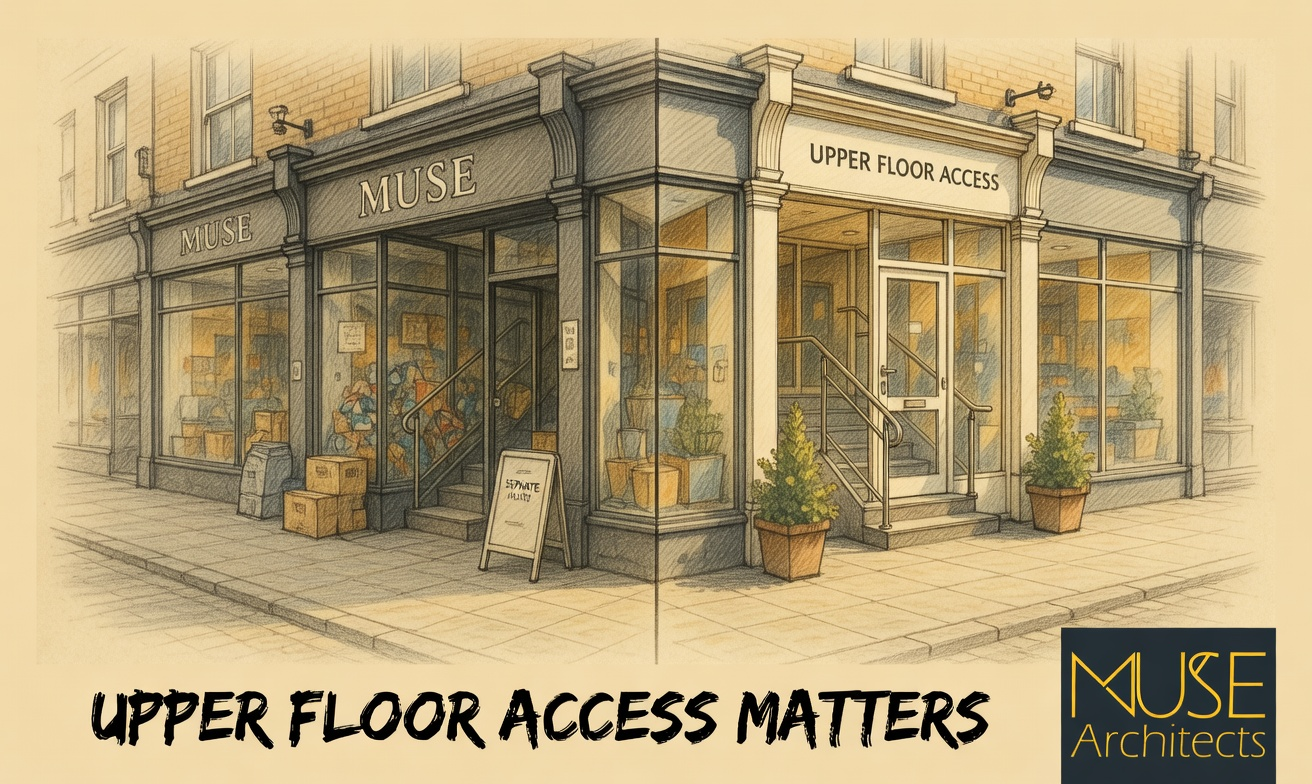
Why Access to Upper Floors Matters More Than Most Owners Think
Introduction
When people look at a building with upper floors, the first thing they usually think about is space. More floor area often means more value. It suggests potential for additional income, whether through residential units, offices, or other uses. On paper, it looks straightforward. If the space exists, it should be usable. But in reality, the value of upper floors is not defined by space alone.

It is defined by how you get to that space.
At Muse Architects, we regularly see buildings where the upper floors look promising but are quietly limited by poor access. The entrance is unclear, the stairs are awkward, or the route conflicts with the ground floor use. These issues don’t always stop a project immediately, but they create friction that affects planning, usability, and long-term value.
You can explore how we approach these challenges here: Musearchitects.co.uk
This article explains why access to upper floors matters more than most owners realise, and how a clear, well-designed entrance strategy can unlock real opportunity.
Access Is Not Just a Detail
Access is often treated as a secondary issue. It comes after decisions about layout, use, and overall design. But in practice, access is fundamental.
It shapes how people enter the building, how they move through it, and how different uses are separated. It also affects how the building is perceived. A clear, direct entrance creates confidence. A confusing or shared route creates uncertainty.
This becomes especially important in mixed-use buildings, where different users need different levels of access and privacy. If access is not resolved early, it can quietly limit what the building can achieve.
The Hidden Problem With Shared Entrances
One of the most common issues is the shared entrance. At first glance, sharing an entrance between the ground floor and upper floors may seem efficient. It saves space and avoids the need for additional structural changes. But it often creates complications.

When residential or office users share an entrance with a retail or commercial unit, several problems can arise. There may be conflicts in how the space is used, especially during busy periods. Noise, security, and privacy all become concerns.
From a planning perspective, shared access can also raise questions. Local authorities often prefer clear separation between different uses, particularly when residential units are involved. Over time, what seemed like a simple solution can become a barrier to both approval and usability.
Awkward Stairs and Their Impact
Stairs are another area where problems often begin. In many existing buildings, stairs were not designed for modern use. They may be narrow, poorly positioned, or difficult to access. In some cases, they are hidden within the layout, making them hard to find. These issues may not seem critical at first, but they affect how the space is experienced.

A difficult or unclear route to upper floors reduces their attractiveness. It can also create challenges in meeting building regulations, particularly around safety and accessibility. In practical terms, awkward stairs can make a space harder to let or sell. People respond to how a building feels, not just how it looks on a plan.
Lack of Separation Between Uses
Another common issue is the lack of clear separation between different parts of a building. For example, if residential units are accessed through a commercial space, it creates overlap between uses. This can lead to operational challenges, such as managing access during different hours or maintaining privacy for residents.
It also raises safety considerations. Fire escape routes, security measures, and general building management all become more complex when uses are not clearly separated. A clean separation, on the other hand, simplifies everything. It makes the building easier to manage, easier to understand, and more attractive to users.
Why Planning Is Affected by Access
Access is not just an operational issue. It is also a planning issue. Local planning authorities look closely at how buildings are accessed, especially in mixed-use developments. They consider whether entrances are appropriate, whether users can move safely, and whether different uses are properly separated. If access is unclear or compromised, it can affect the outcome of an application.
Guidance through the UK planning system highlights the importance of safe and suitable access:
This means that resolving access early is not just good design practice. It is also essential for a smooth planning process.
The Value of a Clear Entrance Strategy
A well-designed entrance strategy can transform a building. Instead of treating access as a constraint, it becomes an opportunity. A clear, well-positioned entrance adds structure to the layout. It defines how the building is used and creates a sense of order. This often unlocks the value of upper floors.
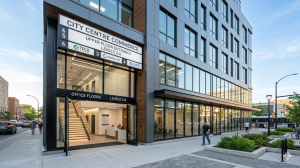
When access is simple and direct, the space becomes easier to use and more attractive to occupants. It also becomes easier to manage and maintain. In many cases, improving the entrance is one of the most effective ways to improve the overall performance of a building.
Simplicity Is Usually the Best Solution
One of the key principles in access design is simplicity. The best layouts are often the simplest ones. They provide a clear route from the street to the upper floors, with minimal confusion or overlap. This does not mean that every building needs a completely separate entrance. But it does mean that access should be logical and easy to understand.
Complex routes, hidden stairs, and shared spaces may seem efficient in the short term, but they often create problems later. A simple, well-resolved layout supports both usability and long-term value.
A Retail Example
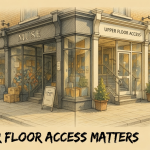
Consider a small retail unit with upper floors that could be converted into residential use. On paper, the opportunity looks strong. The location is good, and the upper floors have potential. But the only access to the upper floors is through the retail space. This creates several challenges. Residents would need to pass through a commercial environment to reach their homes. This raises issues around privacy, security, and management.

Planning approval may also be more difficult, as the lack of separation between uses can be seen as a concern. By introducing a separate entrance, even in a modest form, the entire scheme becomes more viable. The uses are clearly defined, and the building functions more effectively.
A Mixed-Use High Street Example
On a typical high street, many buildings have underused upper floors. The ground floor is active, but the upper levels remain vacant or underperforming. In many cases, the issue is not the space itself. It is the access.
Entrances may be narrow, poorly located, or shared with commercial uses. This makes it difficult to create independent, attractive spaces above. By rethinking the entrance strategy, these buildings can be transformed. A clear, dedicated access point can unlock residential or office use, adding value without major structural change.
Why Early Decisions Matter
Access is much easier to resolve at the beginning of a project. At an early stage, there is more flexibility to adjust layouts, reposition entrances, and explore different options. As the design develops, these opportunities become more limited. Structural constraints, planning considerations, and cost factors all make changes more difficult.
This is why early assessment is so important. It allows potential issues to be identified and addressed before they become embedded in the design.
How Muse Architects Approaches Access
At Muse Architects, we treat access as a core part of the design process. We look at how people will move through the building, how different uses will interact, and how the layout can support both planning and practical use. This includes reviewing entrances, stairs, and circulation routes in detail.
You can learn more about our approach here: Musearchitects.co.uk
Our aim is to resolve these issues early, creating schemes that are both workable and valuable.
The Commercial Impact

Access design has a direct impact on commercial performance. A building with clear, well-designed access is easier to let and easier to manage. It attracts a wider range of users and supports stronger long-term value.
A building with poor access may still function, but it often underperforms. It may be harder to lease, require more management, or deliver lower returns. These differences are not always obvious at the beginning, but they become clear over time.
Final Thought
Upper floors often hold significant potential, but that potential is not automatic. It depends on how the space is accessed and how the building is organised.
A clear, simple entrance strategy can unlock value, improve usability, and support planning success. A poor one can quietly limit what the building can achieve.
Call to Action
If you’re looking at a building with upper floors, it’s worth asking a simple question:
Does the access support the opportunity?
At Muse Architects, we can review your entrance, stair, or layout and help you understand what is possible.
Send us a sketch plan or photos of your building, and we can advise on feasibility before you commit further.
Start here: Musearchitects.co.uk