Why Warehouses Are More Flexible Than You Think (2026 Guide)
Introduction
For a long time, warehouses have been seen as simple storage spaces. Large boxes used for keeping goods, nothing more. But that view is outdated.
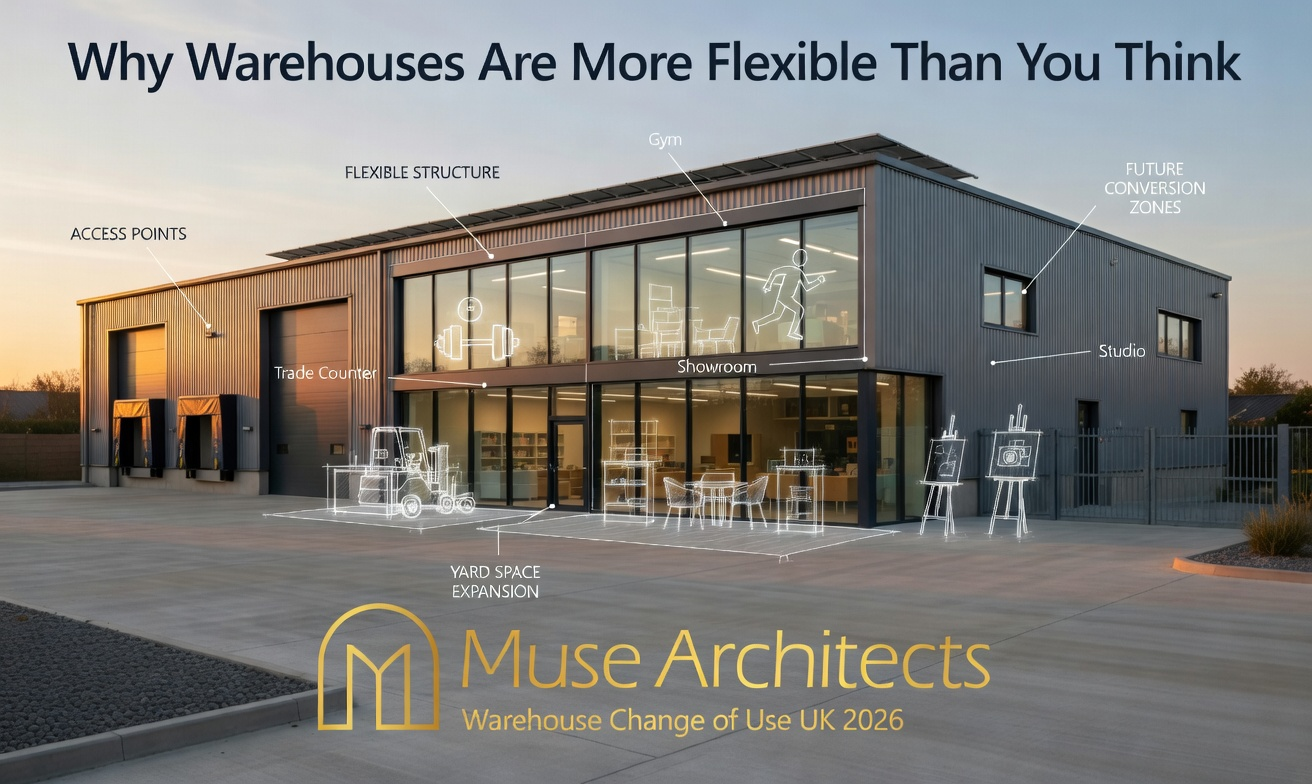
In 2026, warehouses and industrial buildings are some of the most adaptable and opportunity-rich assets in the UK property market. With the right approach, they can support a wide range of higher-value uses, from trade counters and gyms to showrooms, studios, and mixed-use commercial spaces.
Many owners underestimate what their building could become. As a result, they agree to long leases at low rents or sell below true value.
The reality is simple: the value of a warehouse is not defined by its current use. It is defined by its potential.
At Muse Architects, we help owners and investors understand that potential early. Through our change of use strategy services Change-of-use, we assess what a building can realistically become before major decisions are made.
The Shift in How Warehouses Are Used
The industrial market has not weakened, but it has evolved.
Today’s occupiers are not just looking for storage. They are looking for flexibility. They want spaces that can combine storage, customer interaction, and business operations in one place.
This shift is driven by several factors:
- Growth of e-commerce and last-mile delivery
- Increase in small and hybrid businesses
- Demand for customer-facing industrial space
- Rising cost of traditional retail units
According to the UK Planning Portal https://www.planningportal.co.uk commercial buildings are increasingly being adapted to support mixed and flexible uses.
This means warehouses are no longer limited to logistics. They are becoming multi-purpose business spaces.
What Is Warehouse Change of Use?
Warehouse change of use is the process of legally and physically adapting a building for a different purpose.
This does not always mean major redevelopment. In many cases, it involves relatively simple adjustments supported by the right planning strategy.
Common examples include:
- Storage to trade counter
- Warehouse to gym or fitness space
- Industrial unit to showroom
- Storage to creative studio or workshop
- Hybrid spaces combining office, retail, and storage
However, the key point is this: not every warehouse suits every use.
Understanding what works requires a mix of planning knowledge, design understanding, and market awareness.
If you are unsure whether your building qualifies, you can check official guidance here:
UK Guidance.
What Actually Drives Value in a Warehouse
Two warehouses of the same size can perform very differently. The difference comes down to a few key factors.
Access and Connectivity
Good access is essential. Buildings close to main roads, motorways, and urban centres have far more flexibility.
Easy access supports:
- Trade customers
- Deliveries and logistics
- Higher footfall for hybrid uses
Market research from RICS consistently highlights transport connectivity as a major value driver in commercial property.
Yard Space and External Areas
Yard space is often overlooked, but it can be one of the most valuable parts of a site.
It allows for:
- Parking
- Loading and unloading
- Outdoor operations
A warehouse with generous external space can support uses that others cannot.
Before making decisions, it is always worth carrying out a planning feasibility review to understand how your site layout affects your options.
Eaves Height
Height matters more than many people think.
Higher eaves allow:
- Mezzanine floors
- Sports and leisure uses
- Better storage efficiency
This opens the door to a wider range of occupiers and increases potential value.
Power Supply
Modern businesses require more power than traditional storage uses.
This is especially important for:
- Gyms and fitness centres
- Workshops and production
- Electric vehicle infrastructure
Insufficient power can limit your options, while strong capacity increases flexibility.
Frontage and Visibility
A warehouse with strong frontage can attract customer-facing uses.
This includes:
- Trade counters
- Showrooms
- Hybrid retail spaces
Buildings in visible locations often outperform hidden units, even if they are smaller.
You can see how this works in practice through real project examples Musearchitects.co.uk/projects
Surrounding Context
The surrounding area plays a major role in what is possible.
For example:
- Industrial estates suit trade and logistics
- Mixed-use areas support retail and leisure
- Residential areas may limit noise and traffic
Ignoring context is one of the most common mistakes in change of use projects.
Planning: The Factor That Determines Everything
One of the biggest misconceptions is that owners can simply choose a new use.
In reality, planning rules define what is possible.
Use Class and Legal Status
Every building has a legal use class. Most warehouses fall under industrial categories.
Changing use often requires planning permission, depending on the proposed use and location.
You can explore use classes and guidance here: www.planningportal.co.uk
Local Policy and Restrictions
Even if a use seems suitable, local planning policy may restrict it.
Planners consider:
- Protection of employment land
- Traffic impact
- Noise and disturbance
- Compatibility with surrounding uses
This is why early feasibility is critical.
At Muse Architects, our planning feasibility service helps identify risks before time and money are spent.
Limited Permitted Development
Unlike office-to-residential conversions, warehouse change of use rarely falls under permitted development rights.
Most projects require:
- Full planning applications
- Supporting evidence and justification
This makes strategy even more important.
When Warehouse Change of Use Works
Warehouse conversion works best when key conditions are met.
Strong indicators include:
- Good road access
- Visible location
- Flexible internal layout
- Adequate yard space
- Supportive planning context
- Clear local demand
When these factors align, value can increase significantly.
When It Does Not Work
Not every building is suitable for change of use.
Common challenges include:
- Poor access or hidden location
- No external space
- Low ceiling heights
- Weak local demand
- Planning restrictions
Trying to force a conversion in these cases often leads to poor outcomes.
Alternative Uses That Often Create More Value
Many warehouses can support stronger uses than storage alone.
Trade Counters
Trade uses often generate higher rents due to customer activity and turnover.
Gyms and Leisure Spaces
Large open layouts and high ceilings make warehouses ideal for fitness uses.
Showrooms
Visible locations allow businesses to display products while maintaining storage space.
Creative Studios
Flexible layouts attract modern businesses such as designers, makers, and content creators.
Hybrid Commercial Spaces
Combining office, retail, and storage in one building is becoming more common.
The Importance of Getting Strategy Right Early
One of the biggest risks is committing too early without understanding potential.
Common mistakes include:
- Signing long leases at low rents
- Selling without exploring alternatives
- Designing schemes that do not meet planning requirements
A simple early review can prevent these issues.
The Muse Architects Approach
At Muse Architects, the focus is always on identifying the best realistic outcome.
Feasibility First
Every project starts with understanding planning, design, and market conditions.
Clear Decision-Making
Clients receive a simple red-amber-green assessment:
- Green means strong opportunity
- Amber means possible with adjustments
- Red means avoid
Practical Design
Our architectural services Musearchitects.co.uk/services focus on solutions that are practical, compliant, and commercially viable.
Real-World Insight
In one recent case, a warehouse owner was preparing to sign a long-term lease for basic storage use.
After review, the building was repositioned as a trade counter with showroom frontage.
The result:
- Increased rental income
- Stronger tenant demand
- Higher overall asset value
This shows the importance of understanding potential before making decisions.
Financial Perspective
Every decision should be based on value, not assumption.
Key questions to ask:
- What is the highest-value realistic use?
- What are the conversion costs?
- What does the local market demand?
You can also explore wider commercial property insights through RICS.
Frequently Asked Questions
Can a warehouse be converted into retail?
Yes, but planning permission is usually required and depends on location and policy.
Do I need planning permission?
In most cases, yes. Warehouse change of use rarely falls under permitted development.
What is the best use?
There is no single answer. It depends on the building, location, and demand.
Is location important?
Yes, location is one of the biggest drivers of value and flexibility.
Conclusion
Warehouses are far more flexible than most people think.
With the right building and the right strategy, they can support a wide range of high-value uses beyond simple storage.
The key is understanding what is realistic before making decisions.
Many owners lose value by acting too quickly without exploring their options.

Call to Action
Before agreeing a long lease or selling at a low value, take a step back.
Ask what your warehouse could become.
Get clear advice before committing.
Visit Musearchitects.co.uk to start the conversation.