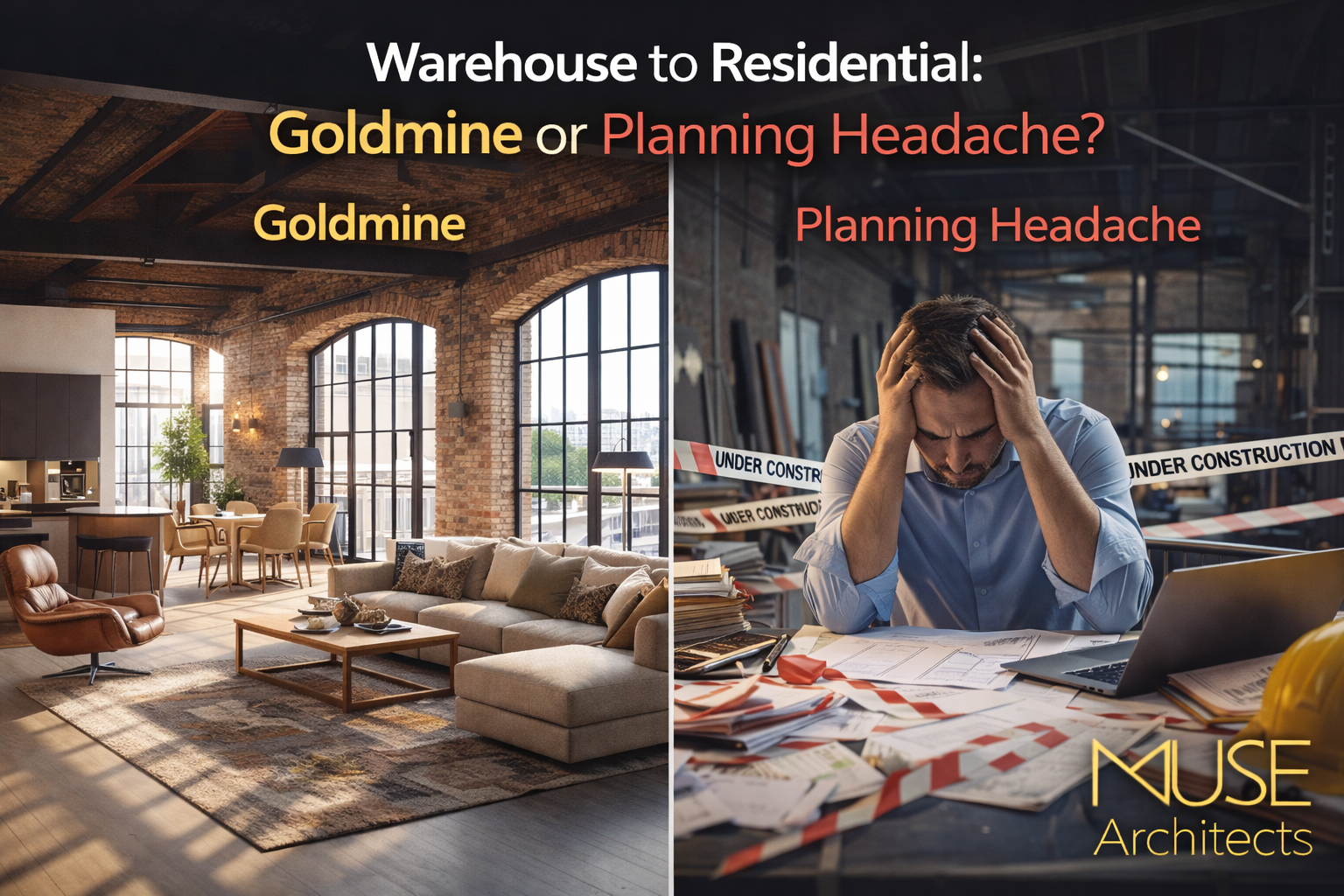
Warehouse to Residential: Goldmine or Planning Headache?
Warehouse to residential conversion is one of the most tempting ideas in UK property—and one of the most misunderstood.
On paper, the logic seems straightforward. Industrial buildings can often be acquired at relatively low prices, while residential values remain strong. The gap appears to offer immediate profit potential.
But this is where many developers and investors get caught out.
The reality is that warehouse to residential conversion is rarely simple. In many cases, the constraints are not just planning-related—they are physical, environmental, and operational.
This is where schemes often break down.
At Muse, this is exactly the type of opportunity that is tested early. Before any commitment is made, both the planning pathway and technical feasibility are assessed—ensuring that decisions are based on real constraints, not optimistic assumptions.
Why Warehouse to Residential Conversion Looks Attractive
There is a clear reason why this strategy continues to attract attention.
Industrial buildings can appear undervalued compared to residential property, creating the perception that conversion offers a straightforward uplift in value.
In theory, a successful warehouse to residential conversion can unlock significant value, transform underperforming assets, and deliver strong resale or rental returns.
However, this outcome is highly conditional.
The buildings that succeed are the exception—not the rule.
This is closely tied to how investors approach repositioning opportunities more broadly. If you are exploring this in more detail, our guide on property investment strategies in the UK breaks down how different asset classes can be evaluated and repositioned effectively
The Reality: Why Most Warehouse Residential Conversions Struggle
While the numbers may look attractive initially, the friction involved in delivering residential schemes from industrial buildings is often underestimated.
Key challenges include contamination risks from previous industrial use, poor outlook and lack of residential-quality surroundings, limited natural daylight due to deep floor plates, servicing conflicts with neighbouring industrial operations, and noise or traffic disruption.
These are not minor issues—they directly impact planning approval, design feasibility, and end value.
In many cases, they make residential conversion impractical or unviable.
Understanding Warehouse Change of Use to Residential (UK 2026)
Planning Resistance and Policy Constraints
A warehouse to residential conversion typically requires full planning permission.
Planning applications are usually submitted through the Planning Portal www.planningportal.co.uk
However, planning authorities are often cautious about losing industrial space, particularly in areas designated for employment use. Local policies may actively resist residential conversion in industrial zones.
Where proposals become more complex or are challenged, they may be reviewed by the Planning Inspectorate.
Why Planning Approval Is Only One Barrier
Even where planning appears achievable, approval alone does not guarantee success.
Authorities assess daylight standards, internal quality, amenity, compatibility with surrounding uses, and environmental constraints.
Because these factors are central to decision-making, it is important to understand how planning frameworks operate in practice. Our UK planning permission guide explores this in more detail.
The Technical Constraints Most Developers Miss
Beyond planning, the physical characteristics of industrial buildings create significant challenges.
Deep floor plates limit daylight penetration, making compliant residential layouts difficult. Structural grids can restrict efficient unit planning, while existing services often require substantial upgrades.
Contamination from previous uses can also introduce costly remediation requirements.
These issues increase both cost and complexity—and can quickly erode projected returns.
Location and Context: The Overlooked Risk
Even if the building itself can be adapted, the surrounding environment plays a critical role.
Industrial areas are rarely designed for residential living. Nearby uses may include heavy vehicle movements, noise-generating operations, and extended working hours.
These factors can negatively impact both planning approval and long-term occupier demand.
A building cannot be assessed in isolation—it must be understood within its wider context.

When Residential Is the Wrong Strategy
One of the most important insights is that not every building should be forced into residential use.
In many cases, a warehouse may be better suited to alternative strategies such as trade counter use, workspace conversion, leisure uses, or light industrial repositioning.
These options often require less intervention and can deliver more reliable returns.
Choosing the right use is often more valuable than forcing the most obvious one.
Common Mistakes in Warehouse to Residential Conversion
Where Projects Go Wrong
Many projects fail due to early-stage assumptions.
Common mistakes include relying on optimistic appraisals, ignoring planning constraints, underestimating technical challenges, and overlooking environmental context.
These issues often lead to delays, redesigns, or unviable schemes.
A structured feasibility approach helps avoid these outcomes.
UK Trends Affecting Industrial to Residential Conversion (2026)
Key Market Shifts
Planning authorities are increasingly protecting industrial land for employment use.
At the same time, residential standards are becoming stricter, particularly around daylight, space, and amenity.
This combination makes warehouse to residential conversion more challenging than in previous years, creating a more selective market where only the strongest opportunities succeed.
How to Assess Whether Residential Is Viable
A Practical Feasibility Checklist
Before proceeding, key questions should be addressed:
Is the site free from contamination risks?
Can sufficient daylight be achieved?
Is the surrounding environment suitable for residential use?
Will planning policy support the change of use?
Are servicing and infrastructure compatible with housing?
If these factors do not align, the risks increase significantly.
How Muse Protects You From High-Risk Conversions
A Reality-First Approach
Muse works with developers and investors to test whether a warehouse to residential conversion is realistic before commitments are made.
This includes planning assessment, building feasibility, environmental review, context analysis, and commercial testing.
Why This Matters
Many projects fail not because they were impossible—but because they were not properly tested early.
Muse helps clients avoid high-risk strategies and identify opportunities that are genuinely viable.
If you are exploring residential routes, you may also find our HMO planning guide in the UK useful for understanding alternative residential strategies
[Internal Link: /hmo-planning-guide]
For a broader view on repositioning assets, our property investment strategies guide provides additional insights
Conclusion: Opportunity Exists—But Only in the Right Conditions
Warehouse to residential conversion can create value—but only under specific conditions.
Planning resistance, technical constraints, and environmental factors make this one of the most complex change-of-use strategies.
The key is not chasing opportunity—it is understanding reality.
When approached correctly, the right buildings can succeed.
When approached blindly, the risks can outweigh the reward.
Call to Action
Before committing to a warehouse to residential strategy, it is essential to understand whether the opportunity is genuinely viable.
Send us your site details—we will assess whether residential is plausible or whether a different route offers a safer and stronger outcome before you commit.
Frequently Asked Questions About Warehouse to Residential Conversion
Can a warehouse be converted into residential in the UK?
Yes, but it depends heavily on planning policy, building suitability, and surrounding context.
Is warehouse to residential conversion profitable?
It can be, but only where constraints are minimal. Many schemes face significant challenges that impact returns.
What are the biggest risks in industrial to residential conversion?
Key risks include contamination, poor daylight, planning resistance, and conflict with surrounding uses.
Do I need planning permission for warehouse conversion?
Yes, full planning permission is typically required, and approval is not guaranteed.
Why do many warehouse conversions fail?
Most failures result from underestimated constraints, including layout limitations, environmental issues, and planning barriers.