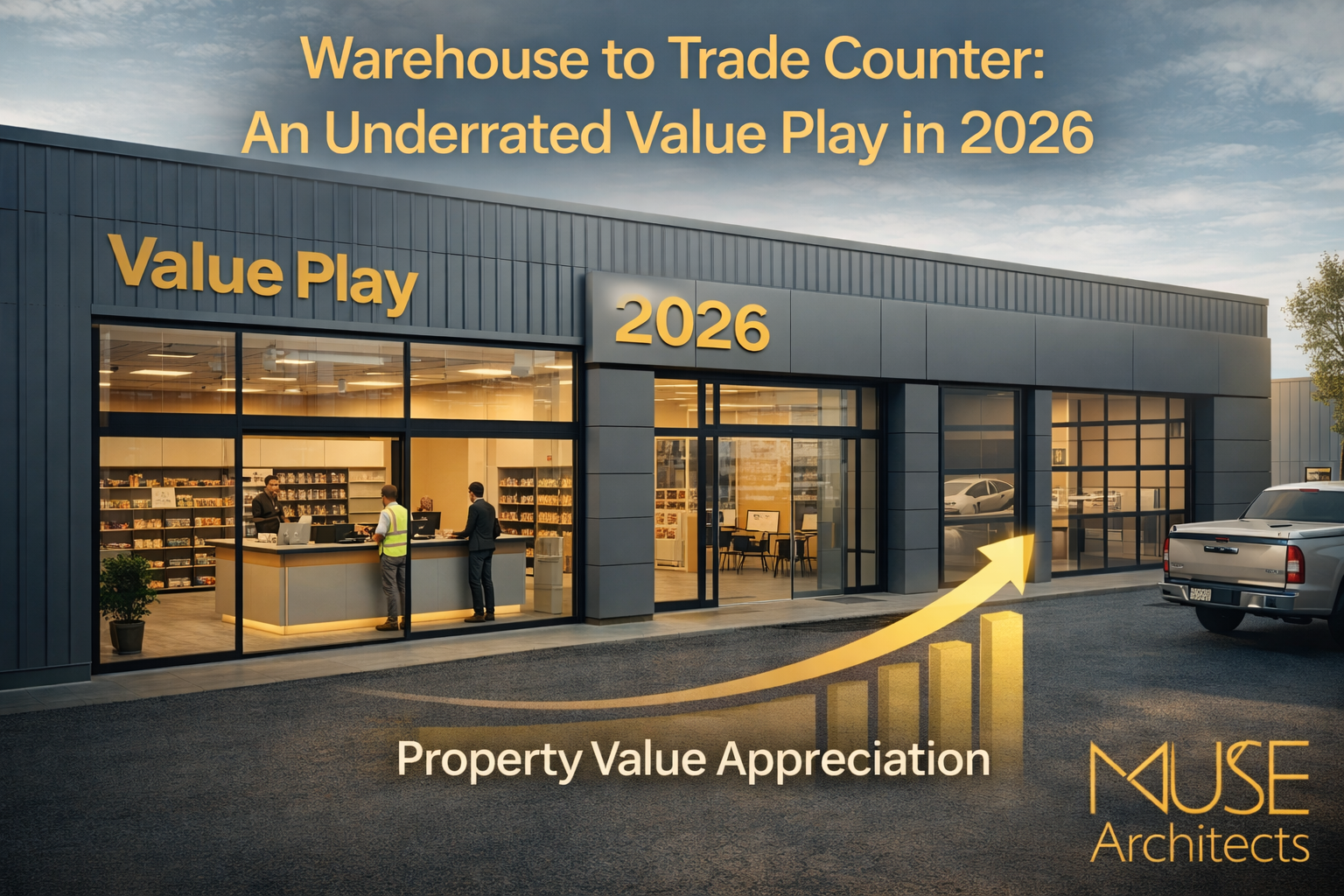
Warehouse to Trade Counter: An Underrated Value Play in 2026
Warehouse to trade counter conversion is one of the most overlooked opportunities in UK commercial property—but in the right locations, it consistently outperforms weaker industrial use.
Across the market, many secondary warehouse units struggle with limited visibility, inefficient layouts, or declining demand for traditional storage and logistics. At the same time, trade occupiers are actively searching for units that prioritise access, frontage, and operational efficiency.
This mismatch is where value is created.
However, success is not driven by planning permission alone. A warehouse to trade counter conversion only works when the building can support how trade occupiers actually operate.
At Muse, this is assessed before any commitment is made. Both the planning route and operational layout are tested together—ensuring the scheme works commercially, physically, and practically.
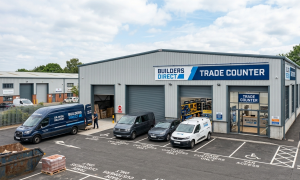
Why Warehouse to Trade Counter Conversion Creates Stronger Returns
The demand for trade counter units across the UK remains stable and, in many locations, growing.
Unlike traditional industrial tenants, trade occupiers rely heavily on accessibility, customer convenience, and fast turnover. This changes what makes a unit valuable.
A well-positioned warehouse to trade counter conversion can increase rental income, improve tenant demand, reduce vacancy risk, and enhance overall asset performance.
In many cases, units that perform poorly as storage or logistics spaces can outperform once repositioned for trade use—particularly where location and frontage are strong.
This reflects a wider shift in how commercial assets are repositioned. If you want to understand this in more detail, our guide on property investment strategies in the UK explains how different uses can unlock value across underperforming assets
What Defines a Successful Trade Counter Unit
Not all warehouses are suitable for trade counter use.
A successful conversion depends on how well the building supports customer interaction, vehicle movement, and operational efficiency.
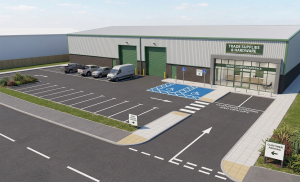
Key characteristics include strong frontage, direct and safe access, dedicated customer parking, efficient van loading, clear signage, and functional yard space.
These factors directly influence how attractive the unit is to trade occupiers.
A unit without these fundamentals may struggle, even if planning approval is achievable.
Understanding Warehouse Change of Use for Trade Counters
What Affects Trade Counter Viability
A warehouse change of use to trade counter involves more than a simple planning application.
Local authorities assess how the use impacts traffic, access, and surrounding properties, while the unit must also function operationally.
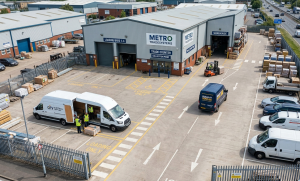
This includes customer arrival patterns, delivery movement, safe circulation, and the interaction between vehicles and pedestrians.
If these elements do not work together, the scheme becomes inefficient and less viable.
Design Strategies That Unlock Value
Many successful warehouse to trade counter conversions do not require major redevelopment.
In practice, value is often unlocked through targeted improvements such as enhancing frontage visibility, creating a dedicated entrance, reconfiguring parking and yard layout, and improving signage and branding.
This approach focuses on function rather than unnecessary structural change—allowing landlords to reposition assets efficiently.
Planning and Highways Considerations for Trade Counter Use
Change of Use and Planning Requirements
Most conversions require a change of use application depending on the existing use class.
Planning applications are typically submitted through the Planning Portal www.planningportal.co.uk
Authorities will assess whether the site is suitable for a customer-facing use rather than purely industrial activity.
Where proposals involve more complex access or highways issues, they may be reviewed by the Planning Inspectorate.
Why Highways and Access Are Critical
Highways considerations are often the deciding factor in trade counter schemes.
Authorities will review vehicle access, parking, delivery movement, and overall site safety.
Even strong locations can fail at planning stage if access and circulation are not properly addressed.
Because these factors are central to planning decisions, it is important to understand how the system works in practice. Our UK planning permission guide explains this in more detail.
Operational Performance: The Key to Long-Term Value
Trade counter units operate differently from standard industrial spaces.
They rely on high-frequency visits, quick transactions, and efficient movement of goods.
Peak periods can create pressure on parking, access, and yard space.
If the layout does not support this, the unit becomes difficult to operate and less attractive to tenants.
This is why warehouse to trade counter conversion must be assessed from an operational perspective—not just planning or design.
Common Mistakes in Warehouse to Trade Counter Conversion
Mistakes That Reduce Value
Many costly mistakes occur early in the process.
Assuming any warehouse can support trade use, ignoring frontage, underestimating parking needs, or overlooking access constraints can significantly reduce viability.
Another common issue is over-investing in structural changes instead of focusing on functionality.
The most effective schemes optimise what already exists rather than overcomplicate the building.
UK Market Trends Supporting Trade Counter Growth (2026)
Key Trends
Trade occupiers are increasingly focused on convenience and accessibility.
Roadside and edge-of-town locations are becoming more attractive, particularly where access and parking are efficient.
At the same time, some industrial units are becoming less competitive for logistics use, creating repositioning opportunities.
This is driving demand for well-designed trade counter units.
How to Assess a Warehouse for Trade Counter Conversion
A Practical Checklist
Before proceeding, key questions should be answered:
Does the unit have strong frontage and visibility?
Is customer parking achievable and convenient?
Can vans access and load efficiently?
Is circulation safe and practical?
Will planning support the use?
Does the layout support trade operations?
These factors determine whether the concept works in reality.
How Muse Helps You Unlock Trade Counter Potential
A Structured Feasibility Approach
Muse supports landlords, investors, and occupiers by testing whether a warehouse to trade counter conversion is viable before commitments are made.
This includes planning assessment, frontage analysis, parking and access review, operational layout planning, and commercial viability testing.
Why This Approach Works
By combining architecture, planning, and operational thinking, Muse ensures that the proposed use works in reality—not just in theory.
This reduces risk, improves decision-making, and enhances long-term asset performance.
If you are exploring alternative residential strategies alongside commercial repositioning, our HMO planning guide in the UK provides useful insight into planning routes
[Internal Link: /hmo-planning-guide]
For a broader view on repositioning assets, our property investment strategies guide explains how to unlock value across different commercial uses
[Internal Link: /property-investment-strategies]
To explore how this applies to your specific site, you can review our work and approach at Muse Architects
Conclusion: A Smarter Way to Reposition Industrial Assets
Warehouse to trade counter conversion is an underrated but highly effective strategy.
When the building supports frontage, access, parking, and operational flow, it can outperform weaker industrial uses and deliver stronger returns.
The key is not just changing use—but making the use work.
Call to Action
Before committing to a warehouse to trade counter conversion, it is essential to understand whether the unit can genuinely support trade operations.
Send your unit location and existing layout—we will assess its trade suitability, identify constraints, and highlight how value can be unlocked before you commit to heads of terms.
Frequently Asked Questions About Warehouse to Trade Counter Conversion
What is a warehouse to trade counter conversion?
It is the process of changing an industrial unit into a customer-facing trade space designed for quick transactions, collections, and trade-based operations.
Do I need planning permission for a trade counter conversion in the UK?
In most cases, yes. A change of use application is typically required depending on the existing use class and local planning policy.
What makes a warehouse suitable for trade counter use?
Key factors include strong frontage, customer parking, van access, loading capability, clear signage opportunities, and efficient yard space.
Can all industrial units be converted into trade counters?
No. Units with poor access, limited frontage, or restricted parking may struggle to function effectively as trade counters.