Summarise with AIClaudeChatGPTGeminiOffice to Clinic, Wellness, or Medical Use: Often a Better Route Than Flats Residential isn’t always the highest-value outcome For many developers and landlords, converting offices into residential units has become the default strategy. It feels familiar, widely discussed, and often appears to offer a clear route to value. But in reality, residential is not always the most profitable or suitable option. In many cases, office buildings are far better aligned with healthcare, wellness, or medical uses—offering stronger long-term returns with fewer compromises in design and delivery. The Overlooked Opportunity: Healthcare & Wellness Conversions A significant number of office buildings already possess the spatial qualities required for medical or wellness use. Unlike residential conversions, which often require major structural changes, these alternative uses can work with the building rather than against it. Typical office layouts naturally support: Consultation and treatment rooms Waiting and reception areas Efficient patient circulation Flexible partitioning without major intervention This means that, in many cases, conversion to clinic or wellness use requires less structural disruption, lower cost, and faster delivery compared to residential schemes. Planning Still Matters—But in a Different Way While switching from office to residential often relies on permitted development routes, healthcare and medical uses follow a different planning pathway. However, this does not make them less viable—it simply shifts the criteria. Key planning considerations include: Parking provision and patient access Accessibility and compliance requirements Impact on neighbouring properties Servicing and operational logistics Suitability of the location for healthcare use For a broader understanding of planning use classes and requirements, refer to the Planning Portal, which outlines how different building uses are assessed within the UK planning system. When these factors align, medical use can often achieve strong planning outcomes—particularly in locations where residential may face constraints. The Commercial Reality: Income vs Assumption One of the biggest misconceptions in the market is that residential always delivers the highest value. In practice, this depends heavily on location, layout efficiency, and market demand. In weaker residential areas—or buildings with layout constraints—returns can quickly diminish. By contrast, a well-matched healthcare operator can offer: Long-term lease stability Strong covenant strength Predictable income streams Reduced void risk In many cases, a strong operator-backed scheme can outperform a poorly executed residential conversion, particularly where unit quality or layout efficiency is compromised. Why the “Residential by Default” Approach Fails The issue is not residential itself—it is the assumption that it is always the best answer. When developers force residential into unsuitable buildings, the result is often: Inefficient layouts and compromised units Higher construction costs due to structural changes Lower sales values or rental demand Increased risk despite planning approval The outcome is a scheme that technically works—but commercially underperforms. The Smarter Approach: Test the Building, Not the Trend Every building has its own logic, shaped by its structure, layout, location, and surrounding context. The most successful developers understand that value is not created by following trends, but by objectively assessing what the asset can genuinely support. Instead of defaulting to popular strategies such as residential conversion, they take a more strategic approach—testing multiple use scenarios to identify the option that delivers the strongest performance. This process involves a detailed evaluation of several key factors. First, the spatial compatibility of the building is analysed to determine how efficiently it can accommodate different uses without excessive structural intervention. At the same time, planning viability is reviewed across multiple routes to understand which use classes are realistically achievable and how they align with local planning policies. Equally important is the demand for alternative uses in that specific location, ensuring that the end product meets real market needs rather than assumptions. Finally, developers compare long-term income potential against short-term gains, weighing stable, operator-backed returns against the risks associated with sales-driven models. Only through this structured and honest assessment can the most effective strategy be identified—one that not only works on paper but delivers strong, sustainable commercial performance in reality. How Muse Architects Identifies the Right Use At Muse Architects, the focus is not on pushing a single solution—it is on identifying the most commercially viable outcome for each building. Instead of assuming residential is the answer, we test multiple use scenarios early in the process, including healthcare, wellness, and alternative commercial uses where appropriate. Through early feasibility and strategic analysis, we help clients: Compare residential vs alternative use performance Assess planning routes across different use classes Identify opportunities with stronger long-term returns Avoid committing to the wrong strategy too early Learn more about our architecture and feasibility services Explore change of use strategy and planning advice Read more latest insights on office conversions The Bottom Line Residential is not always the best use. It is simply the most common assumption. In many cases, office buildings are better suited to healthcare, wellness, or medical use—offering stronger income, lower risk, and better alignment with the existing structure. The key is not choosing the obvious route. It is choosing the right route for the building. Call to Action Before committing to a residential conversion, take a step back and evaluate the full potential of the asset. Send the building details and intended operator type so we can advise on the likely planning route. That one decision can redefine the entire outcome of your investment. FAQs Is office-to-residential always the best option? No. Alternative uses such as healthcare or wellness can often provide better long-term returns depending on the building and location. What types of offices suit clinic or medical use? Buildings with flexible layouts, good access, and suitable surrounding infrastructure are ideal. Is planning more difficult for medical use? Not necessarily. It depends on location and compliance, but strong proposals can gain approval. Why are healthcare tenants attractive to investors? They often offer long leases, strong covenants, and stable income streams. How can I test if my building suits medical use? Through early feasibility studies that compare different use options before committing to a strategy.
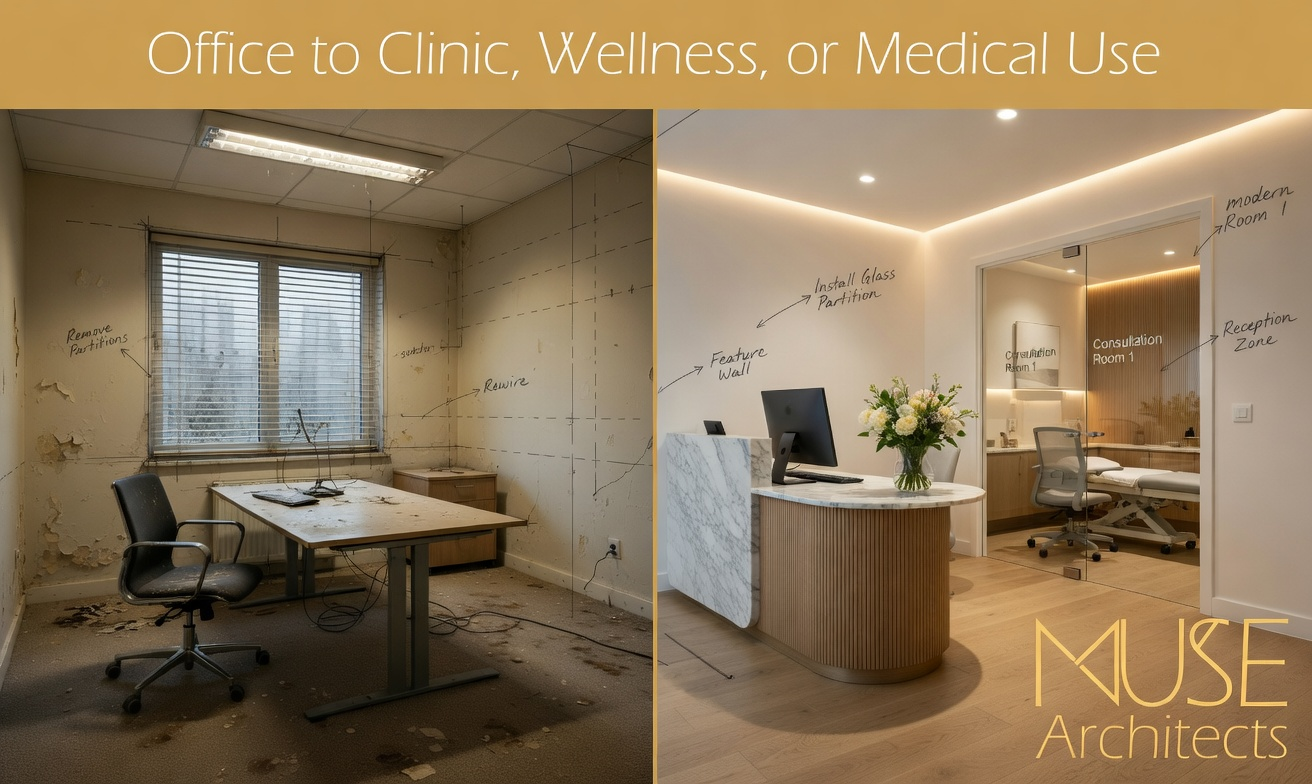
Office to Clinic, Wellness, or Medical Use: Often a Better Route Than Flats
Residential isn’t always the highest-value outcome
For many developers and landlords, converting offices into residential units has become the default strategy. It feels familiar, widely discussed, and often appears to offer a clear route to value.
But in reality, residential is not always the most profitable or suitable option.
In many cases, office buildings are far better aligned with healthcare, wellness, or medical uses—offering stronger long-term returns with fewer compromises in design and delivery.
The Overlooked Opportunity: Healthcare & Wellness Conversions
A significant number of office buildings already possess the spatial qualities required for medical or wellness use. Unlike residential conversions, which often require major structural changes, these alternative uses can work with the building rather than against it.
Typical office layouts naturally support:
- Consultation and treatment rooms
- Waiting and reception areas
- Efficient patient circulation
- Flexible partitioning without major intervention
This means that, in many cases, conversion to clinic or wellness use requires less structural disruption, lower cost, and faster delivery compared to residential schemes.
Planning Still Matters—But in a Different Way
While switching from office to residential often relies on permitted development routes, healthcare and medical uses follow a different planning pathway. However, this does not make them less viable—it simply shifts the criteria.
Key planning considerations include:
- Parking provision and patient access
- Accessibility and compliance requirements
- Impact on neighbouring properties
- Servicing and operational logistics
- Suitability of the location for healthcare use
For a broader understanding of planning use classes and requirements, refer to the Planning Portal, which outlines how different building uses are assessed within the UK planning system.
When these factors align, medical use can often achieve strong planning outcomes—particularly in locations where residential may face constraints.
The Commercial Reality: Income vs Assumption
One of the biggest misconceptions in the market is that residential always delivers the highest value.
In practice, this depends heavily on location, layout efficiency, and market demand. In weaker residential areas—or buildings with layout constraints—returns can quickly diminish.
By contrast, a well-matched healthcare operator can offer:
- Long-term lease stability
- Strong covenant strength
- Predictable income streams
- Reduced void risk
In many cases, a strong operator-backed scheme can outperform a poorly executed residential conversion, particularly where unit quality or layout efficiency is compromised.
Why the “Residential by Default” Approach Fails
The issue is not residential itself—it is the assumption that it is always the best answer.
When developers force residential into unsuitable buildings, the result is often:
- Inefficient layouts and compromised units
- Higher construction costs due to structural changes
- Lower sales values or rental demand
- Increased risk despite planning approval
The outcome is a scheme that technically works—but commercially underperforms.
The Smarter Approach: Test the Building, Not the Trend
Every building has its own logic, shaped by its structure, layout, location, and surrounding context. The most successful developers understand that value is not created by following trends, but by objectively assessing what the asset can genuinely support. Instead of defaulting to popular strategies such as residential conversion, they take a more strategic approach—testing multiple use scenarios to identify the option that delivers the strongest performance.
This process involves a detailed evaluation of several key factors. First, the spatial compatibility of the building is analysed to determine how efficiently it can accommodate different uses without excessive structural intervention. At the same time, planning viability is reviewed across multiple routes to understand which use classes are realistically achievable and how they align with local planning policies. Equally important is the demand for alternative uses in that specific location, ensuring that the end product meets real market needs rather than assumptions. Finally, developers compare long-term income potential against short-term gains, weighing stable, operator-backed returns against the risks associated with sales-driven models.
Only through this structured and honest assessment can the most effective strategy be identified—one that not only works on paper but delivers strong, sustainable commercial performance in reality.
How Muse Architects Identifies the Right Use
At Muse Architects, the focus is not on pushing a single solution—it is on identifying the most commercially viable outcome for each building.
Instead of assuming residential is the answer, we test multiple use scenarios early in the process, including healthcare, wellness, and alternative commercial uses where appropriate.
Through early feasibility and strategic analysis, we help clients:
- Compare residential vs alternative use performance
- Assess planning routes across different use classes
- Identify opportunities with stronger long-term returns
- Avoid committing to the wrong strategy too early
Learn more about our architecture and feasibility services
Explore change of use strategy and planning advice
Read more latest insights on office conversions
The Bottom Line
Residential is not always the best use.
It is simply the most common assumption.
In many cases, office buildings are better suited to healthcare, wellness, or medical use—offering stronger income, lower risk, and better alignment with the existing structure.
The key is not choosing the obvious route.
It is choosing the right route for the building.
Call to Action
Before committing to a residential conversion, take a step back and evaluate the full potential of the asset.
Send the building details and intended operator type so we can advise on the likely planning route.
That one decision can redefine the entire outcome of your investment.
FAQs
Is office-to-residential always the best option?
No. Alternative uses such as healthcare or wellness can often provide better long-term returns depending on the building and location.
What types of offices suit clinic or medical use?
Buildings with flexible layouts, good access, and suitable surrounding infrastructure are ideal.
Is planning more difficult for medical use?
Not necessarily. It depends on location and compliance, but strong proposals can gain approval.
Why are healthcare tenants attractive to investors?
They often offer long leases, strong covenants, and stable income streams.
How can I test if my building suits medical use?
Through early feasibility studies that compare different use options before committing to a strategy.