Muse Architects

Property Investment Strategies -Introduction

Property investment is a multifaceted journey, often perceived as complex and challenging. In the ever-evolving landscape of real estate, achieving success demands a keen focus on education, knowledge, mindset, and network. In this article, we will delve into the pivotal role these elements play in the world of property investment. We will also explore various strategies for property investment and discuss how Muse Architects, a distinguished firm specialising in high-end residential architecture and property development, can assist you on this journey.     The Foundation of Successful Property Investment Before we dive into the intricacies of property investment, let’s understand the foundational principles that underpin success in this field: education, knowledge, mindset, and networking.     Education Property investment is an ongoing learning process. Staying informed about market trends, property values, and investment strategies is crucial. Whether you’re a novice or an experienced investor, Muse Architects can provide valuable resources and insights to keep you informed about the latest developments in property investment. Knowledge Knowledge is the key to making informed decisions. Understanding the local property market, as well as the legal and financial aspects of property transactions, and emerging trends, is critical. Muse Architects can connect you with experts who possess the knowledge needed to ensure your investments are well-informed and sound. Mindset Successful property investors possess a mindset of patience, discipline, and a long-term perspective. It’s vital to be prepared for the ups and downs that come with property investment. At Muse Architects, we can help you develop the right mindset to navigate the challenges and reap the rewards of your investments. Networking Your network in the property investment world can open doors to opportunities and provide access to valuable resources. Muse Architects has an extensive network of industry professionals, including estate agents, mortgage brokers, contractors, and legal advisors, who can assist you in various aspects of property investment. Property Investment Strategies Now, let’s explore different property investment strategies and how Muse Architects can support you in each one: Buying Correctly One of the fundamental principles of property investment is purchasing the right property. This involves conducting thorough research, assessing the market, and identifying properties that are either undervalued or have the potential for growth. Muse Architects’ Expertise: Our team of professionals can provide comprehensive market research, assess property values, and identify opportunities for value addition. We can guide you in making well-informed decisions to set yourself up for success from the outset.     Capitalising on the Demand for Rental Properties Rental properties have seen a surge in demand in recent years due to factors such as the rising cost of living and the challenges faced by many in entering the property market. Muse Architects’ Expertise: We can assist you in optimising your rental properties. Our architectural expertise includes space optimisation, sustainable design, and ensuring legal and safety compliance. This helps you tap into the growing demand for rental properties and generate a reliable income stream. Treating Property Investment as a Business To succeed in property investment, it’s crucial to treat it as a business. This involves creating a clear strategy, setting goals, and developing a plan to achieve them. Muse Architects’ Expertise: We can help you develop a strategic plan for your property investment business. Whether you’re considering property refurbishment or development projects, our team can oversee the entire process, ensuring that your investments align with your business goals. Exploring Creative Financing Alternatives The property investment landscape is evolving, with cheaper and more creative financing alternatives becoming the new normal. These include rent-to-buy and lease options. Muse Architects’ Expertise: We can guide you through the financial aspects of these creative financing options. Our expertise in property valuation and legal guidance ensures that you make sound financial decisions, whether you’re considering a rent-to-buy option or a lease agreement. Stress-Testing the Market Stress-testing the property market is crucial to assess its stability and potential fluctuations. It helps ensure that your investments are sustainable and that you’re prepared for any market changes. Muse Architects’ Expertise: Our market insights and trend analysis can help you understand the current state of the property market and anticipate future developments. We can also assist in identifying potential risks and developing strategies to mitigate them. Seizing Opportunities in a Changing Landscape The property market is not static. Many landlords are retiring, and struggling homeowners are potential sources of opportunity for property investors. Muse Architects’ Expertise: We can assist you in seizing opportunities created by retiring landlords. We can help you identify properties likely to become available due to retiring landlords and negotiate favourable terms. Additionally, we can work with struggling homeowners, connecting you with resources and professionals who can assist them in finding solutions while helping you acquire properties at attractive prices. Ethical Investment Ethical investment is gaining importance in the property investment world. By investing ethically, you can ensure that your investments are sustainable and contribute to positive social and environmental outcomes. Muse Architects’ Expertise: Our commitment to sustainable and eco-friendly design principles can be leveraged in your property investments to promote positive environmental outcomes. We can also connect you with experts who can advise on community engagement and ethical property management practices.         Muse Architects: Your Partner in Property Investment Muse Architects is a distinguished firm specialising in high-end residential architecture and property development. Since our establishment in 2018, we have been dedicated to the design of home extensions, transformative projects, bespoke new builds, and small property developments for clients throughout Manchester and the wider North West region. As experienced architects, we focus on delivering design solutions that prioritise simplicity, abundant natural light, energy efficiency, sustainability, and, most significantly, the optimisation of space. For property developers like you, our commitment to space optimisation is of paramount importance. We understand that adding value to your property developments and investment schemes is a fundamental goal. Whether it’s through innovative designs, smart space utilisation, or sustainable practices, we aim to enhance the quality and value of your projects. The foundation of Muse Architects is built upon the expertise of our founder, Ben Richards. With a

architect to developer

From Architecture to Property Development

Embarking on a Career Transition Embarking on a career in architecture paved the way for my eventual transition into the dynamic realm of real estate development. Shifting from envisioning structures to actualising them marked a significant and rewarding evolution in my professional trajectory. Exploring Lucrative Opportunities in Property Development Unlike the comparatively rigid salary structures in architecture, real estate development unveiled a realm of limitless financial potential. In this field, earnings are intricately linked to the successful execution of projects, transcending the income limitations often inherent in traditional architectural roles. This realisation sparked the consideration of real estate development as a means to not only elevate my career but also to enhance my financial prospects. Navigating the Transition The journey from architecture to real estate development is undoubtedly transformative, demanding a strategic approach. Here are key steps that proved instrumental in my own transition, offering guidance for fellow architects aspiring to venture into property development: Leveraging Architectural Knowledge You can use your architectural expertise as a foundational advantage. Understanding the planning application process, building regulations, and design principles gives you a unique edge in conceptualising and executing outstanding building projects. Market Research and Specialisation Conduct thorough market research to identify trends, demands, and opportunities. Specialise in niches where your architectural background aligns seamlessly, ensuring a targeted and strategic entry into property development. Financial Literacy and Risk Management Develop a strong grasp of financial principles and risk management. Real estate development involves financial intricacies that extend beyond architectural considerations. A sound understanding of budgets, financing, and risk mitigation is essential. Educational Foundations for Property Development In the specific context of property development, educational foundations play a pivotal role. Rather than venturing into unrelated business and property management realms, focus on strategic education tailored to your evolving role: Strategic Education Investment Explore academic programs that bridge the knowledge gap between architecture and property development. Courses in project management, real estate finance, and development strategies can enrich your skill set and enhance credibility. Continual Learning in Development Practices Stay informed about industry-specific developments, legal requirements, and emerging trends within property development. Participation in courses, workshops, and seminars dedicated to real estate development ensures ongoing relevance and adaptability. Building Networks and Practical Approaches Networking and practical experience are indispensable components in the journey from architect to property developer: Networking within the Industry Leverage existing architectural connections and actively seek new ones within the property development sector. Attend industry events, engage with professionals, and build a network that provides valuable insights and potential collaborations. Practical Experience from Ground Up Embrace entry-level opportunities that allow for hands-on experience in property development. Practical exposure at the grassroots level, even with prior architectural expertise, is integral for long-term success. Commitment to Continuous Growth In the dynamic landscape of property development, commitment to continuous learning remains key: Adaptation and Skill Enhancement Commit to ongoing skill enhancement and adaptability. As the industry evolves, staying informed about emerging technologies, market shifts, and sustainable practices is crucial. Engagement in Industry Forums Participate actively in industry forums, webinars, and relevant professional associations. This engagement fosters a deeper understanding of industry dynamics and facilitates valuable connections. Conclusion: Flourishing in Property Development In conclusion, the transition from architecture to property development is a strategic move that requires leveraging architectural knowledge, strategic education, building robust networks, and practical experience. By staying committed to continuous learning and growth, architects can position themselves for success in the dynamic and rewarding field of property development, creating not only structures but thriving environments.

architects role in property develepment

The Architect’s Role in Property Development

Navigating the Architect’s Role in Property Development: A Guide to Client Understanding A property developer acknowledges that success hinges significantly on collaborating with a skilled architect. In this symbiotic relationship, an architect’s responsibilities extend beyond merely designing buildings. The architect’s role encompasses various tasks, including collating designs from multiple consultants, facilitating the planning process, and overseeing construction activities. When aligned with a developer, the architect becomes an integral part of the project team, contributing to site selection, design and planning, budget management, team selection, and even interior and landscape design. Essentially, the architect is entrusted with adding substantial value to the project by crafting designs that resonate with the target audience and align with the developer’s objectives. Architect’s Planning Role for Developers The architect plays a pivotal role in development planning, initiating projects by crafting meticulous plans and designs. They navigate regulatory compliance, submit planning applications, and engage with local authorities to ensure swift approvals. The architect adapts designs based on feedback, negotiates for project support, and employs visual representations to convey project merits. Collaborating with consultants, they monitor the process, compile comprehensive documentation, and serve as the project’s ambassador, laying the groundwork for successful construction. Team Curation Ensuring that a proficient project team is in place involves hiring experienced civil, geotechnical, and structural engineers. Design Implementation and Construction Oversight Architects are responsible for implementing the approved design and overseeing the construction phase. The Significance of an Architect to a Developer Cost-Effective Realisation: Architects help developers achieve their goals in a cost-effective manner. Project Management Expertise: They contribute to effective project planning, supervision, and management, mitigating risks that could lead to project failure. Timely Delivery: Developers rely on architects for their experience in the building process to ensure projects are delivered on time. Team Assembly Skills: Architects excel in forming a skilled and experienced project team, which is crucial for project success. Understanding Developer Goals: They comprehend the needs and aspirations of developers, translating them into projects that are not only aesthetically pleasing but also aligned with the developer’s vision. Value Addition: Architects consider factors that might be overlooked by developers, consistently striving to enhance the overall value of the project. Regulatory Compliance: Developers require architects to prepare building plans and specifications for submission to local planning authorities, ensuring compliance and securing necessary permissions. Tips for Architects Working with Developers Effective collaboration between architects and developers relies on clear communication and understanding. Here are some valuable tips for architects when working with developers: Clarify Service Expectations: Ensure a clear understanding of the services expected from the architect by the developer. Agree on Fees: Collaboratively decide on a fee structure for the architect’s services. Foster Open Communication: Cultivate an environment of open communication, encouraging developers to ask questions and architects to provide informative answers. Professional Reference Sharing: Provide the developer with a comprehensive list of past projects and clients, establishing professional credibility and references. Architectural Qualification: Membership in the national institute for architects signifies architectural licensure and qualification. Site Familiarity: Visit the project site before initiating the design process, taking note of its current condition. Understand Planning Requirements: Visit local planning authorities or councils to understand planning requirements before initiating the building plan. In Conclusion Working as an architect for a property developer can become a seamless and fruitful experience when expectations are clear and collaboration is fostered. By adhering to the outlined tips and understanding the uniqueness of each project and client, architects can not only excel in their role but also cultivate robust and harmonious professional relationships with developers. The key lies in comprehending and responding to the distinct needs of every project, ensuring that each design reflects the aspirations of the developer and resonates with the targeted audience.

Elevating Your Property with Building Regulation Compliant House Design Plans

An In-Depth Examination of Building Regulation Drawing Plans Within the realm of property development, unwavering adherence to building regulations stands as the fundamental pillar of any construction or renovation endeavour. This commitment ensures that your property embodies safety, functionality, and legal compliance. In this comprehensive exploration, we will delve into the intricacies of building regulation plans, elucidating their paramount significance in the realm of planning permission. Furthermore, we will highlight Muse Architects, a distinguished architectural firm renowned for their meticulous craftsmanship in creating building regulation-compliant house design plans in the United Kingdom. Unveiling the Essence of Building Regulations in House Design Plans Building regulations in the United Kingdom serve as the bedrock of standards governing the construction and alteration of buildings. These regulations protect and ensure that properties are secure, structurally sound, energy-efficient, and universally accessible. At the heart of these regulations lie the house design plans—comprehensive documents and drawings that delineate the blueprint for construction or renovation. These plans, often referred to as building regulation plans for extensions, serve as the tangible manifestation of your project’s compliance with the intricate tapestry of building regulations. Within these meticulously conceived plans, one can find a symphony of architectural drawings, structural calculations, and an array of technical details. These elements converge to demonstrate the project’s alignment with the exacting safety and quality standards prescribed by building regulations. Muse Architects: Exemplars of Architectural Excellence and Regulatory Adherence In the pantheon of architectural brilliance, Muse Architects emerges as a leader in creating building regulation-compliant house design plans. Their prowess spans the entire spectrum of architectural design, ensuring that projects not only comply with regulations but also resonate with aesthetic magnificence. Here are several reasons why Muse Architects excels in crafting house design plans that transcend mere compliance: Architectural Prowess: Muse Architects possesses a wealth of experience and expertise, creating homes that are not only secure but also visually captivating. Regulatory Acumen: With a profound understanding of building regulations in the UK, Muse Architects meticulously curate plans that epitomise compliance, leaving no room for errors. Bespoke Elegance: They recognise the uniqueness of each property, tailoring their designs to meet specific needs and individual nuances. Efficiency and Sustainability: Muse Architects champions energy efficiency and sustainability, incorporating environmentally friendly elements into their designs. Meticulous Craftsmanship: Every detail, from layout to structural integrity, is carefully considered and calibrated to perfection. Navigating the Process of Crafting and Submitting Building Regulation-Compliant House Design Plans Creating and submitting house design plans that adhere to building regulations is a pivotal juncture in property development. These plans illuminate the path to compliance and excellence. Let’s explore the steps involved in this process: Preliminary Consultation: The journey begins with an initial consultation with Muse Architects. Here, the intricacies of your project and the requirements for compliance are thoroughly discussed. Artisanal Design: Muse Architects will meticulously create house design plans that harmonise your vision with the demands of regulatory compliance, incorporating architectural drawings and structural calculations. Submission and Regulatory Guidance: Muse Architects will navigate the submission process to ensure your plans align with local building control authorities’ standards. With approval secured, the project can confidently proceed. Construction and Inspectorial Scrutiny: During construction, building control inspectors may visit the site. Muse Architects will provide support to ensure the project progresses smoothly. Certification of Completion: Upon successful inspection, your project will receive final certification, affirming compliance with building regulations. The Fundamental Role of Building Regulations Building regulations play a crucial role in property development. They are designed to: Safeguard Lives: Ensuring the safety of occupants is paramount, establishing the secure and structurally sound nature of buildings. Uphold Quality: These regulations set exacting standards for construction quality, materials, and design. Champion Energy Efficiency: Many regulations aim to reduce the carbon footprint of buildings, leading to cost savings on energy. Ensure Legal Compliance: Violations can result in substantial penalties and necessitate rectifications. Approved plans protect against legal ramifications. The Synergy between Planning Permission and Building Regulations While planning permission and building regulations are intertwined in property development, they serve distinct roles. Planning permission focuses on land use, aesthetics, and environmental impact, while building regulations concentrate on structural and safety aspects. Compliance with both ensures that properties are not only visually appealing but also safe and effectively constructed. The Imperative of Building Regulation-Compliant House Design Plans Creating house design plans that adhere to building regulations is essential in any property development initiative. These plans represent the architectural blueprint that ensures compliance with the rigorous standards in the UK. Their importance can be summarised as follows: Safety: Ensuring the safety of inhabitants and visitors is the core principle of building regulations. Quality Assurance: Adhering to regulations assures the quality of construction, materials, and design. Energy Efficiency: Compliance fosters energy efficiency, resulting in cost savings and sustainability. Legal Obligations: Building regulations are legally binding; non-compliance can lead to penalties and costly delays. Longevity: Properties built in compliance with regulations exhibit greater durability and require less frequent repairs. Enhanced Resale Value: Compliance can increase property resale value, as buyers often prefer homes that are safe and well-constructed. Conclusion Building regulations form the bedrock of successful property development projects, ensuring safety, quality, and sustainability. House design plans that meticulously adhere to these regulations represent the foundation for achieving these objectives. Muse Architects, with their profound understanding of building regulations and commitment to architectural excellence, infuse innovation and meticulous attention to detail into every project. Choosing Muse Architects as your partner in property development means exceeding building regulations and achieving exceptional design. Whether you are considering an extension, new construction, or renovation, trust Muse Architects to craft building regulation-compliant house design plans that elevate your property to unparalleled heights of compliance and excellence.

Property Investment Strategies

Property Investment Strategies -Introduction Property investment is a multifaceted journey, often perceived as complex and challenging. In the ever-evolving landscape of real estate, achieving success demands a keen focus on education, knowledge, mindset, and network. In this article, we will delve into the pivotal role these elements play in the world of property investment. We will also explore various strategies for property investment and discuss how Muse Architects, a distinguished firm specialising in high-end residential architecture and property development, can assist you on this journey. The Foundation of Successful Property Investment Before we dive into the intricacies of property investment, let’s understand the foundational principles that underpin success in this field: education, knowledge, mindset, and networking. Education Property investment is an ongoing learning process. Staying informed about market trends, property values, and investment strategies is crucial. Whether you’re a novice or an experienced investor, Muse Architects can provide valuable resources and insights to keep you informed about the latest developments in property investment. Knowledge Knowledge is the key to making informed decisions. Understanding the local property market, as well as the legal and financial aspects of property transactions, and emerging trends, is critical. Muse Architects can connect you with experts who possess the knowledge needed to ensure your investments are well-informed and sound. Mindset Successful property investors possess a mindset of patience, discipline, and a long-term perspective. It’s vital to be prepared for the ups and downs that come with property investment. At Muse Architects, we can help you develop the right mindset to navigate the challenges and reap the rewards of your investments. Networking Your network in the property investment world can open doors to opportunities and provide access to valuable resources. Muse Architects has an extensive network of industry professionals, including estate agents, mortgage brokers, contractors, and legal advisors, who can assist you in various aspects of property investment. Property Investment Strategies Now, let’s explore different property investment strategies and how Muse Architects can support you in each one: Buying Correctly One of the fundamental principles of property investment is purchasing the right property. This involves conducting thorough research, assessing the market, and identifying properties that are either undervalued or have the potential for growth. Muse Architects’ Expertise: Our team of professionals can provide comprehensive market research, assess property values, and identify opportunities for value addition. We can guide you in making well-informed decisions to set yourself up for success from the outset. Capitalising on the Demand for Rental Properties Rental properties have seen a surge in demand in recent years due to factors such as the rising cost of living and the challenges faced by many in entering the property market. Muse Architects’ Expertise: We can assist you in optimising your rental properties. Our architectural expertise includes space optimisation, sustainable design, and ensuring legal and safety compliance. This helps you tap into the growing demand for rental properties and generate a reliable income stream. Treating Property Investment as a Business To succeed in property investment, it’s crucial to treat it as a business. This involves creating a clear strategy, setting goals, and developing a plan to achieve them. Muse Architects’ Expertise: We can help you develop a strategic plan for your property investment business. Whether you’re considering property refurbishment or development projects, our team can oversee the entire process, ensuring that your investments align with your business goals. Exploring Creative Financing Alternatives The property investment landscape is evolving, with cheaper and more creative financing alternatives becoming the new normal. These include rent-to-buy and lease options. Muse Architects’ Expertise: We can guide you through the financial aspects of these creative financing options. Our expertise in property valuation and legal guidance ensures that you make sound financial decisions, whether you’re considering a rent-to-buy option or a lease agreement. Stress-Testing the Market Stress-testing the property market is crucial to assess its stability and potential fluctuations. It helps ensure that your investments are sustainable and that you’re prepared for any market changes. Muse Architects’ Expertise: Our market insights and trend analysis can help you understand the current state of the property market and anticipate future developments. We can also assist in identifying potential risks and developing strategies to mitigate them. Seizing Opportunities in a Changing Landscape The property market is not static. Many landlords are retiring, and struggling homeowners are potential sources of opportunity for property investors. Muse Architects’ Expertise: We can assist you in seizing opportunities created by retiring landlords. We can help you identify properties likely to become available due to retiring landlords and negotiate favourable terms. Additionally, we can work with struggling homeowners, connecting you with resources and professionals who can assist them in finding solutions while helping you acquire properties at attractive prices. Ethical Investment Ethical investment is gaining importance in the property investment world. By investing ethically, you can ensure that your investments are sustainable and contribute to positive social and environmental outcomes. Muse Architects’ Expertise: Our commitment to sustainable and eco-friendly design principles can be leveraged in your property investments to promote positive environmental outcomes. We can also connect you with experts who can advise on community engagement and ethical property management practices. Muse Architects: Your Partner in Property Investment Muse Architects is a distinguished firm specialising in high-end residential architecture and property development. Since our establishment in 2018, we have been dedicated to the design of home extensions, transformative projects, bespoke new builds, and small property developments for clients throughout Manchester and the wider North West region. As experienced architects, we focus on delivering design solutions that prioritise simplicity, abundant natural light, energy efficiency, sustainability, and, most significantly, the optimisation of space. For property developers like you, our commitment to space optimisation is of paramount importance. We understand that adding value to your property developments and investment schemes is a fundamental goal. Whether it’s through innovative designs, smart space utilisation, or sustainable practices, we aim to enhance the quality and value of your projects. The foundation of Muse Architects is built upon the

What is Property Development

What is Property Development – Commercial & Residential Architects Manchester

What is Property Development? Property development is the process of improving land or buildings to increase their value. It involves renovating, converting, or building new properties. Property development is a business that encompasses multiple elements, such as constructing a new property, renovating an existing one, and converting properties to serve a different function. Developers aim to add value to the land or property they are developing and profit from such developments. Property development can also provide social benefits, such as offering housing, workplaces, and educational facilities that enhance the surrounding community.   As a leading RIBA chartered architectural practice based in Manchester, Muse Architects specialises in property development. We understand the crucial role that property development plays in shaping the built environment around us. This process, also known as real estate development, includes improving land or buildings to increase their value. Our team of experts at Muse Architects works diligently to add value to the land or property we are developing and help our clients profit from such developments. We pride ourselves on providing a comprehensive range of services, including residential, commercial, and mixed-use developments. Our team possesses a deep understanding of the policies, permits, and regulations required for successful property development. When it comes to residential developments, we focus on creating comfortable and functional living spaces tailored to meet the specific needs of our clients. Our architects and designers work closely with clients to understand their goals and objectives, then create detailed plans and drawings that reflect their specific requirements. We also consider local zoning laws and building codes to ensure that the designs conform to regulations and receive approval from relevant authorities.   For commercial developments, our experts understand the unique requirements of various types of commercial properties, such as offices, hotels, and retail spaces. We collaborate closely with clients to create functional and efficient designs that meet their specific needs while ensuring compliance with relevant regulations and codes. Mixed-use developments are becoming increasingly popular, as they integrate a range of different uses within the same development. Our team is well-versed in designing mixed-use developments that provide a balance between residential, commercial, and retail spaces. We understand the unique requirements of each use type and work closely with clients to create designs that are functional, efficient, and tailored to their specific needs. Obtaining planning and building regulations approvals is an essential part of any property development project. Our team has a deep understanding of the policies and regulations that apply to property development projects and can guide clients through the process of obtaining necessary approvals. This includes preparing and submitting planning applications, as well as providing detailed building regulations drawings and calculations. We also offer a range of services that are essential to the property development process, such as site surveys, cost estimating, and project management. This means our clients can rely on us to handle every aspect of their development project from start to finish, giving them peace of mind and allowing them to focus on other aspects of their business. In summary, at Muse Architects, we work closely with developers to provide them with the expertise and support they need to successfully navigate the complex process of property development. From architectural design and planning approvals to site surveys and project management, we have the skills and experience to help our clients achieve their goals. As a leading RIBA chartered architectural practice in Manchester, we are dedicated to providing our clients with reliable and professional service, and we invite you to contact us for more information on how we can assist with your property development project. Contact Us Contact us today to learn more about how we can help you with your property development project. About Muse We are your Residential and Commercial Architects At Muse Architects, we offer a wide range of local architectural services to clients in Manchester and beyond. From building control in Manchester to office design project management, our team of experienced architects has the skills and expertise to handle any project. Whether you’re looking for commercial building architects or residential architects near you, we’re here to help. As a local architect, we understand the unique challenges and opportunities of designing buildings in Manchester. We specialise in Manchester residential architect services and work closely with clients to create beautiful, functional spaces. Our 3D property visualisation services, including 3D visualisation for city planning and interior design, are designed to help you bring your vision to life. Contact us today to learn more about how Muse Architects can help you achieve your architectural goals.

Property Development

5 Tips from Architects to Property Developers

Tips for Successful Property Development The potential for significant earnings in the property development business attracts both developers and investors. However, numerous mistakes can turn opportunities into challenges that you need to avoid if you genuinely want to succeed in this field. By steering clear of common errors, you can maximise your earnings and reduce the associated risks. This article provides you with essential tips to help you achieve your property development goals. Understand Property Development Before You Launch It’s common to see newcomers in property development conduct minimal research, make rough cost estimates, and then embark on a project. To be successful in this industry, you must have a thorough understanding of how property development works. If you plan to oversee the development project yourself, you’ll need to collaborate with various professionals, including architects, town planners, surveyors, technicians, lawyers, building firms, building inspectors, and local councils. If you lack the experience to navigate the property development landscape effectively, consider hiring a planning and development manager or participating in a joint venture with a reputable property development firm. Understand the Property Development Market Understanding the state of the property market is crucial for success. Conduct thorough research and engage with industry players and stakeholders to answer key questions such as: What demographic resides in the selected area? What stage is the property cycle currently in for that location? What price are buyers willing to pay in the area? Will the development be in high demand? These factors can determine your likelihood of success. Spend Time Researching the Site Locating a suitable site is perhaps the most critical aspect of property development. Once you identify a potential site, investigate zoning regulations and subdivision rules. Determine if the site is heritage listed and understand any local area planning policies or proposed rezoning that may impact it. Complete a Feasibility Study After researching the site, the next step is to conduct a feasibility study. This study will evaluate the site’s worth, the number and type of houses you can build, and whether you can achieve substantial profits. Conducting a thorough feasibility study is essential; failing to do so risks your investment and can lower your profit margins. Your feasibility study should include: An analysis of the project’s entire timeframe An estimation of project and subdivision fees The location of services and utilities Soil examination, soil type, and drainage requirements Any restrictive covenants or easements on the land title Understand Your Tax Obligations Your tax responsibilities will vary depending on whether you are an investor or a developer. For instance, investors pay tax on profits made from properties, but if they hold onto the property for over 12 months, they may qualify for a 50% reduction. Developers, on the other hand, may not qualify for such reductions and could have different tax obligations. It’s essential to understand your tax status before starting any development process. Consider consulting a professional tax accountant to determine the appropriate structure for acquiring your property, whether as a company, an individual, in a trust, or as a joint venture. Each structure has its own legal and financial implications.

Permitted Development Rights

Our Guide to Permitted Development Rights

Understanding Permitted Development Rights Permitted development rights are a set of national policies that allow homeowners to carry out certain improvement and extension work, or repurpose their properties, without needing to apply for development permission from the local authority. With this pre-approved permission from Parliament, homeowners can extend or modify their properties within specific limits, saving both time and money as long as they adhere to the relevant rules. In this article, we will explore permitted development rights and their limitations. What Projects Are Covered by Permitted Development Rights? These rights permit homeowners to undertake improvements and extension work on their residential and commercial properties, provided they stay within legal boundaries. Rear Extension Projects Building work must not extend beyond the existing property’s rear wall by more than 3 metres for attached houses or 4 metres for detached houses. Must use the same construction materials as the existing house. Must occupy less than 50% of the area of the land surrounding the existing house. Must be less than 4 metres in height, or less than 3 metres if within 2 metres of a property boundary. Must have eaves and a ridge not taller than the existing house. Side Extension Projects Must be at the side of the existing house and not face the highway. Must use the same construction materials as the existing house. Must occupy less than 50% of the area of the land surrounding the existing house. Must occupy less than 50% of the width of the existing house. Must be less than 4 metres in height, or less than 3 metres if within 2 metres of a property boundary. Must have eaves and a ridge not taller than the existing house. Wraparound Extension Projects For building works that involve both side and rear extensions to create a ‘wraparound’, the permitted development rights restrictions will be evaluated according to the criteria for both side and rear extensions individually, making it more challenging for projects to fall under permitted development rights. Two-Storey Extension Projects Should not have windows in the wall or roof slope of the side elevation on different storeys. Must occupy less than 50% of the width of the existing house. Must occupy less than 50% of the area of the land surrounding the existing house. Must use the same construction materials as the existing house. Must have eaves and a ridge not taller than the existing house. Terraces must not be more than 3.5 metres higher than the next highest terrace. Garage Conversion Projects Construction works must be internal. Must use the same construction materials as the existing house. Must not enlarge the existing building. If converting a detached garage into a bedroom, living room, or office, you may require development permission. Loft Conversion Projects Must have a volume allowance of 50 cubic metres of additional roof space for detached and semi-detached houses. Must use the same construction materials as the existing house. Must not include a window in any section or roof slope creating a side rise of the dwelling. The roof pitch of the primary part of the dwelling must match that of the existing house. Must have a dormer wall set back at least 20 centimetres from the existing wall face. Must have windows that are non-opening if less than 1.7 metres from floor level. Must have side windows that are obscured or frosted. Constructing a New Storey or Flat on Your Property There cannot be windows in the wall or roof slope of added storeys. You may include up to two additional storeys on the topmost storey of a detached house or existing multi-storey properties. The newly extended house must have a maximum height limit of 18 metres. Terraces must not be more than 3.5 metres higher than the next tallest terrace. About Muse We are your Residential and Commercial Architects At Muse Architects, we offer a wide range of local architectural services to clients in Manchester and beyond. From building control in Manchester to office design project management, our team of experienced architects has the skills and expertise to handle any project. Whether you’re looking for commercial building architects or residential architects near you, we’re here to help. As local architects, we understand the unique challenges and opportunities of designing buildings in Manchester. We specialise in Manchester residential architect services and work closely with clients to create beautiful, functional spaces. Our 3D property visualisation services, including 3D visualisation for city planning and interior design, are designed to help you bring your vision to life. Contact us today to learn more about how Muse Architects can help you achieve your architectural goals.

Change of Use

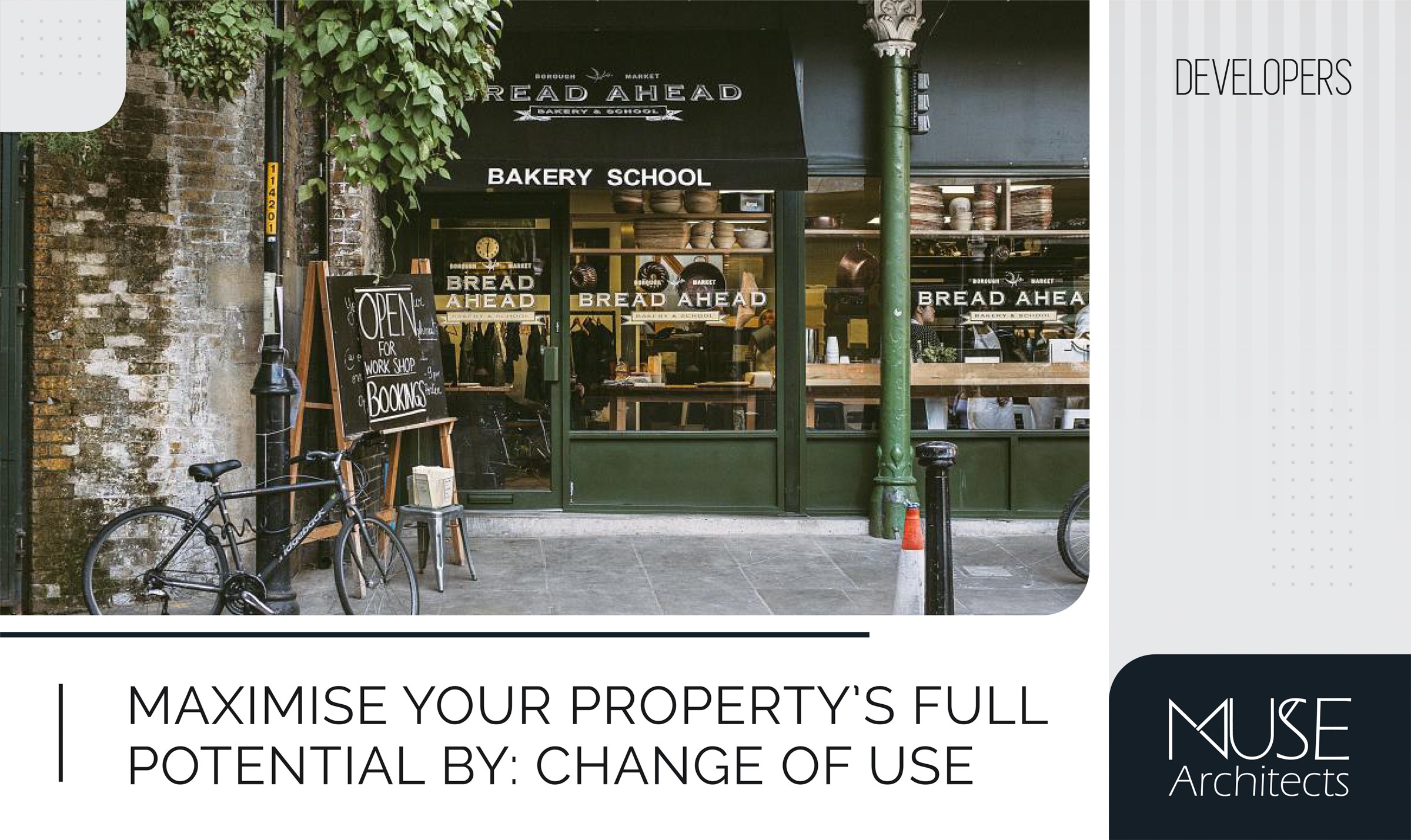
Maximise your Property’s Full Potential by: Change of Use

Unlocking the Potential of Property Change of Use Many landlords and landowners aspire to maximise the full potential of their properties through change of use. However, understanding how to promote or utilise your land effectively can be challenging. In this article, I will provide advice on how to unlock the potential of your property change. The UK Town and Planning Order Under the UK Town and Planning Order, land is categorised into four main ‘use classes’: Class A: This includes shops, financial and professional services, restaurants and cafes, drinking establishments (e.g., wine bars, public houses), and hot food takeaways. Class B: Buildings falling under this category include offices, industrial facilities, and open-air storage facilities. Class C: This class includes hotels, residential institutions, dwelling houses, and houses in multiple occupations (HMOs). Class D: This class comprises non-residential institutions, assembly and leisure houses. The Town and Country Planning (Use Classes) Order 1987 is a statutory order that applies in Wales and England. It outlines the various types of ‘Use Classes’ and the permissions required for land or buildings to change their use. It also establishes the necessary permissions needed to alter the use of a building from one use to another within the same class. As chartered, experienced architects and professional planners, we can help you navigate the UK planning system. It is possible to apply for a change of use without the necessary planning permission, using a system known as permitted development rights. As a leading architectural and planning firm, we assist in fully utilising permitted development rights. If permitted development rights are not applicable, we are available to guide you through the processes of obtaining planning permission. Securing Your Change of Use Planning Permission Obtaining planning permission for a change of use can be a daunting task due to the cumbersome process involved. Planning permission is the approval issued by your local authority to commence a proposed building project, ensuring that developments occur in appropriate areas. According to the National Planning Policy Framework, decisions on when and how planning permission should be issued are made in line with local planning policies. We have extensive experience working with London planning councils and understand the likely restrictions that may be imposed on your change of use application. Designing Your Ideal Change of Use Layout As experts in building and land permission planning, we have crafted a change of use design template to help you develop your design ideas. This template not only helps you create a design concept but also matches your requirements and taste. Whether you are converting from B1 to C3, B1 to D1, or C3 to C4, our templates cover these scenarios. We recognise that projects involving a change of use can be complex, but we manage the design process with your needs in mind. Planning permission may not be required when the existing and proposed uses fall within the same ‘use class’, or if the Town and Country Planning (General Permitted Development) (England) Order 2015 (as amended) allows for changes of use to another specified ‘use class’. This could apply to your property. Conclusion Once you secure planning permission for your change of use from the local authority, we proceed to the technical design and building phase, followed by monitoring the construction project and contract administration. This ensures that your design concept is transformed into reality. Get Free Advice Whether you’ve already purchased a commercial property or are searching for one, the best step is to talk to us as soon as possible. At Muse Architects, we provide complimentary consultations to help you understand the ins and outs of any potential project from the start. Our team offers expert advice on: Design Planning Building regulations Budgeting Programme Construction If you’re looking for a helping hand, book your free consultation today. About Muse We are your Residential and Commercial Architects At Muse Architects, we offer a wide range of local architectural services to clients in Manchester and beyond. From building control in Manchester to office design project management, our team of experienced architects has the skills and expertise to handle any project. Whether you’re looking for commercial building architects or residential architects near you, we’re here to help. As local architects, we understand the unique challenges and opportunities of designing buildings in Manchester. We specialise in Manchester residential architect services and work closely with clients to create beautiful, functional spaces. Our 3D property visualisation services, including 3D visualisation for city planning and interior design, are designed to help you bring your vision to life. Contact us today to learn more about how Muse Architects can help you achieve your architectural goals.

Property Developers

Working with Property Developers

Working with Property Developers Over the years, the property market has seen significant interest and investment from small to medium professional property developers. People are increasingly recognising that land is an appreciating asset, making it one of the highest Return on Investment (ROI) opportunities available. Real estate developers are individuals and companies that manage all activities involved in transforming ideas on paper into tangible assets (properties). Their responsibilities include buying land, financing real estate deals, and overseeing the development process from start to finish. In this article, I will explain what working with property developers entails. How Do You Work with Property Developers? Property developers, also known as real estate developers, are responsible for turning conceptual ideas into real property. The development process involves various professionals, including civil engineers, land and quantity surveyors, architects, and attorneys. The presence of these professionals highlights the extensive work involved in the development process. What Is Commercial Development? Commercial property developers, or real estate commercial developers, engage in purchasing and leasing commercial investments such as retail centres and industrial facilities. This sector encompasses diverse avenues and methods for generating profits through investments. Commercial property development typically involves three stages: 1. Site Selection and Evaluation Site selection and evaluation are the most critical decisions a property developer will make. The success or failure of a project largely depends on the approach taken during this stage. While many aspects of a commercial property development can be changed, the location cannot. New developers often make the mistake of purchasing cheap properties in non-marketable locations, believing they will eventually realise larger profits. 2. Property Flipping and Development Property flipping, often referred to as merchant development, involves developers who specialise in constructing buildings for near-term resale. Merchant builders typically sell properties shortly after they are completed, often within a year, to minimise the risks associated with long-term asset holding and to realise immediate profits. 3. Creating a Holding Strategy A proper holding strategy is essential for maximising ROI in a well-selected location. Many commercial property developers base their holding strategies on the length of lease terms they can secure. In real estate, longer lease terms often lead to greater patience before considering a sale. What Do Commercial Property Developers Want from Architects? Historically, property developers have not always enjoyed strong relationships with architects. Here are a few key qualities that developers look for before partnering with architects: Professionalism: Developers prefer to work with architects who have experience in the real estate industry. A strong professional rapport is more likely to develop with architects who are knowledgeable and competent. Team Spirit: The ability to collaborate effectively is crucial. The commercial development process requires a collective effort from all parties involved to achieve success. Experience: Practical, hands-on experience as an architect offers a significant advantage when working with property developers in the real estate sector. Conclusion At Muse Architects, we are committed to producing the highest quality, industry-leading designs for new build and refurbishment developments in both the residential and commercial sectors. Whether you are looking to unlock the potential value of land before acquisition, build an iconic new luxury apartment or mixed-use development, or provide essential new housing through a multi-unit residential scheme, our expert architects will maximise the gross development value of any site. We ensure the best possible return on investment while effectively managing the entire process.

Select the fields to be shown. Others will be hidden. Drag and drop to rearrange the order.
  • Image
  • SKU
  • Rating
  • Price
  • Stock
  • Availability
  • Add to cart
  • Description
  • Content
  • Weight
  • Dimensions
  • Additional information
Click outside to hide the comparison bar
Compare