
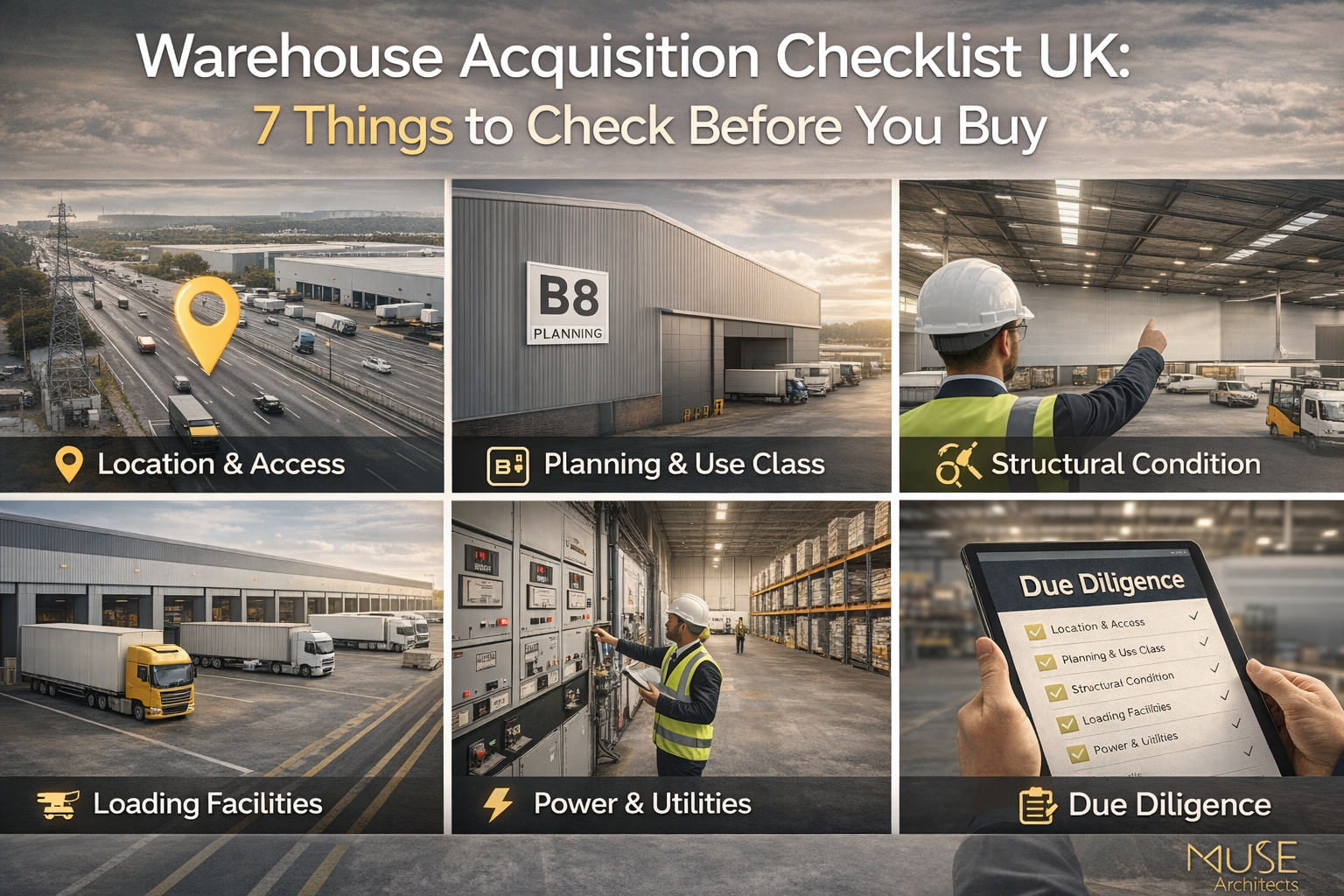
Warehouse Acquisition Checklist UK: 7 Things to Check Before You Buy
An empty warehouse often looks like a strong investment opportunity.
Large floor space, lower purchase price, and perceived flexibility can make industrial property appear attractive—especially to first-time buyers and investors.
But in reality, many warehouse investments fail because the fundamentals are not properly assessed.
The assumption that “empty space equals opportunity” is one of the most common and costly mistakes in warehouse acquisition in the UK.
The truth is simple:
A warehouse only has value if it works operationally, commercially, and within planning constraints.
Before considering redevelopment, design, or change of use, a structured warehouse acquisition checklist is essential.
At Muse, this is always the first step—testing whether a warehouse is viable before time and money are spent on drawings or legal work.
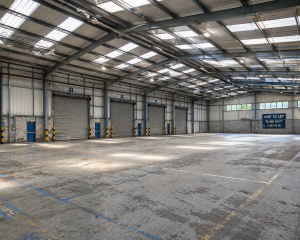
1. Lawful Use and Planning: The Foundation of Warehouse Investment
The first step in any warehouse due diligence in the UK is understanding lawful use.
It defines what the building can legally be used for and whether planning permission is required for any change.
This directly impacts:
- Development potential
- Change of use feasibility
- Investment risk
Planning applications are typically submitted through the Planning Portal
However, local planning policy is often the deciding factor. Some areas restrict changes from industrial use, particularly where employment land is protected.
To understand how planning decisions affect warehouse investment in the UK, our UK planning permission guide explains the process in detail
[Internal Link: /planning-permission-guide]
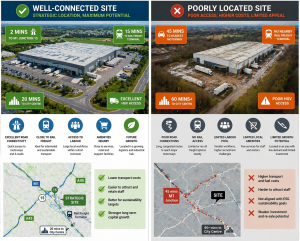
2. Location Analysis: The Key Driver of Warehouse Value
Location is one of the most important factors in any industrial property acquisition.
A warehouse in a poor location will struggle regardless of price or size.
You need to assess:
- Connectivity to major roads and transport routes
- Proximity to customers and supply chains
- Availability of workforce
- Local commercial demand
A low purchase price often reflects weak location fundamentals.
This is why location should always be evaluated alongside demand and long-term viability.
For a deeper understanding, our property investment strategies guide explains how location impacts returns and asset performance
3. Warehouse Access and Circulation: A Critical Operational Factor
Access is one of the most important elements in any warehouse feasibility checklist.
If vehicles cannot move efficiently, the building becomes difficult to use and less attractive to occupiers.
Key considerations include:
- Entry and exit points
- Turning space for HGVs and vans
- Internal circulation routes
- Safety of vehicle movement
Poor access can reduce lettability, affect planning approval, and limit operational efficiency.
In many cases, warehouse access constraints are the main reason assets underperform.

4. Yard Space and Site Layout: Where Warehouses Actually Work
Yard space is a defining factor in industrial property value.
It supports:
- Loading and unloading
- Vehicle manoeuvrability
- Parking and operational flow
A poorly designed yard can significantly reduce usability.
Common issues include:
- Insufficient space
- Poor layout
- Shared or conflicting usage
- Restricted access routes
Even a well-located warehouse can fail if the yard does not function properly.
This is why warehouse site layout and yard space should always be assessed before acquisition.
5. Power Supply and Infrastructure: A Hidden Constraint
Power capacity is a critical factor in modern warehouse investment.
Industrial occupiers increasingly require:
- High electrical capacity
- EV charging infrastructure
- Modern systems and equipment
Older warehouses often lack sufficient power supply, which can lead to costly upgrades.
This directly affects:
- Occupier suitability
- Operational capability
- Long-term asset value
Ignoring power constraints is a common mistake in warehouse due diligence.
6. Eaves Height and Building Specification: Flexibility and Demand
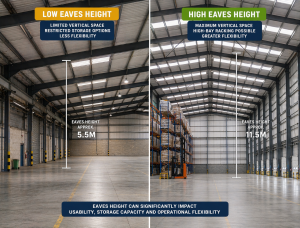
Eaves height is one of the simplest ways to assess warehouse quality.
Higher buildings offer greater flexibility and attract a wider range of occupiers.
Benefits of adequate height include:
- Efficient storage
- Modern logistics use
- Adaptability for alternative uses
Low eaves height reduces demand and limits potential uses.
This makes building specification a key factor in warehouse acquisition decisions.
7. Market Demand and Neighbouring Sensitivity
A warehouse must work within its wider context.
This includes both market demand and surrounding uses.
You need to assess:
- Local demand for industrial space
- Compatibility with neighbouring properties
- Potential noise or traffic issues
- Planning sensitivity
Even if the building works technically, external factors can limit its viability.
Understanding local demand and context is essential for any successful industrial property investment in the UK.
Why This Warehouse Acquisition Checklist Matters
Most investment mistakes happen before design begins.
Developers and investors often move too quickly into planning, drawings, and legal processes without properly assessing feasibility.
This leads to:
- Delays
- Unexpected costs
- Reduced returns
- Unviable projects
A structured warehouse feasibility checklist helps avoid these risks.
If you are also exploring alternative strategies such as residential or mixed-use, our HMO planning guide in the UK provides insight into planning routes and constraints.
How Muse Supports Warehouse Acquisition and Feasibility
A Planning-Led, Commercial Approach
Muse works with investors and owners to assess warehouse acquisition opportunities in the UK before commitments are made.
This includes:
- Planning and lawful use analysis
- Location and demand assessment
- Access and yard evaluation
- Building and infrastructure review
- Operational and commercial feasibility
Why This Approach Delivers Better Outcomes
Most failed investments are not obvious at the start—they become clear later.
By testing the fundamentals early, Muse helps clients avoid high-risk decisions and identify viable opportunities.
To see how this approach works in practice, you can explore Muse Architects.
Or if you want a direct review of a site, you can contact the team here
Conclusion: Warehouse Investment Is About Fit, Not Just Space
A warehouse is not valuable because it is empty—it is valuable because it works.
Successful warehouse investment in the UK depends on alignment between:
- Planning and lawful use
- Location and demand
- Access and layout
- Building capability
If these factors align, the opportunity is real.
If they do not, the risks increase significantly.
The key is understanding this before committing capital.
Call to Action
Before buying a warehouse, make sure the fundamentals are tested properly.
Send us the brochure and site plan—we will carry out a first-stage warehouse feasibility review and identify risks, constraints, and opportunities before you invest further.
Frequently Asked Questions About Warehouse Acquisition in the UK
What is a warehouse acquisition checklist?
A warehouse acquisition checklist is a structured way to assess planning, access, location, and building factors before investing.
What should I check before buying a warehouse in the UK?
You should review lawful use, location, access, yard space, power supply, building height, and local demand.
Why is warehouse access important?
Access determines how efficiently vehicles can operate, which directly impacts usability and tenant demand.
How does power supply affect warehouse investment?
Limited power can restrict usage and require costly upgrades, reducing overall value.
Is location more important than price?
Yes. A strong location supports demand and long-term value, while a cheap but poorly located asset often underperforms.