Why Office Layout Efficiency Decides Whether a Conversion Makes Money
Planning success alone doesn’t create value. Efficiency does.
Many developers approach office conversions with one primary goal: secure planning approval. While this is important, it is not what ultimately determines whether a project makes money.
The real difference between a high-performing scheme and a disappointing one lies in how efficiently the internal space is used. Two identical buildings with the same planning consent can produce completely different financial outcomes—simply because one layout works harder than the other.
In conversion projects, profitability is not just designed. It is calculated through efficiency.
Internal Efficiency Is the Real Value Driver
When working within an existing building, the external envelope is fixed. This means the opportunity to create value lies entirely inside.
Every square metre must justify its existence. The way space is organised determines how much of it can be sold, let, or monetised effectively.
The key factors that influence this include:
- Core positioning
- Corridor lengths
- Riser placement
- Window rhythm
- Unit configuration
These are not minor design decisions. They directly shape yield, unit quality, and overall return on investment.
Where Profit Is Won (or Lost)
1. Core Positioning

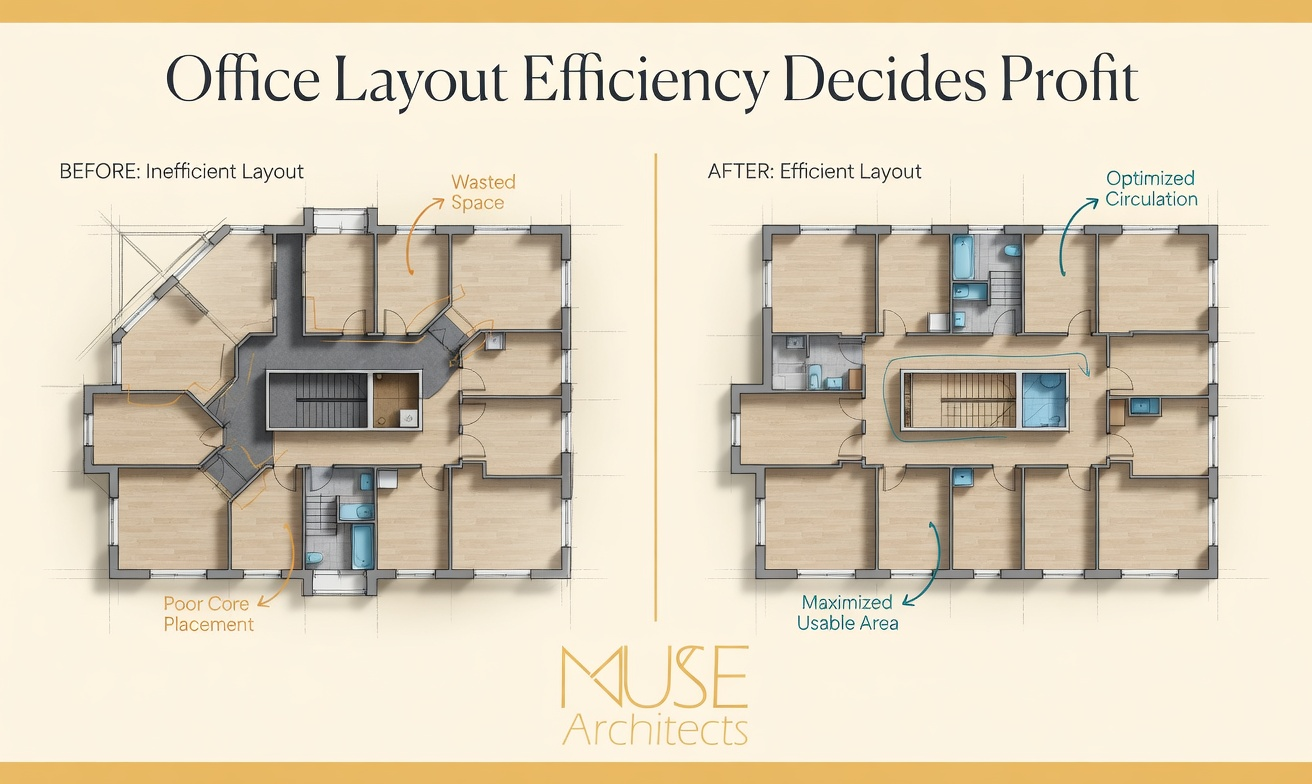
The building core—typically housing lifts, stairs, and essential circulation elements—acts as the structural and spatial anchor of the entire layout in any office-to-residential conversion. Its position has a direct and often underestimated impact on how efficiently the floor plate can be utilised. When the core is poorly located, it can break the continuity of the space, forcing longer and more complex circulation routes while limiting how units can be arranged around it. This often leads to fragmented layouts, reduced access to natural light, and inefficient use of valuable frontage.
In contrast, a well-positioned core allows the layout to function logically and cohesively. It enables a more balanced distribution of units, improves access to windows, and supports better proportions within each space. By aligning circulation efficiently, it reduces unnecessary movement areas and ensures that more of the floor plate can be converted into usable, revenue-generating space.
In practical terms, this results in reduced wasted space, more efficient and repeatable unit layouts, and a higher value per square metre—ultimately improving both the market appeal and financial performance of the entire development.
2. Corridor Lengths and Circulation
Corridors are essential for access, but they do not generate revenue. Every additional metre of corridor is space that cannot be sold or rented, yet still adds to construction cost.
In inefficient schemes, corridors often extend unnecessarily, creating dead zones and reducing net-to-gross efficiency. This directly impacts profitability.
Efficient layouts aim to:
- Minimise unnecessary circulation
- Maximise usable floor area
- Improve overall space efficiency
3. Riser Placement and Services Strategy
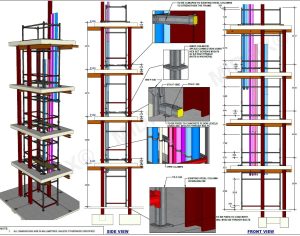
Service risers play a critical role in both layout efficiency and construction feasibility within office-to-residential conversions. When risers are poorly positioned, they impose rigid constraints on unit planning, often forcing inefficient layouts, increasing service run distances, and adding unnecessary complexity to the build process. This not only compromises spatial efficiency but also drives up construction costs and coordination challenges. In contrast, strategically aligned risers enable cleaner, more logical layouts that support consistent unit stacking and streamlined service distribution. This approach allows for more repeatable unit designs, reduces on-site complexity, and improves cost control throughout delivery—ultimately enhancing both the build efficiency and the overall financial performance of the scheme.
4. Window Rhythm and Unit Quality
Window placement is one of the most restrictive elements in any conversion. It determines where rooms can be located and how units are configured.
Ignoring window rhythm often leads to awkward layouts, poorly lit interiors, and reduced unit quality. Designing in alignment with existing windows creates more desirable, functional spaces.
Strong layouts achieve:
- Better natural light distribution
- Functional and marketable units
- Higher sales and rental values
Why Inefficient Layouts Destroy Value
Many office conversion schemes fail not because of planning constraints, but due to poor internal layout efficiency that undermines their commercial potential. Inefficient designs often introduce excessive dead space that adds no financial value, awkward room configurations that reduce usability, and lower-quality units that struggle to compete in the market. While such schemes may still achieve planning approval, their real weakness becomes evident at the point of sale or letting. Buyers and tenants ultimately respond to how a space feels and functions—prioritising natural light, layout flow, and usability over simple compliance. As a result, poorly designed layouts directly limit achievable values, weaken demand, and reduce the overall profitability of the development.
For a broader industry perspective on how space standards and design quality influence housing performance, you can refer to the UK Government Housing Design Guidance, which highlights the importance of efficient layouts and usable space in residential developments.
Good Architecture Extracts More Value From the Same Building
In conversion projects, architecture is not simply about appearance or securing planning approval—it is about unlocking the maximum commercial potential of an existing building. Since the external envelope remains fixed, the real opportunity lies in how efficiently the internal space is organised and utilised. Every design decision directly influences how much value can be extracted from the same structure.
The more efficient the layout, the stronger the overall performance of the scheme. This translates into higher unit yield, better-quality living spaces, and increased market competitiveness. In practical terms, efficient design does not just improve how a building looks—it enhances how it functions, how it sells, and ultimately how much return it generates.
How Smart Developers Approach This
Experienced developers do not commit to a layout too early. Instead, they test multiple options before progressing with planning.
This allows them to:
- Compare different yield scenarios
- Identify inefficiencies early
- Optimise layouts before design commitment
- Avoid costly revisions later
This early-stage thinking is what separates high-performing schemes from average ones.
How Muse Architects Protects Your Profit
At Muse Architects, the focus is not just on getting projects approved—it is on ensuring they perform financially.
Through early test-fit studies, multiple layout options are explored before committing to a scheme. This process highlights inefficiencies, improves unit yield, and prevents costly mistakes.
By analysing layouts at the right stage, clients are able to make informed decisions and avoid pursuing strategies that look viable—but underperform in reality.
Explore more here:
Musearchitects.co.uk/services
Musearchitects.co.uk/change-of-use
Musearchitects.co.uk/blog
The Bottom Line
Two developers can work with the same building and achieve completely different outcomes.
One delivers a profitable, high-performing scheme.
The other is left with compromised layouts and reduced returns.
The difference is not planning approval.
It is layout efficiency.
Call to Action
Before committing budget to any conversion scheme, it is critical to understand how efficiently the building can perform.
Ask for a quick test-fit study before committing to a scheme budget.
That one step can turn a good opportunity into a highly profitable one.
FAQs
What is office layout efficiency?
It refers to how effectively internal space is used to maximise saleable or lettable area while minimising wasted space.
Why is layout efficiency important in conversions?
Because it directly impacts profitability, unit quality, and overall return on investment.
How do inefficient layouts reduce profit?
They create dead space, poor-quality units, and lower market appeal, reducing achievable value.
What is a test-fit study?
An early-stage layout analysis that tests different configurations to find the most efficient and profitable option.
Does planning approval guarantee a profitable project?
No. Profit depends on how efficiently the internal layout is designed and executed.