
The Architect’s Role in Property Development – UK 2026 Guide

Section 1: Introduction – Why Architects Matter in Property Development
Property development in the UK is far more than bricks and mortar. It demands seamless integration of creative vision, strategic planning, regulatory compliance, cost management, sustainability, and risk mitigation — all within an increasingly complex legal and environmental landscape.
In 2026, with tightened planning rules, evolving Building Regulations, and heightened focus on building safety post-Grenfell, the architect’s role in property development has never been more strategic. Far beyond aesthetics, RIBA-qualified architects act as key advisors who translate developer ambitions into viable, approvable, and profitable projects.
Architects help developers by:
- Converting ideas into buildable, compliant designs
- Navigating the planning system and securing approvals
- Embedding Building Regulations compliance from the outset
- Enhancing sustainability credentials and market appeal
- Minimising risks that could delay or derail projects
References:
- Gov.uk – Planning overview: https://www.gov.uk/browse/planning-permission
- Planning Portal – Planning & Building Regulations: https://www.planningportal.co.uk/
Section 2: The State of UK Construction and Development (2026)
The UK construction sector continues to show resilience amid economic pressures. Latest Office for National Statistics (ONS) data indicates that annual construction output grew by 1.8% in 2025, with monthly output rising 0.2% in January 2026. Public sector infrastructure investment remains a key stabiliser, while private housing shows cautious recovery supported by new planning reforms expected to take fuller effect later in 2026 and into 2027.
Developers must carefully factor in:
- Rising material and labour costs (BCIS reports tender prices up 0.7% quarter-on-quarter in Q1 2026, with a 2.8% annual increase)
- Persistent supply chain challenges
- Ongoing planning policy shifts (including the Planning and Infrastructure Act)
- Stricter sustainability and net-zero standards
Section 3: What Is Property Development?
Property development involves enhancing land or existing buildings to create higher economic or social value. The typical process includes:
- Site acquisition
- Feasibility and appraisal
- Concept and detailed design
- Planning application and approvals
- Regulatory compliance (including Building Regulations)
- Procurement and construction
- Handover, occupation, and post-completion review
H3 – Role of Architects
Architects play a pivotal role across both early strategic phases (feasibility, concept, planning) and technical delivery (detailed design, construction oversight). Their involvement aligns with RIBA Plan of Work stages and helps ensure projects meet client goals while satisfying local authority, safety, and environmental requirements.
Section 4: The Architect’s Role in Concept Design
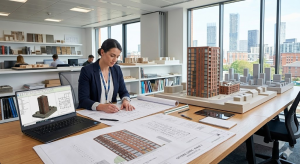
In the earliest stages, architects interpret the developer’s brief by balancing:
- Client objectives (e.g., rental yields, sales values, use class requirements)
- Site-specific context (amenity, noise, access, topography)
- Local planning policies (density limits, height restrictions, design guidelines)
They produce initial concept sketches, 3D massing models, and basic layouts. Using BCIS benchmarking data, architects can quickly test feasibility against realistic build costs per m², helping developers avoid pursuing unviable schemes.
Section 5: Feasibility & Early Appraisal
Feasibility studies are critical to de-risk projects. Architects lead or coordinate:
- Review of local and national planning policy
- Assessment of site constraints (flood risk, heritage assets, contamination, ecology)
- Preliminary cost estimates and value engineering options
- Iterative design testing
By integrating early input from environmental consultants, structural engineers, and utilities providers, architects help identify and mitigate issues before they become expensive problems.
Section 6: Planning Permission Basics
Most significant developments require planning permission from the local authority. Key considerations include:
- Proposed land use and compliance with the local plan
- Design quality and impact on neighbouring properties
- Environmental and heritage effects
- Transport, parking, and infrastructure implications
Architects prepare high-quality planning applications, including detailed drawings, Design & Access Statements, and supporting reports. Professional architectural input significantly improves approval prospects.
Section 7: Planning Portal & Submission Process
The Planning Portal remains the primary online gateway for UK planning and building control submissions. Architects routinely use it to:
- Submit applications electronically
- Upload drawings, statements, and technical reports
- Calculate and pay fees
- Track application progress
This digital process streamlines coordination and reduces administrative delays.
Section 8: Planning Decisions & Appeals
Local planning authorities aim to determine applications within 8–13 weeks (longer for major schemes). If refused or conditioned unfavourably, options include:
- Amending and resubmitting the scheme
- Appealing to the Planning Inspectorate
Architects play a vital role in both routes by refining designs to better align with policy and preparing robust appeal statements.
Note on 2026 reforms: New elements of the Planning and Infrastructure Act are beginning to influence processes, with expectations of faster, more predictable decisions for certain smaller and self-build schemes emerging later in 2026.
Section 9: Building Regulations – What They Are
While planning permission addresses land use and external impact, Building Regulations ensure the building itself is safe, energy-efficient, and accessible. Core areas in 2026 include:
- Fire safety (Approved Document B – including updated sprinkler and staircase requirements)
- Energy efficiency and carbon reduction (Part L)
- Accessibility (Part M)
- Structural integrity and drainage
Architects embed these requirements into designs from day one.
Section 10: Building Safety & High-Risk Buildings
The Building Safety Act 2022 continues to reshape construction in 2026. Higher-risk buildings — generally over 18 meters or seven storeys — face enhanced oversight from the Building Safety Regulator (BSR), which became fully independent in January 2026.
Key requirements for these buildings include:
- Comprehensive fire strategies and clear means of escape
- Maintaining a golden thread of information throughout the building lifecycle
- Demonstrated competence across the entire design and construction team
Architects often take a leading role in ensuring compliance with these safety standards for complex developments. Learn more from HSE / Building Safety.
Section 11: Architect as Principal Designer (CDM 2015)
Under the Construction (Design and Management) Regulations 2015, a Principal Designer must be appointed to manage health and safety risks during pre-construction. Architects often fulfil this role, coordinating:
- Design risk assessments
- Integration of safety measures
- Clear communication to contractors
This responsibility highlights the strategic importance of architects in modern property development. Full guidance is available at CDM 2015 Guidance.
Section 12: Detailed Design & Technical Documentation
Once planning is secured, architects prepare comprehensive technical packages that include:
- Full construction drawings and schedules
- Material and workmanship specifications
- Coordination with structural, M&E, and specialist engineers
- Detailed fire, accessibility, and sustainability provisions
These documents form the foundation for accurate tendering, on-site quality control, and project success.
Section 13: Cost Estimating & BCIS Data
Architects use BCIS construction cost data to:
- Benchmark costs per square metre against similar projects
- Provide early-stage cost certainty
- Undertake value engineering to stay within budget
With tender prices rising modestly in early 2026, this data-driven approach is essential for financial planning and project viability. For reference, see BCIS.
Section 14: Procurement & Tendering Support
Architects advise on the most suitable procurement route, whether traditional, design & build, or two-stage tendering. Support includes:
- Preparing tender documentation and drawings
- Clarifying design intent for bidders
- Evaluating submissions for compliance, quality, and value
This guidance helps developers select contractors effectively and ensures that design intent is maintained throughout construction.
Section 15: Construction Administration

During the build phase, architects typically undertake contract administration duties, including:
- Regular site inspections and progress monitoring
- Responding to contractor queries (RFIs)
- Reviewing work against approved drawings
- Assessing and approving variations or changes
This oversight helps maintain design quality and control costs.
Section 16: Sustainability & Energy Performance
In 2026, sustainability is a commercial imperative as well as a regulatory one. Architects integrate:
- Passive design strategies for energy reduction
- Low-carbon and sustainable materials
- BREEAM, NABERS, or similar environmental assessments
- Future-proofing for net-zero operation
Section 17: Post Completion & Handover
Architects support the final stages by providing:
- As-built drawings and the “golden thread” of information
- Snagging and defects liability inspections
- System commissioning verification
- Comprehensive client handover documentation
Section 18: How Architects Add Commercial Value
A skilled architect enhances project outcomes through:
- Superior design that commands higher rents or sale prices
- Proactive risk management around planning and regulations
- Intelligent cost control using BCIS data
- Stronger sustainability credentials that appeal to occupiers and investors
In short, early and continuous architectural involvement typically delivers better returns and fewer costly surprises.
Section 19: Common Misconceptions About Architects
H3 – Misconception 1: Architects only draw
Truth: They function as strategic planners, regulatory experts, coordinators, and value engineers throughout the entire development life cycle.
H3 – Misconception 2: Architects increase costs
Truth: Professional input reduces overall risk, prevents expensive redesigns or rework, and often improves long-term value and efficiency.
H3 – Misconception 3: Small projects don’t need architects
Truth: Even modest schemes must comply with planning and Building Regulations. Early architectural advice frequently saves time and money on all project scales.
Section 20: Case Study – Muse Architects in Property Development
Muse Architects, a Manchester-based practice specialising in residential and commercial projects across the North West, exemplifies the modern architect’s role in property development. The firm works closely with developers from feasibility through to delivery, offering planning-led design, masterplanning, and technical support that aligns schemes with local policies while maximising commercial outcomes.
Their hands-on approach — combining creative concept work with rigorous regulatory navigation — helps clients de-risk sites, secure timely approvals, and deliver high-quality, marketable developments. Practices like Muse demonstrate how regionally focused architects can provide tailored expertise that large national firms sometimes overlook, making them valuable partners for both small-scale and larger mixed-use schemes.
Section 21: FAQs – Common 2026 Questions
Q – Do I need an architect to submit a planning application?
A – While not legally mandatory, professional architectural drawings and a well-prepared Design & Access Statement significantly increase the chances of approval.
Q – What is the difference between planning permission and Building Regulations?
A – Planning permission concerns land use, design impact, and policy compliance. Building Regulations focus on the technical safety, performance, energy efficiency, and accessibility of the building itself.
Q – How long does planning permission take in 2026?
A – Typically 8–13 weeks for standard applications, though major schemes or those requiring consultation may take longer. Reforms aim to improve predictability.
Q – Can architects handle building control submissions?
A – Yes. Architects prepare the necessary technical documents and often coordinate submissions and approvals with building control bodies or the BSR for higher-risk projects.
Q – When should I hire an architect?
A – As early as the feasibility stage. Early involvement maximises value, identifies constraints quickly, and prevents costly changes later.