Muse Architects

Industrial Commercial architecture office Manchester

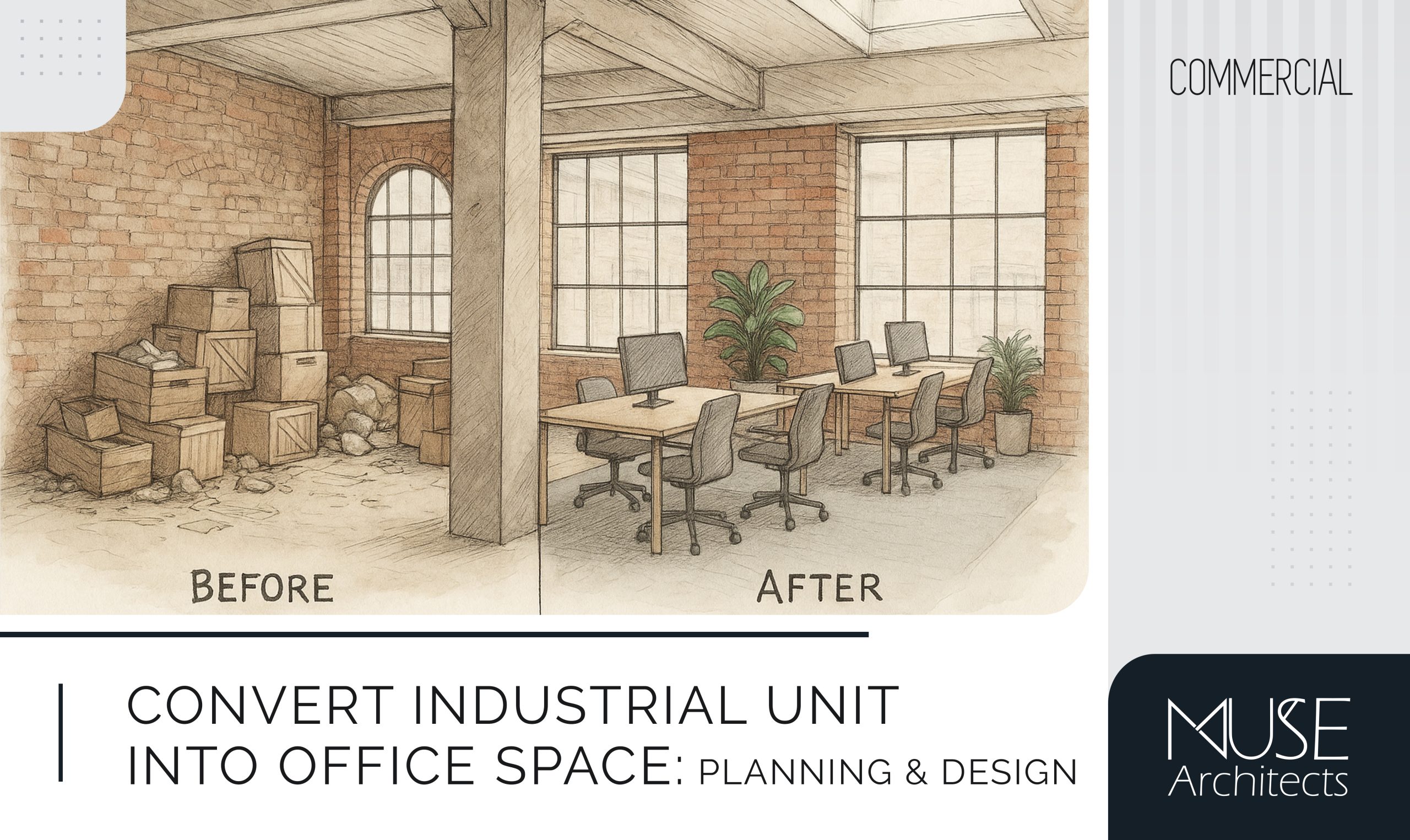
Convert Industrial Unit into Commercial Offices

Summary The North West of England is witnessing renewed interest in converting older industrial and warehouse buildings into vibrant, sustainable, and modern office spaces. For businesses aiming to upskill their teams and create productive environments, these conversions offer a unique opportunity. This article outlines the architectural and planning approach required to transform such buildings, covering planning frameworks, sustainable design principles, material considerations, and how to optimise daylight and occupant wellbeing. Aimed at professionals and business leaders, it offers detailed insights while concluding with strategic recommendations for a successful conversion project. 1. Introduction: Why Industrial-to-Office Conversion Makes Strategic Sense As businesses adapt to hybrid work models and seek more sustainable practices, industrial-to-office conversions are gaining traction. These schemes revitalise underutilised assets, reduce embodied carbon compared to new builds, and allow businesses to configure spaces aligned with their operational and cultural needs. Architects play a central role in shaping these conversions, not just aesthetically, but in terms of regulatory compliance, spatial planning, and long-term usability. 2. Planning Context: UK Policy and North West Local Guidance 2.1 General Permitted Development Rights (GPDR) and Use Class Order The Use Class Order (amended 2020) merged offices (formerly B1) and light industrial (B1c) into Use Class E, which allows greater flexibility in planning. However, prior approval is still needed in many conversions under Permitted Development (PD), especially if significant external alterations are proposed. 2.2 Local Authority Planning in the North West Each local authority (e.g., Manchester, Liverpool, Stockport, Bolton) has its own local plan, sustainability targets, and urban regeneration priorities. Key planning considerations include: Parking and transport access Flood risk assessments (particularly in lower-lying industrial zones) Noise impact on adjacent residential properties Conservation or heritage overlays if the building or location is sensitive Engagement with planning officers early via a pre-application process is essential.   3. Architectural Considerations in Converting Industrial Units 3.1 Site Appraisal and Constraints An in-depth appraisal includes assessing: Structural integrity of steel or concrete frames Roof condition and insulation Eaves height and suitability for mezzanine insertions Natural daylight potential (rooflights, wall openings) Existing services infrastructure (power, water, HVAC) 3.2 Internal Space Planning Modern offices need to accommodate: Collaborative zones Quiet workstations Breakout areas Accessibility (DDA compliance) The original layout of an industrial unit is typically open plan, which gives architects freedom but also challenges in achieving acoustic comfort and thermal efficiency. 3.3 External Appearance and Streetscape Impact Retaining industrial character (e.g., exposed steel, loading bay doors) can enhance appeal. However, interventions like curtain walling, new glazing, and entrances must balance function with planning acceptability. 4. Daylight and Design for Wellbeing Daylight is a key challenge in converting deep-plan industrial buildings. Strategies include: Roof lanterns or sawtooth skylights Enlarged window openings, subject to planning Courtyards or lightwells if depth allows Daylight not only enhances wellbeing but reduces reliance on artificial lighting. Offices must meet minimum daylighting standards in the British Standard BS EN 17037, particularly where the converted space is expected to host long-stay desk workers. 5. Sustainable Design Strategies 5.1 Embodied Carbon and Retrofitting Benefits Adaptive reuse drastically lowers embodied carbon compared to demolition and rebuild. Retaining the frame and envelope where possible should be prioritised. 5.2 Operational Energy and Part L Compliance Thermal upgrades are essential to meet Part L (Conservation of Fuel and Power) of the Building Regulations: Insulated cladding upgrades High-performance glazing Efficient HVAC systems Air-tightness improvements Photovoltaic panels, battery storage, and heat pumps can further enhance energy profiles. 5.3 BREEAM and WELL Standards For companies pursuing accreditation, early design decisions are key to achieving BREEAM Excellent or WELL Gold ratings. Factors include: Indoor air quality monitoring Water efficiency Use of low-VOC materials 6. Materiality: Blending Industrial Heritage with Contemporary Use Material choices often determine the success of an industrial-to-office conversion. The approach should celebrate the building’s past while aligning with modern office aesthetics and performance needs. Recommended materials: Exposed brickwork: For warmth and texture Steel and timber composites: For visual contrast Reclaimed materials: For sustainability Modern cladding: In neutral tones to lift dated facades Acoustic panels, polished concrete floors, and natural timber finishes can create a modern yet grounded workspace. 7. Navigating Regulatory Compliance Besides planning and Part L, other key regulations include: Part M: Accessibility for all users Part B: Fire strategy, particularly in mezzanine additions or multi-tenanted layouts CDM Regulations 2015: Health and safety responsibilities from design stage onwards Asbestos Surveys: Crucial in older industrial buildings Early engagement with Building Control ensures regulatory pathways are clear and cost risks are minimised. 8. Going Back to the Office: Designing for Post-Pandemic Needs The office is no longer just a workplace; it’s a social hub, brand expression, and productivity enabler. As such, conversions should embrace: Flexibility for future layout changes Generous breakout areas Strong visual identity and biophilic elements Quiet pods and video call booths Mechanical ventilation and smart lighting systems are now baseline expectations. 9. Procurement and Construction Strategy Industrial-to-office conversions may uncover unforeseen challenges (e.g., slab levels, contamination). A flexible, phased procurement strategy helps mitigate risks. Design and Build: Speeds up delivery but may limit design control Traditional Contracting: Allows detail refinement but requires active project management Two-Stage Tendering: Useful in live environments or phased projects A Principal Designer must be appointed early under CDM. About Muse We are your Residential and Commercial Architects At Muse Architects, we offer a wide range of local architectural services to clients in Manchester and beyond. From building control in Manchester to office design project management, our team of experienced architects has the skills and expertise to handle any project. Whether you’re looking for commercial building architects, residential architects near you, or specialists in industrial conversions, we’re here to help. We specialise in residential and commercial new builds as well as industrial-to-office conversions. We work closely with clients to create beautiful, functional spaces tailored to their needs. Our 3D property visualisation services—including 3D visualisation for city planning and interior design—are designed to help bring your vision to life. Want to explore the potential of your existing site? Our architectural
Muse Architects - How National Planning Policy Framework Works

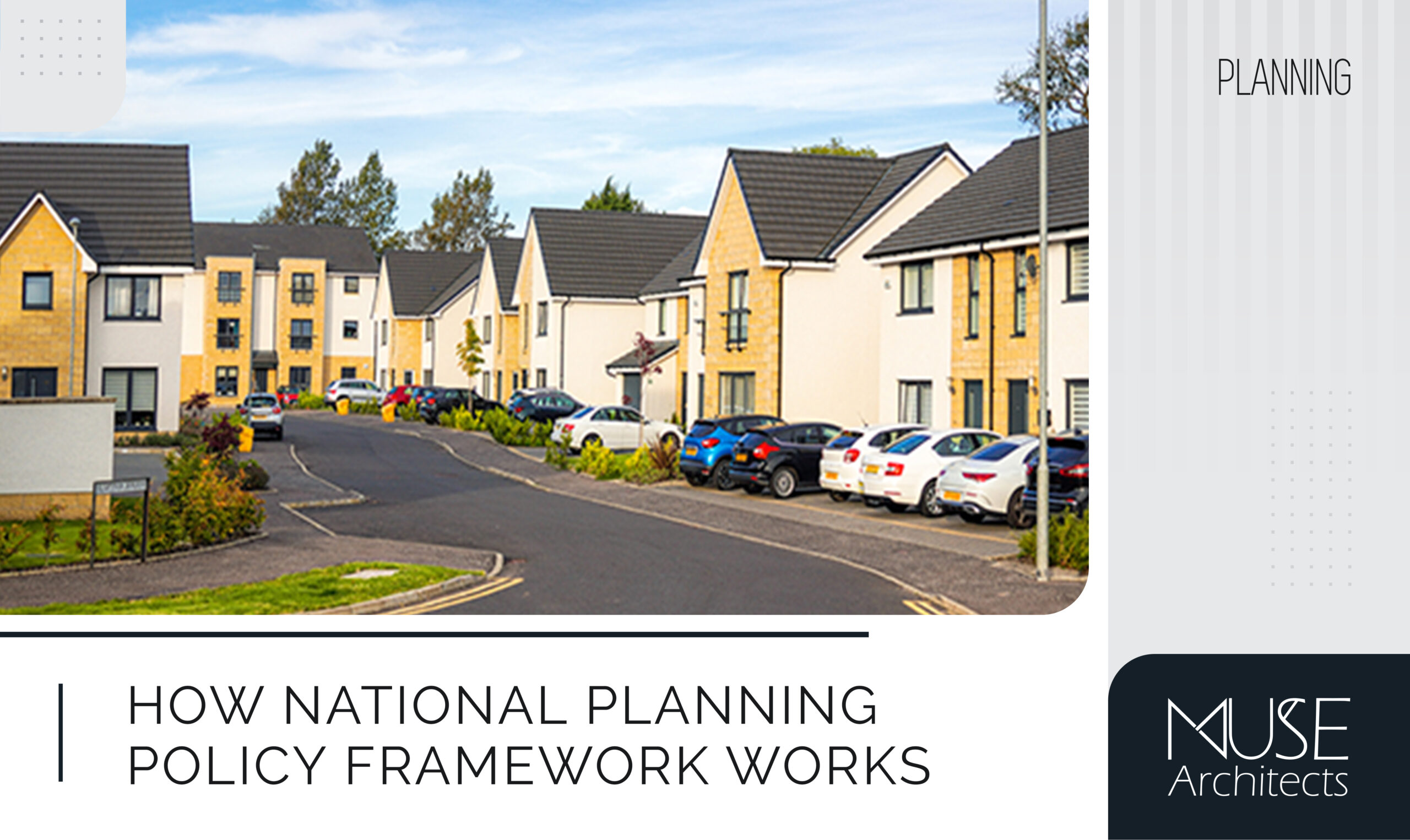
How National Planning Policy Framework Works

The Role of the National Planning Policy Framework (NPPF) in Sustainable Development Introduction The National Planning Policy Framework (NPPF) sets out the government’s policies for the economy, environment, and land use planning in England. Since its introduction in March 2012, it has replaced a range of planning policy statements and guidance. The NPPF ensures that decisions made in planning applications align with sustainable development principles. This essay explores the NPPF’s role in achieving sustainable development, its approach to local plans, and its impact on neighbourhood planning. Sustainable Development The NPPF affirms that the aim of the planning system is to contribute to sustainable development. Development projects that demonstrate sustainability should not face delays in approval. The framework promotes sustainability by reducing dependence on unsustainable structures and encouraging practices that foster a prosperous rural economy, a strong competitive economy, and sustainable transport. It also advocates for high-quality housing, the protection of green belt land, the promotion of healthy communities, sustainable mineral use, conservation of the historic environment, and proactive measures against climate change and flooding. Local Plans The NPPF mandates that local plans must align with its principles and policies, particularly the presumption in favour of sustainable development. Local plans should include strategic policies addressing job creation, housing needs, climate change mitigation, and infrastructure provision. These plans must be based on up-to-date and relevant data. Neighbourhood Planning According to the NPPF, neighbourhood plans should support the broader development strategy of the area. They should not promote less development or undermine strategic objectives. Instead, they should focus on reshaping development outside the main elements of local plans. Neighbourhood plans must adhere to national policy and guidance, ensuring they are generally consistent with the NPPF. Conclusion The NPPF plays a crucial role in ensuring that land use planning in England contributes to sustainable development. It outlines government policies on the economy, environment, and land use, promoting high-quality housing, green belt protection, and climate change action. It also requires local plans to be consistent with its principles and supports neighbourhood planning that aligns with the NPPF framework. Understanding the NPPF’s role is essential for effective property development and land use planning in England. How Muse Architects Can Help At Muse Architects, we recognise the critical role architects play in designing and developing buildings and spaces. We understand the importance of operating within the framework of the NPPF to achieve sustainable development. Our team is well-versed in the NPPF’s policies and principles. We ensure our designs comply with local and national planning regulations, conducting thorough research to understand the local planning context. This knowledge allows us to create buildings and spaces that align with local priorities. We believe architects have a responsibility to engage with local authorities and communities, ensuring our designs meet the needs of the people they serve. We consult with stakeholders and incorporate feedback into our proposals. Collaborating with other professionals, such as planners and engineers, ensures our designs are well-integrated within development projects. At Muse Architects, we are passionate about creating well-designed, sustainable buildings that meet community needs. Whether it’s a new build or a renovation, our architects are dedicated to delivering high-quality designs that exceed client expectations. If you are looking for architects in Manchester with a deep understanding of the NPPF’s policies, strong research and analytical skills, and the ability to collaborate effectively, contact Muse Architects today to learn more about our services and how we can help you achieve your development goals.

Housing Multiple occupancies

Planning For Houses Of Multiple Occupancy (HMO)

Understanding Housing in Multiple Occupations (HMO) Housing in multiple occupations, commonly referred to as HMOs, describes a situation where a house is let out to a minimum of three individuals forming two or three households. The occupants share common facilities such as a kitchen, bathroom, and toilet. For a house to be classified as an HMO, it must be the primary or only residence of the tenants. In this post, I will explore and explain what HMOs entail. What is the Design of an HMO? If you plan to build a house of multiple occupations, employing professional architectural services is essential. As a potential HMO owner, understanding the layouts and design patterns of various HMOs is beneficial. An HMO should include several key features. Typically, bathrooms and kitchens are shared areas for all occupants, along with other common spaces such as gardens and staircases. HMOs are commonly divided into self-contained flats, bed-sitting rooms, and simple lodgings. How to Obtain an HMO Licence Obtaining an HMO licence is not as straightforward as some may think. HMOs are popular among buy-to-let investors due to their potential for high income within a short time frame. The high-income potential of HMOs makes them appealing to investors looking at buy-to-let properties. Converting a single property into smaller units with separate tenancy agreements can help landlords minimise losses from unpaid rent. Licensing is generally classified into three categories: 1. Mandatory Licensing for Large HMOs This licence is required for large HMOs where there are a minimum of five tenants from at least two households. This requirement is applicable nationwide for HMOs with five or more occupants and two or more households. However, this licence does not apply to flats situated in a building containing four or more self-contained flats. 2. Additional Licensing Additional licensing may be imposed by a council requiring other sizes of HMOs to be licensed. 3. Selective Licensing Selective licensing allows the borough to decide on licensing at their discretion. This can affect all rental properties, regardless of size, number of storeys, or tenant count. Before granting a licence, the local authority must ensure that the landlord and any managing agent are fit to hold a licence and that the property meets the required physical standards. Licences are granted when: Necessary fire safety measures, such as smoke detectors and extinguishers, are in place. Annual gas safety checks are up to date. Electrical wiring and appliances are certified safe by an expert for the next three years. The property is not overcrowded. Communal and publicly used areas are kept clean and well-maintained. Appropriate refuse storage and disposal facilities are available. Once granted, the licence must be displayed in the communal areas. The procedures for obtaining an HMO licence can vary by country. Strict laws in countries like Ireland, the USA, and the UK outline the licensing process. Therefore, it is advisable to conduct thorough research and consult relevant agencies for guidance on obtaining an HMO licence. Conclusion Owning one or several HMOs can be a significant asset, generating consistent income. Always ensure you have the correct licence from the appropriate authority to operate an HMO. If you need architectural services to help you achieve your goals, please get in touch—our team would be delighted to assist. About Muse We are your Residential and Commercial Architects At Muse Architects, we offer a wide range of local architectural services to clients in Manchester and beyond. From building control in Manchester to office design project management, our team of experienced architects has the skills and expertise to handle any project. Whether you’re looking for commercial building architects or residential architects near you, we’re here to help. As local architects, we understand the unique challenges and opportunities of designing buildings in Manchester. We specialise in Manchester residential architect services and work closely with clients to create beautiful, functional spaces. Our 3D property visualisation services, including 3D visualisation for city planning and interior design, are designed to help you bring your vision to life. Contact us today to learn more about how Muse Architects can help you achieve your architectural goals.

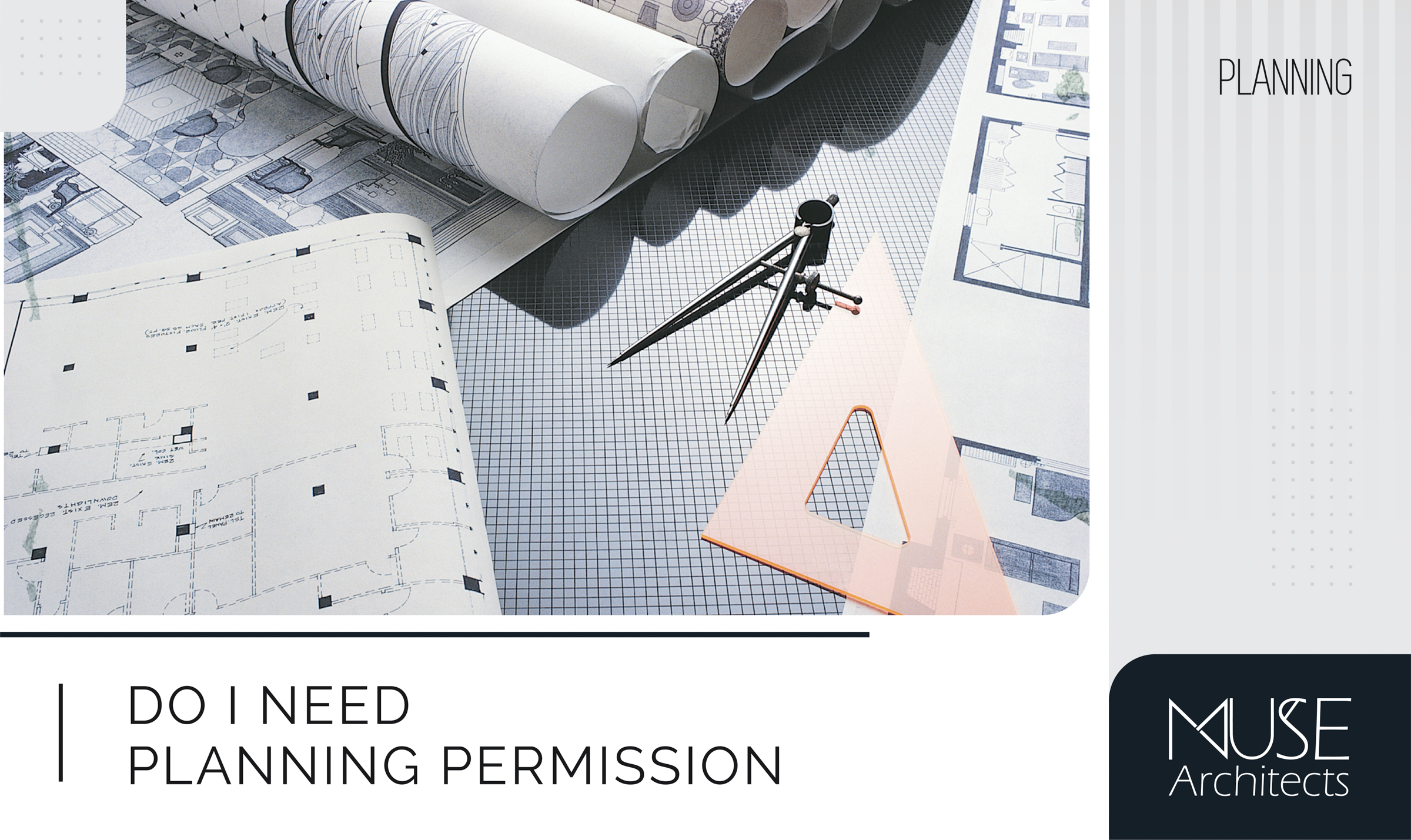
Do I Need Planning Permission

Do I Need Planning Permission?

Navigating Planning Permission for Your Property Extension Obtaining planning permission to extend your property into your dream home can be frustrating, given the various procedures involved. Planning regulations are complex, and if not carefully understood, they can lead to pitfalls. It’s essential to know that you need planning permission for major architectural changes to your UK building, as well as for erecting new structures. Failure to secure the necessary planning permission can result in an enforcement notice, requiring you to remove any changes made. Understanding the ins and outs of planning permission and the types of changes it affects is crucial, although this can be daunting for many. In this post, I will outline the building projects that require a permit and how the process of obtaining one in the UK typically flows. Changes and Their Planning Permission Requirements Generally, significant changes to a building’s architecture will necessitate obtaining a permit. However, some major changes aimed at improving the building do not require permission. Below are common changes and their requirements: Extensions If you plan to add an extension to your home, this is usually considered permitted development. However, the extension must not cover more than half the land around the original house (curtilage) and must not exceed the height of the existing roof. Specifically, the extension shouldn’t be more than eight metres for a detached house and six metres for other houses above the rear wall. Additionally, the materials used should match the appearance of the existing house. Garages and Outbuildings Extensions to garages, sheds, greenhouses, and other outbuildings are generally considered permitted development. You can extend these structures without requesting planning permission, as long as the extension does not exceed four metres in height and does not cover more than half the land. Paving Over Garden You do not require planning permission for paving your garden, regardless of size, as long as non-porous materials are not used. However, if impermeable materials cover more than five square metres, planning permission will be needed. Doors and Windows Repairing or replacing windows or doors typically does not require planning permission. However, if your property is listed, you will need listed building approval and building control approval for window changes. External Walls and Roof Minor repairs or modifications to your walls and roof, such as painting or fixing a skylight, do not require planning permission. However, if you live in a conservation area or an area with significant vegetation, you will need permission to make changes. Wind Turbines and Solar Panels Temporary wind turbines do not require planning permission, but permanent installations do. The installation of solar panels generally does not require a permit. Fences, Gates, and Walls Extensions to fences, walls, or gates usually require planning permission, especially if changes are over one metre close to the road or two metres away from a boundary with a listed building. Trees and Hedges Trees and hedges are protected by tree preservation orders, meaning you will need permission to trim them, especially in conservation areas. However, you can reduce a hedge if it becomes a nuisance without needing permission. Indoors Most interior renovations, such as garage conversions, new staircases, bathrooms, kitchens, or rewiring, do not require planning permission. How to Get Planning Permission Planning permission can be a significant hurdle for homeowners. According to the Annual Homeowner Survey conducted in 2019, 27% (4.7 million people) experienced issues relating to planning permission while trying to renovate their homes. To avoid setbacks, consult a good planning advisor to understand local planning restrictions, targets, and priorities. They can help tailor your design to meet legal requirements. Alternatively, you can schedule an appointment with your local planning authority before submitting your application. Bring your proposal, including current floor plans and the proposed new design. During the meeting, seek feedback on your plan, ask about potential issues such as traffic and noise, and discuss site-specific matters like roads, footpaths, watercourses, sewers, and telephone lines. Conclusion Obtaining planning permission can be challenging, but by following the correct procedures, you can save yourself considerable trouble in the long run. Ensuring your planning drawings are accurate in scale and clearly demonstrate how the extension will affect its surroundings is crucial for a smooth approval process.

Planning Permission Process

Planning Application Process Explained

Understanding the Planning Permission Process If you want to carry out development, you need planning permission. The department responsible for the approval of development is your Local Planning Authority (LPA). To obtain permission, you must submit an application to your LPA. Interestingly, not all developments require planning permission. Let’s explore the planning permission process. Developments That Do Not Require Planning Permission Typically, minor changes to residential buildings may not require planning permission. If you’re unsure whether your intended development needs permission, visit your LPA’s website for clarification. In this article, we will outline the steps involved in the planning application process. Who Can Apply? You can apply for planning permission yourself, or you can appoint a planning consultant, architect, or surveyor to do it for you. This is advisable because detailed plans are required for the application, and a professional is best suited for this task. You can also apply for planning permission for land you do not yet own. However, it’s recommended that you establish an agreement with the landowner to purchase or lease the land before applying to prevent others from using the planning permission you have worked to obtain. When filling out a planning application form, you will need to sign different certificates depending on land ownership: Certificate A: If you are the sole owner of the land. Certificate B: If you are not the landowner but know all the owners. Certificate C: If you know some, but not all, of the landowners. Certificate D: If you do not know any of the landowners. How to Apply To apply, you need to fill out the planning permission application form, which you can obtain from the LPA website. Applications are submitted electronically through the Planning Portal or the LPA’s website. After submitting your application, your LPA must determine if it contains all the necessary plans and documents for evaluation. Once your application is certified as valid, the local authority will send you or your representative a formal acknowledgement, including a reference number for your application. It typically takes at least eight weeks for your local authority to grant or reject your application. For major applications, this process may take 13 to 16 weeks. After applying, the local authority will inform the public by advertising in newspapers, notifying neighbours, and placing a notice at the site. Before making a decision, the LPA needs to consult various agencies and bodies, such as the Highways Agency and the Parish Council. What Are The Planning Conditions? If your planning permission application is granted, it will often come with conditions. Common conditions may require you to commence work within a specified timeframe. All conditions imposed by your local authority must be justified concerning their relevance to planning and development. What to Do If Your Application Is Rejected If your application is disapproved, it is often because the proposal does not comply with planning policies. Your local authority will issue a refusal notice stating the valid reasons for the rejection and how it conflicts with planning policies. In this case, you can modify your application and resubmit it. If you resubmit your modified application within 12 months of the previous decision, you will not need to pay another application fee. However, if you wish to appeal the decision, you can do so within six months of the initial decision. The Planning Inspectorate handles such cases. Conclusion The process of applying for planning permission can be lengthy. However, with this article as a guide, you can better understand the application process and how to navigate any potential challenges.

refused planning Application

What To Do If Planning Application is Refused?

Understanding Refused Planning Applications The planning process can be lengthy and complicated, often not yielding the desired results. If your application is refused, it’s essential to understand why and what steps to take next. This post outlines how to deal with a refused planning application. Options After a Refusal When you learn that your application has issues, communication is key. Your architect should regularly seek updates, address any issues raised by planners promptly, and inquire about any additional requirements needed to gain support. Often, applications are refused simply because architects did not update the submitted plans as requested by the planning officer. If your application is rejected, you have several options: Accept the Decision: Sometimes it may be best to accept the refusal. Amend Your Application: Make changes to your application to address the reasons for refusal. Withdraw and Resubmit: You can withdraw your application and submit a new one. Appeal the Decision: If you believe the refusal was unjust, you can appeal the decision. What Happens When You Get a Refusal? When your planning permission is refused, you will receive a written notification detailing the reasons for the decision. If you disagree with these reasons, you can request that the Planning Inspectorate review your case. If the reasons for refusal are clear, you can submit a modified application free of charge, addressing the issues outlined. Conversely, you may also appeal to the First Secretary of State if the local authority does not reach a decision within eight weeks or if you receive no communication about a delay. Appeal Process In England, appeals against planning decisions should be directed to the Planning Inspectorate. They will review your case file and make a final decision, which may take up to 23 weeks. You can appeal in the following situations: Your planning permission was refused. Your planning permission was granted, but you object to the attached conditions. Your planning permission was refused after having been approved previously. You did not receive a decision on your application within eight weeks and were not informed of any delays. You received an enforcement notice from the local authority that you wish to contest. Planning Breach A planning breach occurs when you carry out development without the necessary planning permission. If you proceed without approval, the local authority may serve you an enforcement notice. However, if a breach occurs due to a refused application, the authority can issue an enforcement notice. Before concluding a planning breach, the local authority will assess whether the development negatively impacts public amenities. If you receive an enforcement notice, you must comply unless you have submitted an appeal. Conclusion If your application is refused, it’s important to understand your options. Contact us for assistance in investigating the reasons for the refusal. A refusal may highlight specific issues that can be addressed in a new application. If you need planning advice, do not hesitate to reach out to our experienced team. For more information on appealing a planning decision, visit the GOV.UK website.

How to choose the right Architect for your project

How To Choose The Right Architect for Your Project

Choosing the Right Architect for Your Project Every client is unique, and the same applies to designers and architectural practices. Not all architects will suit every client for various reasons, such as budget constraints, the scope of work, or the size of the practice. Some designers may lack the experience to handle larger home extensions or new builds, while others might only work on projects of a certain scale. This is why it is crucial to choose the right architect for your project. Sourcing Multiple Quotes We always recommend that clients source at least three quotes from builders; similarly, you should consider multiple designers. By meeting and speaking with different architects, you can gauge who best suits your needs. Initial Planning Questions When you begin planning a home extension, you will likely have numerous questions. This is entirely normal, which is why selecting the right architect is vital. They should be able to provide comprehensive answers to your queries, instilling confidence from the outset. Most designers and architects offer a free initial consultation. During this meeting, consider asking the following questions: Questions About Design Design Approach: Don’t hesitate to ask the designer what they would do. A competent designer should be able to share ideas based on their experience. Planning Regulations: Inquire about what is permissible under planning regulations. It’s important to know from the start if your design may face planning issues. Permitted Development: Understand the difference between planning permission and permitted development. Not all works require full planning consent. For more information, the government’s Planning Portal is a good resource. Timescales: How long does the design process take? What about planning and building regulations timescales? How long will it take to find the right builder? How long will the construction take? Estimated Build Costs: Your architect should discuss your budget and ensure it aligns with the proposed design. Importance of the Initial Consultation The initial consultation is crucial; it’s your opportunity to assess who you will be working with throughout the project. It’s essential that you feel comfortable and can trust your designer. This choice will significantly impact your project’s success. Our Experience As a commercial and residential architectural practice, we are always looking forward to the next project. We enjoy the diversity of our work, whether it’s conducting feasibility studies, detailing drawings for building regulations, or completing various types of projects—from house extensions to office conversions. Residential Architects If you are looking for residential architects and want to explore what is achievable on your site, or if you need plans for a loft conversion or house extension, please don’t hesitate to get in touch. We welcome all inquiries and are here to inspire you, making your vision a reality.

Changes To Planning Permission 2020

Changes To Planning Permission 2020

Changes to Planning Permission 2020 On 6th August 2020, two significant consultation documents were released: the ‘Planning for the Future’ and ‘Changes to the Current Planning System’ White Papers. These outline extensive reforms to the planning system in England. Throughout the COVID-19 pandemic, there have already been several changes to rules regarding change of use and permitted development rights (PDRs), with more planning policy changes anticipated. In this article, we’ll explore these changes and explain how Muse Architects can help you navigate through them. Overview of Proposed Changes For some time, the Government has indicated its intention to implement radical changes to the planning system in England. The pandemic prompted immediate adjustments to certain planning policies, such as allowing pubs to offer hot food takeaway services. However, substantial changes aimed at creating a more suitable system for the 21st century are being discussed in the ‘Planning for the Future’ White Paper. Key Points from the Planning White Paper The ‘Planning for the Future’ white paper outlines several proposed changes: Enhanced Community Consultation: Local communities will be consulted from the very beginning of the planning process, utilising online maps and data to make the system more accessible. Protection of Green Spaces: Valued green spaces will be preserved for future generations, with a focus on building on brownfield land and ensuring new streets are tree-lined. Faster Housing Development: Local housing plans are to be developed and agreed upon within 30 months, significantly reducing the current timeframe of up to 7 years. Local Plans for All Areas: Every area will be required to have a local plan in place; currently, only 50% of local areas have one. Overhaul of the Planning Process: The planning system will be replaced with a clearer, rules-based framework, addressing the fact that around one-third of planning cases that go to appeal are overturned. Simplified National Levy: A new national levy will replace the current system of developer contributions, which often causes delays. Fast-Track System for Beautiful Buildings: A system will be established for fast-tracking beautiful buildings while providing local design guidance. Zero Carbon Ready Homes: All new homes will need to be ‘zero carbon ready’, ensuring no new homes delivered under the new system require retrofitting to achieve net-zero carbon emissions by 2050. Criticism of the Proposed Changes The proposals have faced significant criticism. Victoria Hills, Chief Executive of the Royal Town Planning Institute (RTPI), expressed concerns about the “planner bashing rhetoric” and argued against sweeping away the planning system. Alan Jones, President of the Royal Institute of British Architects, acknowledged the need for reform but described the proposals as “shameful.” Detailed Changes to the Current Planning System The ‘Changes to the Current Planning System’ document addresses important aspects such as assessing housing numbers, delivering first homes, and supporting small and medium-sized developers. The consultation period for ‘Planning for the Future’ runs until 29th October 2020, and the proposals aim to eliminate the piecemeal and ad hoc fixes that have characterised the planning system since 1947. Moving Forward These significant changes will impact all aspects of planning permission and permitted development. While it may take time to fully understand their implications, adaptation is essential. At Muse Architects, we are ready to assist you with your development, regardless of its location, type, or size. Give us a call, and let us help you navigate these new planning changes effectively.

Planning Permission

Common Questions about Planning Permission

Understanding Planning Permission Making changes to a property can be a lot of work. Before starting any development, it’s essential to determine if you need planning permission. The process of applying for planning permission can be intimidating, so it’s important to understand the key aspects before you apply. What is Planning Permission? Planning permission is the approval from your local authority for any significant structural changes to your building. While major changes require a planning application, minor developments, such as loft conversions or conservatories, are often considered permitted development and may not need planning permission. How to Obtain a Planning Permit Many people ask how to get planning permission to build a house. While the process may be time-consuming, it is worth the wait. You can choose to apply through your local authority or online via the Planning Portal. The first step is to contact your local planning department for advice. After receiving guidance, you can apply online, submitting all required documents and fees. The local authority will validate your application, after which a planning officer will make a decision and contact you if any documents are missing. Costs of Planning Permission The fees for planning applications vary depending on the nature of the development. You can calculate the specific costs using the government’s Planning Portal. Planning Conditions If your application is granted, pay attention to the planning conditions outlined in the approval letter. These conditions, set by the planning authority, must be adhered to during construction. To discharge these conditions, you will need to apply formally and receive confirmation; failing to do so will invalidate your approval. Application Format A planning application typically includes the following: Five copies of the application forms A signed ownership certificate A site plan A block plan Elevations of existing and proposed sites A Design and Access statement The application fee You can withdraw your application at any time before a decision is made and reapply free of charge. Timeline for Planning Permission Once validated, the local authority will provide a target date for the decision, which usually takes 8 to 12 weeks. Validity of Planning Permission A planning application remains valid for three years from the decision date. If construction has not started within this period, you will need to reapply. What If Planning Permission is Refused? If your application is refused, the first step is to understand the reasons for the refusal. You can then either reapply or appeal to the planning inspectors while addressing the issues raised. Risks of Not Having Planning Permission If you proceed with building without planning permission, the local authority has the right to demolish or alter the structure you have built, regardless of the time and money spent. It is far better to be safe than sorry. Who Can Apply for Planning Permission? You can apply for planning permission if you have the necessary documents. However, hiring a planning consultant can save you time and effort, as they are well-versed in the latest planning rules. Muse Architects Muse Architects cover all of the North West, including Cheshire, Greater Manchester, Liverpool, and surrounding areas. Let us support you with your project; schedule a free consultation call today!

Select the fields to be shown. Others will be hidden. Drag and drop to rearrange the order.
  • Image
  • SKU
  • Rating
  • Price
  • Stock
  • Availability
  • Add to cart
  • Description
  • Content
  • Weight
  • Dimensions
  • Additional information
Click outside to hide the comparison bar
Compare