Muse Architects

Change of Use

Who we are Change of Use Planning Permission Architects Muse Architects supports property owners, developers, and investors with planning-led architectural services for change of use planning permission across the  Manchester .We evaluate site potential, planning constraints, and regulatory requirements before design decisions are made, helping clients understand development viability early in the process. Our approach combines planning strategy, architectural design, and technical assessment to guide conversions from feasibility through submission. Whether transitioning between commercial, residential, or mixed uses, we prepare compliant proposals aligned with local authority expectations and development objectives. Book Free Feasibility Review Muse how can we ​help? Understanding Change of Use Planning Permission Buildings and land are categorised under planning use classes, which determine how they may be legally used. A change of use occurs when a property shifts from one category to another — for example from office to residential or retail to mixed-use. Depending on the proposal, approval may require planning permission, prior approval, or confirmation that permitted development rights apply. Planning Policy & Regulatory Considerations To make a successful shift of usage, you need to know about policy frameworks, development goals, and technical requirements. Authorities look at the effects on transportation, the environment, the quality of life, and how well the new building fits in with the neighborhood. We take these things into account early on in the architectural process to make it more likely that the project will get approved and to lower the possibility of having to alter it later on. planning permission Muse Architect delivers expert commercial and residential planning services, guiding applications from concept to approval with confidence. Architectural Design Muse Architect delivers thoughtful architectural design, transforming ideas into practical, well-crafted spaces. Interior Design We create considered interior designs that balance functionality, aesthetics, and the way spaces are experienced. Master Planning We provide master planning solutions for commercial and residential developments, creating cohesive layouts that support long-term growth and usability.    Change of use Change of Use Architectural Services Commercial to Residential Conversions Before investing in design, conversion potential is assessed by evaluating daylight compliance, geographical feasibility, and policy alignment. Retail & Mixed-Use Adaptation Assessment of accessibility, infrastructure implications, and planning limitations to delineate feasible redevelopment trajectories. Prior Approval Applications Preparing paperwork for allowed development routes when they are eligible, which includes checking eligibility and coordinating submissions. Technical Compliance & Drawings  Making planning drawings, regulatory documents, and coordinating with consultants to make sure that legal criteria are met.    Where Spaces Inspire, and Design Comes Alive Started In 2009 Planning-Led Architectural Approach High-Quality Residential & Commercial Design Experienced Manchester Architects Free Feasibility Study for New Projects We offer imaginative architectural solutions for difficult residential and commercial locations all around Manchester. We do this by combining our knowledge of planning, design, and project feasibility. More About Us


Muse Partners

Partners Muse Architecture Recommended Partners This directory is intended to help clients identify specialist consultants and delivery partners. Listings are published with partner consent; clients may contact partners directly using the links provided. Disclaimer; Listings are provided for convenience only. Clients should undertake their own due diligence. Any appointment is a direct contract between the client and the relevant partner; Muse Architects accepts no responsibility for third-party services. F&T Terrix F&T Terrix supplies resilient Terrix polymer silicate building fabrics for UK new-build and restoration projects; renders, spray plaster, paints, brick slips and related systems. Offers contractor-focused technical advice… Learn More JAK Construction JAK Construction delivers tailored residential construction in Cheadle Hulme, Cheshire, from small works to new build. Services include house extensions, loft conversions, renovations, knock-throughs, roofing, kitchens and bathrooms… Learn More DEP Landscape Architecture Manchester-based landscape architecture studio supporting public realm and residential environments from concept through delivery. Scope typically includes masterplanning support, levels and materials coordination, planting strategy… Learn More Planit-IE North West landscape and urban design practice delivering public realm, regeneration and placemaking projects at scale. Supports feasibility, planning and technical stages; aligning movement, identity, maintenance and stakeholder needs… Learn More SpaceInvader Design Manchester interior design studio delivering workplace, hospitality and culture-led interiors. Strong at concept-to-technical progression; materiality, joinery intent, lighting coordination and procurement-ready packages… Learn More North Made Studio Architectural visualisation studio producing high-quality CGI, animation and marketing visuals for planning and stakeholder engagement. Effective where design changes need fast, accurate updates without losing realism. Helpful for retrofit narratives… Learn More PixelFlakes Architectural visualisation studio specialising in high-quality CGI imagery and animation for the built environment. Focused on visualising the unbuilt, they work closely with architects and developers to create clear, atmospheric visuals that communicate design… Learn More Sheila Bird Studio Manchester-based interior architecture practice delivering high-quality, brand-led spaces. Known for strong concept, coherent materials and detail development; with buildable outputs that support procurement and delivery… Learn More Domis Construction Manchester-based main contractor delivering residential, mixed-use and urban developments. Known for accessible leadership and a collaborative pre-construction approach, providing technical clarity and practical solutions… Learn More Seddon Long-established North West contractor delivering new build, refurbishment, retrofit and property services across housing and other sectors. With experienced pre-construction input including planning and procurement and active engagement… Learn More PJA Transport planning and highways consultancy supporting development from feasibility through approvals and detailed design. Typical scope includes access and servicing strategy, parking management, technical notes and authority… Learn More Astute Transport Planning Independent transport planning consultancy supporting development planning and delivery. Advises on access, servicing, parking and transport statements/assessments; with pragmatic negotiation… Learn More Ward Williams Associates Built environment consultancy providing cost management, programme support and project management. Helps maintain commercial viability through cost plans, procurement strategy and disciplined change control… Learn More Magnitude QS Chartered quantity surveying and construction consultancy supporting cost planning, tendering and contract administration. Strong on scope definition, package alignment and variation control. Suitable for interface-heavy projects where clear… Learn More Delva Patman Redler Specialists in daylight/sunlight analysis and rights of light for complex urban development. Supports planning submissions, design optimisation and neighbour risk… Learn More Anstey Horne Rights of light and neighbourly matters consultancy supporting developers and design teams from early feasibility to delivery. Provides technical assessment, negotiation support and clear mitigation options. Learn More BB7 Specialist fire safety consultancy supporting complex buildings, including high-rise and refurbishment programmes. Advises on fire strategy, façade risk and compliance pathways… Learn More Alt Fire Engineering Fire engineering practice providing strategy and compliance support across new build and retrofit. Experienced in stakeholder engagement and evidence-led design; supporting planning, design development and delivery queries… Learn More Renaissance Associates Manchester engineering consultancy offering civil, structural and geotechnical services from due diligence to delivery. Strong fit for refurbishment constraints where pragmatic… Learn More HBL Associates Civil and structural engineering consultancy supporting development teams with coordinated engineering design and delivery-stage input. Provides practical advice across structures, drainage and technical coordination… Learn More GLD Technical Consulting Building services engineering consultancy supporting architects, clients and contractors with MEP strategy and coordinated design. Useful where refurbishment, compliance and performance constraints must be balanced with programme and cost… Learn More S I Sealy & Associates Building services engineering practice supporting MEP design, coordination and compliance across residential, commercial and healthcare. Helps resolve services interfaces and deliver workable solutions from concept through detailed design… Learn More Lighthouse Acoustics Acoustic consultancy providing environmental acoustics, internal acoustic design and testing coordination. Supports noise impact, façade sound performance and resident amenity targets… Learn More Hepworth Acoustics Acoustics consultancy supporting noise and vibration assessments, façade performance advice and verification testing. Provides practical guidance aligned with procurement and construction… Learn More Wintech Group Multi-discipline engineering group providing specialist technical support across building performance-related services. Useful where envelope performance, technical assurance or complex interface resolution is required on tall or refurbishment schemes… Learn More N D Oliver & Co Chartered surveying practice providing measured surveys and reality capture; including laser scanning and point cloud outputs. Critical on refurbishment projects where accurate as-built data reduces unknowns, rework and disputes. S Learn More Where Spaces Inspire, and Design Comes Alive Started In 2009 Planning-Led Architectural Approach High-Quality Residential & Commercial Design Experienced Manchester Architects Free Feasibility Study for New Projects We offer imaginative architectural solutions for difficult residential and commercial locations all around Manchester. We do this by combining our knowledge of planning, design, and project feasibility. More About Us
Free Feasibility Study

Assessing your Project Free Feasibility study for property development in Manchester Understand what a development site can actually achieve before you commit to purchase costs, design fees, planning submissions, or financing. At Muse Architects, we specialise in planning-led feasibility studies and site viability assessments that help serious property developers make informed decisions, minimise risk, and avoid costly mistakes Planning feasibility insight Site viability review Early risk identification Commercial-focused clarity Book Free Feasibility Review Feasibility Study What Is a Property Development Free Feasibility A property development feasibility study is an early, strategic assessment that evaluates whether your site is viable, deliverable and worth pursuing before investing further time or money. It is more than a basic report. It provides: Planning risk assessment Site viability evaluation Development potential analysis Strategy guidance for next steps Unlike a business plan, which outlines how you intend to build or manage a project, a feasibility study tests whether the project makes sense to build in the first place. A comprehensive feasibility review helps you: Identify obstacles early Test assumptions Minimise investment risk Make confident decisions based on planning reality Book Free Feasibility Review Feasibility Study why do you need a feasibility study? Why Conduct a Feasibility Study Before Development? Most development problems occur before construction starts and they are often avoidable. So we are offering free feasibility report . Here’s why a feasibility study is essential: Avoid Planning Surprises Save Money & Time Measure True Development Potential Reduce Downside Risk   Get in Touch Help how can we ​help? How Muse Architects Helps With Free Feasibility We at Muse Architects look at feasibility the same way planners do: by looking at your site through the eyes of local authority regulations, policy restrictions, and commercial realism. Our Feasibility Process Includes:  Reviewing planning policies and analyzing restrictions  Assessing the site’s context and location   Estimating the development potential and unit count   Identifying planning risks   Considering strategic choices and future actions   Looking at the commercial viability perspective   What You Actually Get  Looking over planning rules and figuring out what they mean  Figuring out how many units can be built and how much they will cost Finding risks in planning   Thinking about strategic options and what to do next   From the point of view of business viability We don’t make design drawings right now. This is just planning-led analysis to keep risks under check and make development apparent. Request a Free Feasibility Review Where Spaces Inspire, and Design Comes Alive Started In 2009 Planning-Led Architectural Approach High-Quality Residential & Commercial Design Experienced Manchester Architects Free Feasibility Study for New Projects We offer imaginative architectural solutions for difficult residential and commercial locations all around Manchester. We do this by combining our knowledge of planning, design, and project feasibility. More About Us Feasibility Study Feasibility Before You Buy? Why It Makes Sense to Do Feasibility Before Buying a Site The best developers look at viability before buying land. A feasibility analysis before you buy helps you: Don’t spend too much for a site that isn’t very useful Find out about planning limits early Make your negotiating position stronger Choose a strategy before spending money Lower the chance of planning refusals after buying This preemptive approach might save tens of thousands or perhaps hundreds of thousands of dollars in lost income. Get in Touch Feasibility Study How Muse Architects Helps With Free Feasibility We at Muse Architects look at feasibility the same way planners do: by looking at your site through the eyes of local authority regulations, policy restrictions, and commercial realism.Our Feasibility Process Includes: Reviewing planning policies and analyzing restrictions Assessing the site’s context and location Estimating the development potential and unit count Identifying planning risks Considering strategic choices and future actions Looking at the commercial viability perspective At this point, we don’t make design drawings. This is only planning-led analysis for the purpose of controlling risk and making development clear. Book Free Feasibility Review
Terms & Conditions

Muse Architects LtdWebsite Terms of Use Last updated: 1 March 2026 PLEASE READ THESE TERMS CAREFULLY BEFORE USING THIS WEBSITE. These Website Terms of Use (together with the documents referred to in them) set out the terms on which you may use this website (the “Site”), whether as a guest or otherwise. Use of the Site includes accessing, browsing, and submitting an enquiry via the Site. By using the Site, you confirm that you accept these terms and agree to comply with them. If you do not agree to these terms, you must not use the Site. Other applicable terms These terms refer to the following additional terms, which also apply to your use of the Site: Our Privacy Notice (which explains how we collect, use and protect personal data); and Our Cookie Notice and Cookie Policy (which explains how cookies and similar technologies are used on the Site). If there is any inconsistency between these terms and the Privacy Notice or Cookie Policy, the relevant Privacy Notice or Cookie Policy will apply to that specific subject matter. Information about us This Site is operated by Muse Architects Ltd (referred to as “we”, “us” or “our”). We are an architectural practice trading as “Muse Architects Ltd”. Address: 455 Chester Rd; Old Trafford; Stretford; Manchester M16 9HA Email: Mail@MuseArchitects.co.uk Company number: 12131252; Registered in England and Wales. Changes to these terms and the Site We may revise these terms at any time by amending this page. Please check this page from time to time; the updated terms will apply from the date they are posted. We may update the Site from time to time and may change the content at any time. Content may be out of date at any given time; we are under no obligation to update it. We do not guarantee that the Site, or any content on it, will be free from errors or omissions. Accessing the Site The Site is made available free of charge. We do not guarantee that the Site, or any content on it, will always be available or uninterrupted. Access to the Site is permitted on a temporary basis. We may suspend, withdraw, discontinue or change all or any part of the Site without notice. We will not be liable to you if for any reason the Site is unavailable at any time or for any period. You are responsible for making all arrangements necessary for you to have access to the Site; and for ensuring that all persons who access the Site through your internet connection are aware of these terms and comply with them. Where parts of the Site are protected by reCAPTCHA or similar services, the relevant provider’s privacy policy and terms of service may also apply. User accounts and security (where applicable) Where the Site provides login functionality, any user identification code, password or other security information must be treated as confidential and must not be disclosed to any third party. We may disable any user identification code or password at any time if, in our reasonable opinion, you have failed to comply with these terms. If you know or suspect that anyone other than you knows your login details (where applicable), please notify us promptly using the contact details in section 2. Intellectual property rights We are the owner or the licensee of all intellectual property rights in the Site and in the material published on it. Those works are protected by copyright and other intellectual property laws; all such rights are reserved. You may print off one copy, and may download extracts, of any page(s) from the Site for your personal use; you may also draw the attention of others within your organisation to content posted on the Site. You must not modify the paper or digital copies of any materials you print off or download; and you must not use any illustrations, photographs, video or audio sequences, or any graphics separately from any accompanying text. Our status (and that of any identified contributors) as the authors of content on the Site must always be acknowledged. You must not use any part of the content on the Site for commercial purposes without obtaining a licence to do so from us or our licensors. If you print off, copy or download any part of the Site in breach of these terms, your right to use the Site will cease immediately; you must, at our option, return or destroy any copies of the materials you have made. No reliance on information The content on the Site is provided for general information only. It is not intended to amount to advice on which you should rely. You should obtain appropriate professional or specialist advice before taking, or refraining from, any action on the basis of the content on the Site. Although we make reasonable efforts to update the information on the Site, we make no representations, warranties or guarantees, whether express or implied, that the content on the Site is accurate, complete or up to date. Limitation of liability Nothing in these terms excludes or limits our liability for death or personal injury arising from our negligence; or for fraud or fraudulent misrepresentation; or for any other liability that cannot be excluded or limited by English law. To the extent permitted by law, we exclude all conditions, warranties, representations or other terms which may apply to the Site or any content on it, whether express or implied. We will not be liable to any user for any loss or damage, whether in contract, tort (including negligence), breach of statutory duty, or otherwise, arising under or in connection with: (a) use of, or inability to use, the Site; or (b) use of or reliance on any content displayed on the Site. If you are a business user, we will not be liable for loss of profits, sales, business or revenue; business interruption; loss of anticipated savings; loss of business opportunity, goodwill or reputation; or any indirect or consequential loss

Retrofit

Tailored design services for private homes, including room makeovers and complete home transformations.

Masterplanning

Tailored design services for private homes, including room makeovers and complete home transformations.

Industrial Commercial architecture office Manchester

Convert Industrial Unit into Commercial Offices

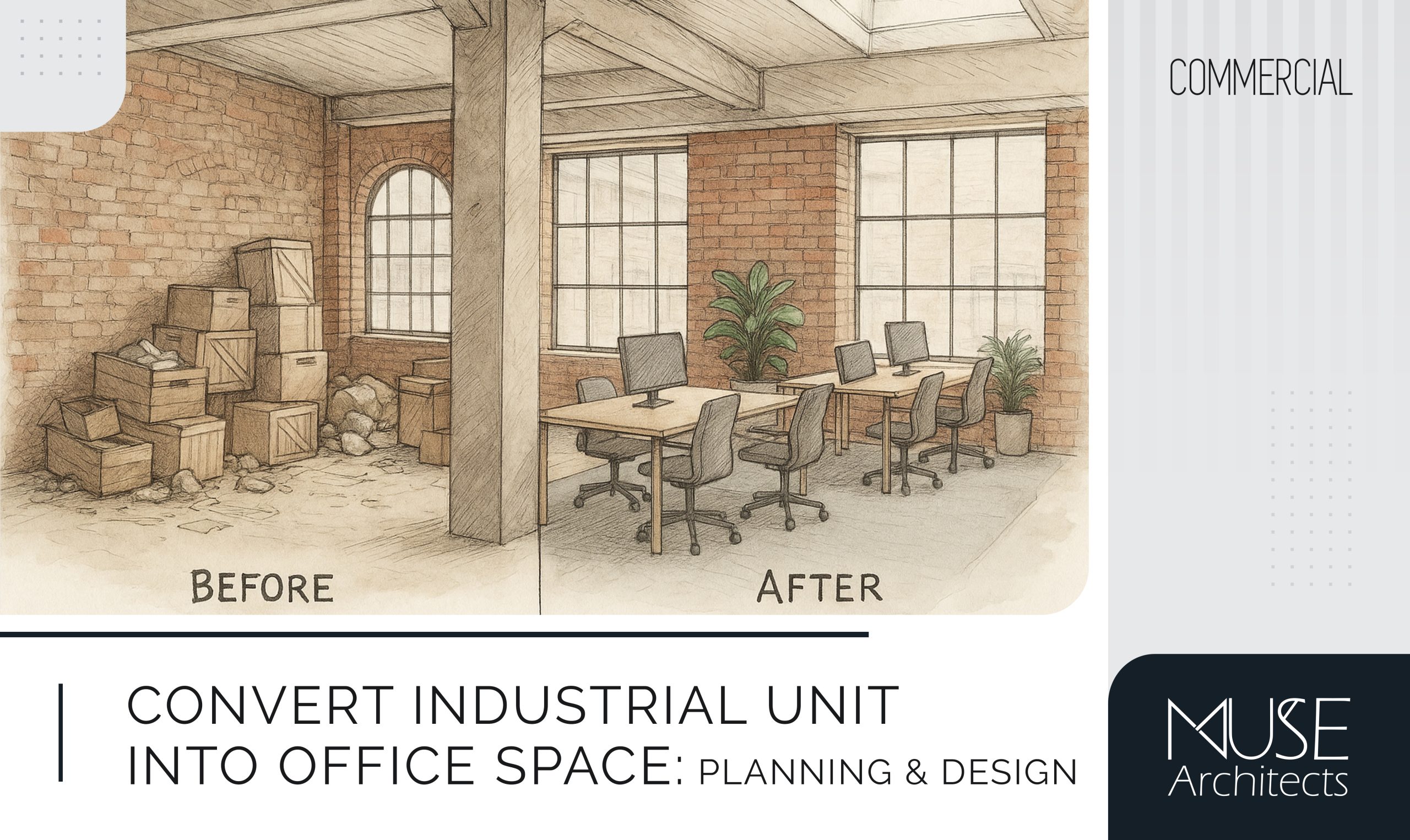
Summary The North West of England is witnessing renewed interest in converting older industrial and warehouse buildings into vibrant, sustainable, and modern office spaces. For businesses aiming to upskill their teams and create productive environments, these conversions offer a unique opportunity. This article outlines the architectural and planning approach required to transform such buildings, covering planning frameworks, sustainable design principles, material considerations, and how to optimise daylight and occupant wellbeing. Aimed at professionals and business leaders, it offers detailed insights while concluding with strategic recommendations for a successful conversion project. 1. Introduction: Why Industrial-to-Office Conversion Makes Strategic Sense As businesses adapt to hybrid work models and seek more sustainable practices, industrial-to-office conversions are gaining traction. These schemes revitalise underutilised assets, reduce embodied carbon compared to new builds, and allow businesses to configure spaces aligned with their operational and cultural needs. Architects play a central role in shaping these conversions, not just aesthetically, but in terms of regulatory compliance, spatial planning, and long-term usability. 2. Planning Context: UK Policy and North West Local Guidance 2.1 General Permitted Development Rights (GPDR) and Use Class Order The Use Class Order (amended 2020) merged offices (formerly B1) and light industrial (B1c) into Use Class E, which allows greater flexibility in planning. However, prior approval is still needed in many conversions under Permitted Development (PD), especially if significant external alterations are proposed. 2.2 Local Authority Planning in the North West Each local authority (e.g., Manchester, Liverpool, Stockport, Bolton) has its own local plan, sustainability targets, and urban regeneration priorities. Key planning considerations include: Parking and transport access Flood risk assessments (particularly in lower-lying industrial zones) Noise impact on adjacent residential properties Conservation or heritage overlays if the building or location is sensitive Engagement with planning officers early via a pre-application process is essential.   3. Architectural Considerations in Converting Industrial Units 3.1 Site Appraisal and Constraints An in-depth appraisal includes assessing: Structural integrity of steel or concrete frames Roof condition and insulation Eaves height and suitability for mezzanine insertions Natural daylight potential (rooflights, wall openings) Existing services infrastructure (power, water, HVAC) 3.2 Internal Space Planning Modern offices need to accommodate: Collaborative zones Quiet workstations Breakout areas Accessibility (DDA compliance) The original layout of an industrial unit is typically open plan, which gives architects freedom but also challenges in achieving acoustic comfort and thermal efficiency. 3.3 External Appearance and Streetscape Impact Retaining industrial character (e.g., exposed steel, loading bay doors) can enhance appeal. However, interventions like curtain walling, new glazing, and entrances must balance function with planning acceptability. 4. Daylight and Design for Wellbeing Daylight is a key challenge in converting deep-plan industrial buildings. Strategies include: Roof lanterns or sawtooth skylights Enlarged window openings, subject to planning Courtyards or lightwells if depth allows Daylight not only enhances wellbeing but reduces reliance on artificial lighting. Offices must meet minimum daylighting standards in the British Standard BS EN 17037, particularly where the converted space is expected to host long-stay desk workers. 5. Sustainable Design Strategies 5.1 Embodied Carbon and Retrofitting Benefits Adaptive reuse drastically lowers embodied carbon compared to demolition and rebuild. Retaining the frame and envelope where possible should be prioritised. 5.2 Operational Energy and Part L Compliance Thermal upgrades are essential to meet Part L (Conservation of Fuel and Power) of the Building Regulations: Insulated cladding upgrades High-performance glazing Efficient HVAC systems Air-tightness improvements Photovoltaic panels, battery storage, and heat pumps can further enhance energy profiles. 5.3 BREEAM and WELL Standards For companies pursuing accreditation, early design decisions are key to achieving BREEAM Excellent or WELL Gold ratings. Factors include: Indoor air quality monitoring Water efficiency Use of low-VOC materials 6. Materiality: Blending Industrial Heritage with Contemporary Use Material choices often determine the success of an industrial-to-office conversion. The approach should celebrate the building’s past while aligning with modern office aesthetics and performance needs. Recommended materials: Exposed brickwork: For warmth and texture Steel and timber composites: For visual contrast Reclaimed materials: For sustainability Modern cladding: In neutral tones to lift dated facades Acoustic panels, polished concrete floors, and natural timber finishes can create a modern yet grounded workspace. 7. Navigating Regulatory Compliance Besides planning and Part L, other key regulations include: Part M: Accessibility for all users Part B: Fire strategy, particularly in mezzanine additions or multi-tenanted layouts CDM Regulations 2015: Health and safety responsibilities from design stage onwards Asbestos Surveys: Crucial in older industrial buildings Early engagement with Building Control ensures regulatory pathways are clear and cost risks are minimised. 8. Going Back to the Office: Designing for Post-Pandemic Needs The office is no longer just a workplace; it’s a social hub, brand expression, and productivity enabler. As such, conversions should embrace: Flexibility for future layout changes Generous breakout areas Strong visual identity and biophilic elements Quiet pods and video call booths Mechanical ventilation and smart lighting systems are now baseline expectations. 9. Procurement and Construction Strategy Industrial-to-office conversions may uncover unforeseen challenges (e.g., slab levels, contamination). A flexible, phased procurement strategy helps mitigate risks. Design and Build: Speeds up delivery but may limit design control Traditional Contracting: Allows detail refinement but requires active project management Two-Stage Tendering: Useful in live environments or phased projects A Principal Designer must be appointed early under CDM. About Muse We are your Residential and Commercial Architects At Muse Architects, we offer a wide range of local architectural services to clients in Manchester and beyond. From building control in Manchester to office design project management, our team of experienced architects has the skills and expertise to handle any project. Whether you’re looking for commercial building architects, residential architects near you, or specialists in industrial conversions, we’re here to help. We specialise in residential and commercial new builds as well as industrial-to-office conversions. We work closely with clients to create beautiful, functional spaces tailored to their needs. Our 3D property visualisation services—including 3D visualisation for city planning and interior design—are designed to help bring your vision to life. Want to explore the potential of your existing site? Our architectural

Muse Sectors

About Our Sector Muse Architects Sector Overview Muse Architects is a Manchester-based, RIBA Chartered practice specialising in planning-led property development across the North West of England. We deliver architecture, feasibility and pre-application strategies, Building Regulations design, and project delivery support for developers, landowners, investors and end-users; from early viability through to construction-stage coordination. Start Free Consultation Our portfolio spans residential-led development (new build and conversion), mixed-use regeneration, leisure and hospitality (hotels, bars, restaurants and destination venues), industrial and commercial (warehousing, trade units, yards, offices and mixed employment sites), and education and community-focused projects. We also undertake heritage and conservation work, supporting sensitive repairs, refurbishment and adaptation of valued buildings in line with conservation best practice and local authority expectations. Across every sector, we focus on outcomes that matter: deliverable design, policy compliance, buildability, cost awareness and long-term value. Each project is shaped around its context and client objectives, translating a clear development brief into a robust planning case and an exceptional built environment. Explore our work across these specialist sectors. About Our Sector Explore Our Work across these specialist sectors Leisure and Hotel Industrial and Commercial Education Housing Heritage and Conservation Community Where Spaces Inspire, and Design Comes Alive Started In 2009 Planning-Led Architectural Approach High-Quality Residential & Commercial Design Experienced Manchester Architects Free Feasibility Study for New Projects We offer imaginative architectural solutions for difficult residential and commercial locations all around Manchester. We do this by combining our knowledge of planning, design, and project feasibility. More About Us
top 12 cities for rentals

Top 12 Cities for Maximum Rental Yields in the UK

The UK property market remains a lucrative avenue for investors seeking rental income. In this comprehensive guide, we will explore the top 12 cities for property investment, considering average rental yields and recommended areas within each city. Investing in property mandates careful consideration of market trends, potential yields, and the unique characteristics of each city. Whether one prefers the vibrant atmosphere of Manchester or the historic charm of Edinburgh, these top 12 cities offer a spectrum of opportunities for property investors seeking optimal rental returns.  1. London Average Rental Yield: 2% to 4% Overview: London, the capital, boasts a diverse property market. While yields are relatively lower due to high property prices, certain areas offer steady returns. Recommended Areas: Islington: Known for its cultural diversity and proximity to central London, Islington can be an attractive option for investors. Greenwich: This historic area offers a blend of modern amenities and historical charm, potentially attracting tenants willing to pay a premium. 2. Bristol Average Rental Yield: 4% to 6% Overview: Bristol’s property market is characterized by moderate to good yields, making it an appealing choice for investors. Recommended Areas: Clifton: Renowned for its Georgian architecture, Clifton is a sought-after area with potential for steady rental income. Redland: With its vibrant community and proximity to the University of Bristol, Redland offers investment opportunities in student housing. 3. Southampton Average Rental Yield: 4% to 6% Overview: Southampton provides a stable property market with moderate to good rental yields. Recommended Areas: Ocean Village: This waterfront area appeals to professionals and offers potential for higher rental returns. Highfield: Home to the University of Southampton, Highfield can be a strategic location for student accommodation. 4. Cambridge Average Rental Yield: 2% to 4% Overview: Cambridge, known for its prestigious university, presents a market with lower rental yields due to high property values. Recommended Areas: Mill Road: A diverse and vibrant area, Mill Road may attract tenants looking for a mix of cultural experiences. Newnham: With its green spaces and proximity to the university, Newnham can be appealing for families and professionals.   5. Edinburgh Average Rental Yield: 4% to 6% Overview: Edinburgh offers a stable property market with moderate to good rental yields. Recommended Areas: Marchmont: Close to the city center and the University of Edinburgh, Marchmont is popular among students and professionals. Stockbridge: Known for its village-like atmosphere, Stockbridge appeals to a diverse range of tenants.   6. Cardiff Average Rental Yield: 4% to 6% Overview: Cardiff provides a stable property market with moderate to good rental yields. Recommended Areas: Cathays: A popular area for students due to its proximity to Cardiff University and affordable housing options. Pontcanna: Known for its parks and proximity to the city center, Pontcanna may attract professionals and families. 7. Manchester Average Rental Yield: 6% to 8% Overview: Manchester stands out with a robust property market and attractive rental yields, making it a hotspot for investors. Recommended Areas: Ancoats: This trendy area offers a mix of modern apartments and cultural attractions, appealing to young professionals. Salford Quays: With waterfront views and proximity to MediaCityUK, Salford Quays is a prime location for rental properties.   8. Birmingham Average Rental Yield: 5% to 7% Overview: Birmingham’s property market has seen consistent growth, providing investors with solid rental yields. Recommended Areas: Digbeth: Known for its arts and cultural scene, Digbeth attracts a diverse tenant demographic. Jewellery Quarter: A mix of historic charm and modern living, the Jewellery Quarter is a sought-after area for professionals. 9. Glasgow Average Rental Yield: 5% to 7% Overview: Glasgow offers a stable property market with moderate to good rental yields. Recommended Areas: West End: Home to the University of Glasgow, the West End is popular among students and professionals. Merchant City: With its vibrant atmosphere and cultural attractions, Merchant City appeals to a diverse range of tenants. 10. Leeds Average Rental Yield: 5% to 7% Overview: Leeds has emerged as a strong contender in the property market, offering investors competitive rental yields. Recommended Areas: Headingley: A popular choice for students and young professionals, Headingley provides affordable housing options. Roundhay: Known for its green spaces and family-friendly environment, Roundhay is attractive to professionals and families. 11. Nottingham Average Rental Yield: 5% to 7% Overview: Nottingham’s property market offers a balance between affordability and rental returns. Recommended Areas: Lenton: With its proximity to the University of Nottingham, Lenton is ideal for student accommodation. Mapperley: A residential area with good transport links, Mapperley appeals to a mix of tenants. 12. Newcastle Average Rental Yield: 6% to 8% Overview: Newcastle provides a robust property market with attractive rental yields. Recommended Areas: Jesmond: A popular choice for students and young professionals, Jesmond offers a vibrant living experience. Ouseburn: Known for its cultural scene and regeneration, Ouseburn attracts a diverse tenant base. Conclusion Investing in property requires careful consideration of market trends, potential yields, and the unique characteristics of each city. Whether you prefer the vibrant atmosphere of Manchester or the historic charm of Edinburgh, these top 12 cities offer a range of opportunities for property investors seeking optimal rental returns. Conduct thorough research, stay informed about local developments, and leverage the expertise of real estate professionals to make the most informed investment decisions. Happy investing! Conclusion: Elevating Investments with Muse Architects Across UK Cities As we traverse the landscape of the UK’s property market, it becomes abundantly clear that investing in real estate is not just a financial decision but a strategic move towards securing a prosperous future. In this nuanced investment environment, Muse Architects, headquartered in Manchester, emerges as the discerning partner for individuals seeking to navigate the intricacies of property ventures across diverse cities. The cities identified in this guide represent not merely locations but thriving hubs with distinctive characteristics. A strategic investment approach necessitates not only understanding the current market dynamics but also envisioning the future trajectory. The selection of these cities is rooted in a meticulous analysis of factors such as rental yields, affordability, and growth projections. As a reputable

Navigating the 2024 Planning Reforms in the UK

Navigating the 2024 Planning Reforms: Implications for Architects and Urban Development In the ever-evolving landscape of architecture and urban development, staying attuned to regulatory shifts is paramount. The United Kingdom is set to witness a transformative wave in 2024, with a suite of planning reforms designed to reshape the architectural canvas. Let’s delve into the intricacies of these changes and their profound implications for architects, builders, and city planners. 1. Levelling Up Bill: Streamlining the Planning Odyssey The Levelling Up and Regeneration Bill aims to revitalise the planning application process. Recognising the system’s inefficiencies, Housing Secretary Michael Gove has committed to a more focused and expeditious planning journey. The goal is to achieve adoption within 30 months through reduced evidence requirements and an earlier emphasis on planning. Among the notable provisions, every local planning authority is mandated to create a design code, serving as a visual narrative for its domain. This code, integrated into either the local plan or a supplementary plan, is envisioned as a catalyst for cohesive, aesthetically pleasing urban development. 2. Empowering Communities: The Rise of ‘Street Votes’ A groundbreaking inclusion in the Bill is the ‘street vote’ powers, which empower residents to propose and execute property redevelopment plans based on their design preferences. This marks a paradigm shift, granting local communities the authority to shape their development guidelines, fostering a sense of ownership and communal identity. 3. National Housing Targets, Green Belt Protections, and Brownfield Prioritisation The Levelling Up Bill preserves national housing targets while introducing new flexibilities to accommodate local circumstances. A noteworthy commitment is the strengthened protection of Green Belt areas, although specific mechanisms remain undisclosed. Additionally, brownfield land takes centre stage, with a dedicated government review exploring its optimal utilisation. 4. The Sunset of the ‘Four-Year Rule’: Welcoming the 10-Year Epoch In a significant change, the ‘four-year rule’—which allows homes to remain without planning permission after four years—is being replaced by a more expansive 10-year rule. This provides a broader timeframe for compliance. 5. Infrastructure Levy: A New Chapter in Funding Urban Development The introduction of a new Infrastructure Levy, designed to replace Section 106, marks a significant departure. Local authorities will have the authority to set varying levy rates based on geographical nuances, potentially reducing rates on brownfield land and fostering renewed interest in its development. 6. Neighbourhood Plans Reinvented Neighbourhood plans, vital for community involvement, will be fortified. Plans integrated into broader local authority development for five years will gain enhanced strength, amplifying community roles in shaping their locales. 7. Enforcement Action and Community Collaboration The Bill proposes a novel approach, allowing applications to be refused in their current state while offering a two-month pause on enforcement action. This respite enables applicants to compile necessary documents and resubmit applications more effectively. 8. A Revised National Planning Policy Framework (NPPF) The Levelling Up Bill will trigger revisions in the National Planning Policy Framework (NPPF). Among the changes are a 35% increase in planning fees for major applications and a 25% hike for minor applications. Homeowners will now be required to seek planning permission for short-term holiday lets, ushering in a new era of regulatory oversight. Conclusion: Forging a New Architectural Frontier As architects and urban visionaries, these unfolding changes invite us to adapt, innovate, and collaborate. The 2024 planning reforms represent more than a legal evolution; they signify a collective opportunity to shape resilient, vibrant, and community-centric urban landscapes. Challenges on the Horizon: Navigating Disadvantages However, every paradigm shift brings challenges. The alterations in planning regulations, while progressive, may present hurdles in execution. Increased planning fees could strain budgets, and the balance between national targets and local flexibilities will require adept navigation. Muse Architects: Your Guiding Constellation In the dynamic landscape of 2024’s architectural and regulatory challenges, Muse Architects serves as your guiding constellation. Our seasoned team is equipped with profound insights to navigate complexities, from deciphering design codes to optimising infrastructure levies. Collaborate with Muse Architects, where innovation meets regulation, to sculpt a future where architectural brilliance seamlessly intertwines with regulatory pragmatism. Recognising the complexities and opportunities presented by these changes, Muse Architects is committed to guiding you through this transformative period. Our team, well-versed in the evolving regulatory landscape, is ready to collaborate with you, turning challenges into opportunities. For any questions or further clarification, feel free to reach out. We highly value our partnership and look forward to continuing our journey together, shaping the future of UK architecture.

Select the fields to be shown. Others will be hidden. Drag and drop to rearrange the order.
  • Image
  • SKU
  • Rating
  • Price
  • Stock
  • Availability
  • Add to cart
  • Description
  • Content
  • Weight
  • Dimensions
  • Additional information
Click outside to hide the comparison bar
Compare